
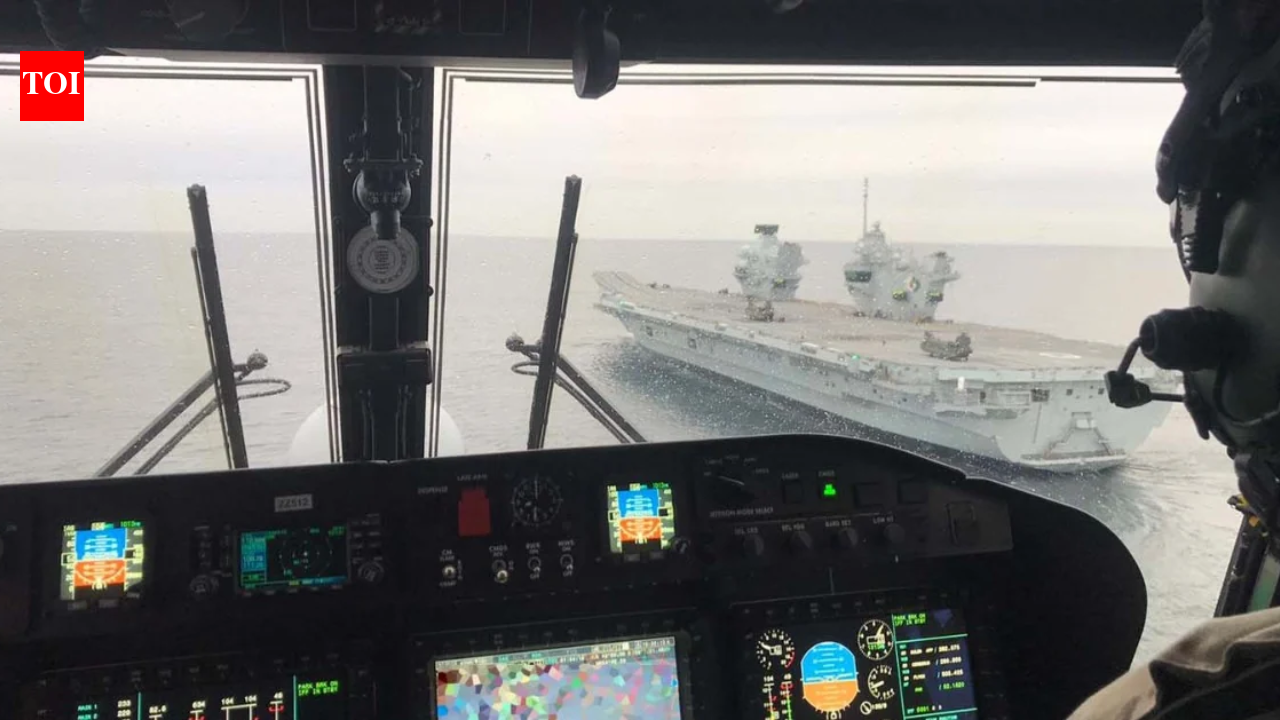
UK's HMS Queen Elizabeth as seen from the cockpit of a Wildcat helicopter. (Image credit: Royal Navy)The Royal Navy wants to see a collaborative combat aircraft (CCA) fly from one of its aircraft carriers next year, and the experiment could be useful well beyond Britain. First Sea Lord General Sir Gwyn Jenkins announced aboard HMS Prince of Wales, at the international sea power conference held in Oslo, that Northrop Grumman's Talon Blue, designated YFQ-48A by the US military, is being prepared for a carrier launch. The jet drone flew for the first time only last month.For India, the interest is obvious, HMS Queen Elizabeth and INS Vikrant share a basic design feature as neither of the two ships has catapults to launch fighters. Both launch fixed-wing fighters from a bow ski-jump ramp, set at roughly 14° on the Vikrant and 13° on the British carrier. The catapult helps launch aircraft from the deck of these massive ships. While on ships such as the INS Vikrant and HMS Queen Elizabeth, aircraft take off under their own power. The ramp helps jets leave the deck with heavier fuel and weapon loads than a flat deck would allow. Both ships also carry an air wing of roughly 30 to 40 aircraft, and both depend on forward speed into the wind to help launches.That is why the British trial matters. If a CCA can be launched from a ski-jump deck and handled alongside crewed jets, it will show New Delhi that the concept works on carriers like its own.India's own effortThe Indian Navy is developing its Naval Collaborative Combat Air Vehicle (N-CCAV), centred on the Abhimanyu platform by Bengaluru-based NewSpace Research & Technologies. The company was selected under the Ministry of Defence's iDEX (innovations for defence excellence) initiative through Innovations for Defence Excellence (ADITI) 2.0, signed a design-and-development contract in April 2025 and displayed a half-scale model at Aero India in February 2025. A proof-of-concept aircraft was targeted for 2026, and these remain targets, not an induction.The unmanned aircraft is meant to fly with the MiG-29K and the Rafale-M, not replace them. The CCAs are expected to take on roles such as surveillance, electronic warfare, decoy and strike-support missions. It could fly ahead of manned fighters, gather information, jam radars or draw fire from air defences. It is expected to work semi-autonomously, with pilots giving high-level commands.Where the comparison stopsThe proof of concept is partial, but the Vikrant uses arrested recovery, this method uses a tailhook to catch one of four wires to safely stop an aircraft as it lands on the deck, while the British carriers are designed for short take-off and vertical landing aircraft. The US Navy though demonstrated the landing of a large unmanned system on an aircraft carrier back in 2013 when the X47-B landed on the USS George HW Bush (CVN 77). The US Navy is also planning to regularly operate the MQ-25A Stingray from its flat tops from 2029 onwards.A successful launch off a ski-jump would help India, but recovery may need its own demonstration. Shipboard storage, handling, maintenance and launch and recovery arrangements for India's CCA will also have to be tested on Indian decks.
Britain's aircraft carrier drone experiment could hold the key to India's next naval leap
Full Article
Original Source
Read the full article at Timesofindia →KhanList aggregates and links to publicly available news content. We do not host full articles from third-party sources. Always verify important information with original sources.