
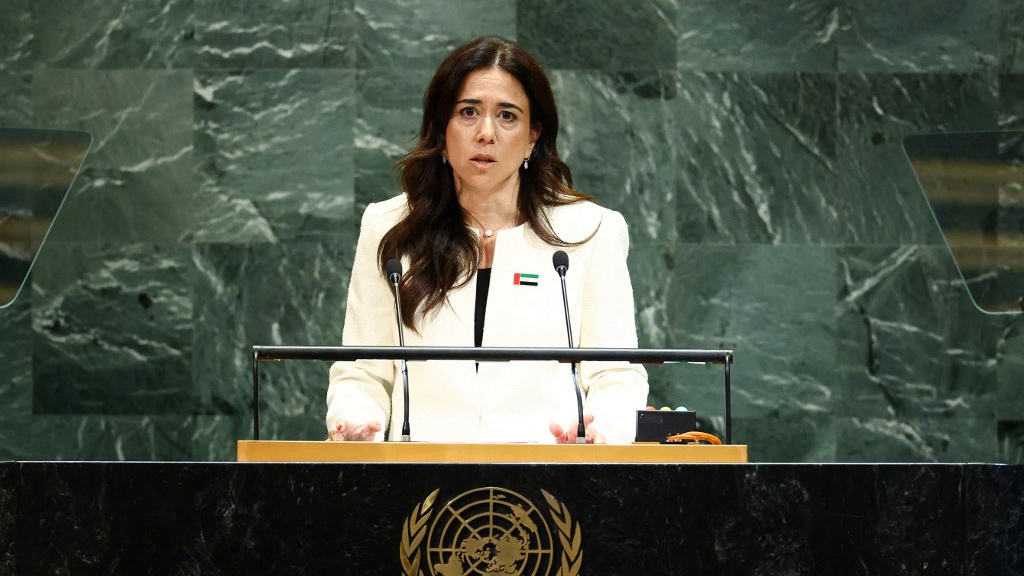
For as long as anyone can remember, US President Donald Trump and Israeli Prime Minister Benjamin Netanyahu have used every platform to attack the United Nations, and every opportunity to defund its life-saving institutions. Netanyahu called the UN a “swamp of antisemitism” that had to be drained. Trump called the UN Human Rights Council “craven hypocrites” who had little to say about the persecution of Christians, and accused Unesco - with its “ceaseless promotion of mass migration” - of actively destroying the greatest culture in history (ie the US). Long before Israel claimed, without proof, that the UN Relief and Works Agency (Unrwa) was infiltrated by Hamas, Trump withdrew funding from Unrwa, cutting off the only UN agency dedicated specifically to Palestinian refugees. How curious, then, that so much effort is being put into placing their candidate as the next secretary general of the UN. New MEE newsletter: Jerusalem Dispatch Sign up to get the latest insights and analysis on Israel-Palestine, alongside Turkey Unpacked and other MEE newsletters Their candidate is Lana Nusseibeh, a British-educated diplomat from an old Palestinian family, who served as the UAE’s permanent representative to the UN from 2013 to 2024. During those years, the country she represented actively worked against everything the UN was trying to do to stabilise the Middle East and Africa. The Emirati network The UAE funded a military coup in Egypt. In Libya, it ran guns, armoured vehicles and surveillance equipment in a constant airlift to the renegade general Khalifa Haftar in Benghazi and Tobruk, despite a UN arms embargo. Between April and July 2025, more than 30 military Il-76 flights were recorded between the UAE and Benghazi, some of which were operated by private firms contracted by Abu Dhabi. Alongside the Egyptian military, the UAE plotted the downfall of parliamentary democracy in Tunisia. In Sudan, it has provided arms shipments, intelligence and logistics to the Rapid Support Forces (RSF). It established two airfields - Berbera in breakaway Somaliland, and Bosaso in Puntland - to act as logistics hubs. The UAE is attempting to leverage conflict and separatism in Libya, Sudan and the Horn of Africa, to project its power and economic influence without a territorial footprint. It acts mainly through proxies. The objective is to position Abu Dhabi as a key security player and economic partner at strategic ports and global trade chokepoints, without the appearance of a traditional military footprint During this campaign, the UN has been at the forefront of bringing the atrocities committed by UAE proxies to light. UN agencies have published a series of reports on ethnic cleansing by the RSF, the UAE’s primary actor in Sudan, which Abu Dhabi arms and bankrolls. Last year, the UN Human Rights Office published details of widespread killings, rape, torture and abductions committed during a three-day RSF offensive on the Zamzam displacement camp, which killed more than 1,000 civilians. This past February, the Independent International Fact-Finding Mission for the Sudan found all the hallmarks of genocide in the RSF’s 500-day siege and sacking of El Fasher, the capital of North Darfur. The sum effect of the UAE’s campaign in the Middle East and Africa can be measured in the latest World Food Programme (WFP) report on global famine. The UAE and Israel are fighting and fomenting strife in three of the five countries whose populations are identified by the WFP as facing catastrophe and risk of famine - Gaza, Nigeria, South Sudan, Yemen and Sudan. The conflicts it backs are the key drivers of famine, displacement and refugees. The WFP, one of the main providers of food in Gaza, recently had to cut aid by a third, because it received half as much funding this year for its operations in Palestine. Denying the undeniable Put another way, the UAE exports more than just oil and gas. In Sudan alone, its exports amount to 19.5 million people facing acute hunger, and millions of others either internally displaced or fleeing to Chad, South Sudan, Egypt, Ethiopia or the Central African Republic. The UAE’s covert interventions are highly structured, never ad hoc. And they are interlinked: supply routes through Chad and Libya have been used to arm the RSF in Sudan since April 2023, UN experts found, while the UAE has also shipped in mercenaries from Colombia. The objective is to position Abu Dhabi as a key security player and economic partner at strategic ports and global trade chokepoints, without the appearance of a traditional military footprint. Who is Lana Nusseibeh, the UAE diplomat in the race to become next UN secretary-general? Read More » Almost everything it does is deniable - and it was Nusseibeh’s role for 11 years at the UN to keep it that way. Her second task was to forge ties with Israel, turning the Emiratis into Israel’s strongest diplomatic and military ally in the Arab world - far more important than the two Arab states with negotiated peace deals, Jordan and Egypt. Netanyahu is a natural partner for UAE President Mohammed bin Zayed. Both think political Islam is an existential enemy. Mohammed bin Zayed is obsessed by the reach of the Muslim Brotherhood, believing it has power far beyond Egypt, its country of origin. If Mohammed bin Zayed’s cohort of dictators saw the Arab Spring in Tunisia, Egypt and Yemen as a personal threat, the Emirati ruler saw it also as an ideological one. In his jihad against political Islam, Mohammed bin Zayed sees the Brotherhood everywhere, ascribing to it a presence and a role far greater than it actually possesses. He sees the Brotherhood in London, Paris and Berlin - and the Emiratis are hard at work funding and tutoring the racist European far right in Islamophobia. Reshaping the region Outside Mohammed bin Zayed’s jihad, the truth about the Muslim Brotherhood is ironically quite different. While the movement is organisationally at its weakest, after decades of oppression and imprisonment in Egypt, Jordan and Tunisia, Israel’s genocide in Gaza helped political Islam recover to an extent not thought possible just a few years ago. The Gaza genocide has lowered the barriers between political Islam and the secular left - barriers once so high that they fatally weakened the first wave of democratic revolution in Egypt and Tunisia for more than a decade. The key distinction in the diaspora now is less whether you are secular or Islamist, but whether you are active or passive in organising against genocide. Can anyone imagine what Israel would do to the UN, and to all those fact-finding reports and investigations bubbling away inside, with its own candidate running the institution? Both the UAE and Israel have big ambitions to “reshape” the Middle East, away from the dominance of traditional nation states. Both are small countries, dwarfed in population and land by larger neighbours, and their aim is to dominate as technological and military hubs by splitting up the others. Israel says this openly about Syria, and allows academics to speculate about dismembering Egypt. The UAE is only too happy to encourage these plans, because its principal target is its lumbering neighbour, Saudi Arabia. Both Israel and the UAE are avid users of mobile phone software to spy on and target dissidents abroad. Pro-Israel lobbying groups are too quick to recognise the importance of Nusseibeh’s work and reward her for it. In a revealing column, Jake Wallis Simons, former editor of the Jewish Chronicle, said he preferred an Emirati Palestinian over a progressive Jew from Costa Rica, Rebeca Grynspan - as if the choice of secretary general boiled down to ethnicity. True, everything that happens in Israel is ruled by ethnicity. Even Zionist Arabs are discarded as potential partners for government by the opposition leaders desperate to get rid of Netanyahu. But happily, racism outside the pariah state has not yet descended to those depths. Not a shoo-in Unusually, with the backers she has secured, Nusseibeh is not a shoo-in for the top UN job. There have now been nine “straw polls”, or informal soundings of the permanent and elected members of the Security Council, to determine who should replace Antonio Guterres as secretary general. Although these votes are cast anonymously, the UK, France and China, all permanent members, are believed to have voted against Nusseibeh. In the latest poll on Friday, Nusseibeh received seven “encourage” votes, six “discourage” votes, and two “no opinion” votes - the same result she achieved on 6 November. The process is opaque, and until now, no permanent member has formally cast a veto. But the selection of a successor appears deadlocked. China is an advocate of the principle of rotation, and therefore favours a candidate from Latin America, but the reluctance of the UK and France to sign on the dotted line was unexpected. No one needs a UN report to tell them what is happening in Sudan or Yemen. The military defeats of western alliances in the last six interventions in the Middle East and Central Asia, should not lead anyone to rashly assume that the ideology of intervention has been abandoned. It’s simply easier all around to sell the franchise to Israel and the UAE. At the same time, Abu Dhabi has been hard at work selling the myth that it represents the “model Arab” state of the future: a lip gloss of social liberalism covering a hard-baked, technologically cutting-edge dictatorship. Not even Iran’s missiles and drones have punctured the myth that it’s “business as usual” again in Dubai and Abu Dhabi. The financial incentives for Britain to look the other way are enormous, when all that blood gold, and those blood diamonds from Africa, are laundered on their way to Moscow. Lobbying pressure Britain is locked in a tight embrace with the UAE. Some 250,000 expat Britons work in Dubai and Abu Dhabi. More than 5,000 British companies work in the Emirates as a whole. The UAE holds nearly £30bn ($39bn) of investment pledges in more than 50 deals. Apart from Manchester City, it owns P&O Ferries, and holds an eight percent stake in Gatwick Airport. It also has stakes in the broadband provider CityFibre, parts of Berkeley Square in central London, and a major regeneration project in Manchester. In the twilight years of neoliberalism, British Prime Minister Andy Burnham finds that his country has already flogged the Emiratis anything that was not nailed down, and much that was. The biggest brake on Burnham changing anything radically in the relationship between Britain and its colonial creation is being applied by the Treasury, not the Foreign Office - although there are many there who are still in love with the UAE model. Nusseibeh's first task would be to kill off the only international mechanism the world has left to calm things down, reintroduce stability and resolve conflicts The UK’s presumed veto in the straw polls has put ferocious lobbying pressure on Foreign Secretary Ed Miliband. The lobbying campaign for Nusseibeh has been relentless and wide-ranging. She came to visit former Conservative Party leader Iain Duncan Smith at his office in Westminster after he spoke out in parliament against the UAE’s involvement in Sudan and her candidacy. Duncan Smith denounced the UAE’s “sponsoring of a huge amount of terrorism in Sudan”, and called on Britain to use its Security Council veto to block her nomination. Interestingly, Nusseibeh reportedly did not deny to Duncan Smith that her country was funding and bankrolling the RSF. Nusseibeh’s supporters in the UK wax lyrical about the qualities and energy of the 48-year-old diplomat. “She’s charming. She’s extremely eloquent. She’s a fast thinker. She’s the best diplomat I’ve ever met,” one former British diplomat told Middle East Eye. “She’s assertive, and so she’s been good at articulating the UAE’s foreign policy position, which is that it has a right to be assertive.” And, of course, she was educated at Wycombe Abbey and Cambridge - so that’s all right, then. One source who spoke to the Financial Times said the choice was between principle and pragmatism. But that is exactly where the UK is going wrong. Global recovery Miliband and Burnham should be preparing the UK for the post-Trump era. Today, it is funny to be a racist bigot in Israel. Elon Musk thinks it's a good look to throw the weight of his satellites around politics in the US and Ukraine, and into space, like some 16th-century buccaneer on a mission to discover the New World. But in a very short time, today’s testosterone-fuelled, ego-driven strongman act is going to look so dated, and so ill-suited to the state the world is actually in. The neoliberal legacy, honed to extremes by Trump and his oligarchs, will be a weaker global economy, no real international order, and a chaos buffeted regularly by war, climate shocks and economic crashes. The world will need a long period in which to recover, if indeed it ever does. It will have to rediscover the need for strong international institutions to feed populations, keep the peace, and rebuild postwar landscapes across the Middle East, Ukraine and Africa. Why Britain must oppose UN candidacy of UAE's Nusseibeh Read More » It will need international rules and courts to adjudicate those rules, not nations that tear those rules up. The International Criminal Court and International Court of Justice will need to work around the clock. The world will not need international courts cut down to size to protect war criminals in the US or Israel. Putting Nusseibeh in place as secretary general would be to put her paymasters - the UAE and Israel - in charge of the UN. These are the very pariah states that are actively working to spread conflict around the Middle East and Africa, and to subvert the institutions of the UN and international law for their own gain. Israel is starving Gaza by keeping UN agencies at the Egyptian border, and bombing aid workers inside the territory. Can anyone imagine what Israel would do to the UN, and to all those fact-finding reports and investigations bubbling away inside, with its own candidate running the institution? Nusseibeh’s first task would be to kill off the only international mechanism the world has left to calm things down, reintroduce stability and resolve conflicts. It is pragmatism, not just principle, to oppose such a takeover. Britain, as a veto-wielding member of the Security Council, must hold firm. The views expressed in this article belong to the author and do not necessarily reflect the editorial policy of Middle East Eye.
Britain must stand firm against Nusseibeh's UN candidacy
Full Article
Original Source
Read the full article at Middleeasteye →KhanList aggregates and links to publicly available news content. We do not host full articles from third-party sources. Always verify important information with original sources.