
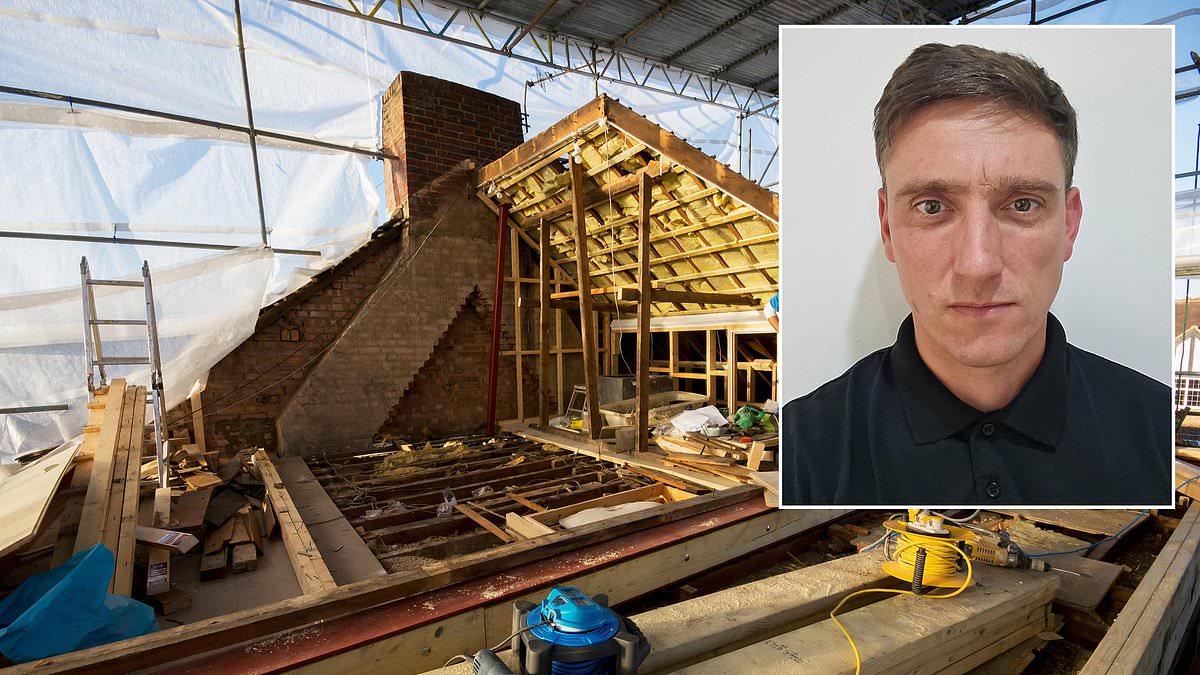
Britain is facing a severe shortage of skilled tradespeople including electricians, plumbers, bricklayers and carpenters.Industry reports suggest that the country needs nearly one million new recruits over the next decade to meet housing, infrastructure and net-zero energy goals.The work can also be lucrative. While youngsters might starting at £14,000 at apprenticeship level, this can rise to £32,000 for a qualified builder and then all the way to £74,000 a year for business owners according to Checkatrade.Eric Hargreaves, owner of Manchester-based Your Choice Home Improvements, says: 'It's really important for people to know that when they become good at their jobs and start working for themselves, they can command really good rates.'It's a very safe industry to go into. It's pretty unlikely AI will take over the role of a bricklayer or a joiner, which could influence some young people when weighing up career paths.' Building a career: Manchester builder Eric Hargreaves says those who work for themselves can command 'really good rates'Builders can work on all kinds of projects, from residential houses to commercial projects such as offices or warehouses. While some might specialise in areas such as bricklaying, roofing, insulation or soundproofing, other builders have a broad range of skills within their trade.Eric says some bricklayers are in such high demand that they are able to charge by the brick.'The more bricks you lay, the more money you make,' he says. 'If you've got a trade in the building industry and you're competent at it, you can command anything.' How Darren built his career in construction Darren Byrne, building and construction manager at Your Choice, started his career in construction at 17, immediately after leaving school.Inspired by his dad who worked as a bricklayer, he joined a 12-month Youth Training Scheme - a vocational training programme run by the Government at the time - with Sheffield-based construction firm Henry Boot.Over the 12 months he was able to experience plastering, bricklaying, joinery and various other aspects of the building trade.He particularly enjoyed joinery, which led him to take a secondment at a joiner's. When he completed his course, he stayed there for another three years making snooker tables from scratch. Darren started his career in construction at age 17 - and hasn't looked backAfter that, he decided he wanted a change and moved away from construction into logistics. He started in a warehouse as a forklift truck driver and progressed into management, becoming a warehouse supervisor within two or three years and warehouse manager within around five years.He stayed in that industry for approximately 12 years.His route back into construction came through a good friend who he had previously worked with at the joiner's shop. The friend had his own building company, and while he was doing some work on Darren's property he offered him the opportunity to join him as a partner.Darren was immediately thrown into managing the building side of the business.He was dealing with pricing, managing the finances going out and organising the work. However, they became so busy that Darren and his business partner had to get involved on site as well.Although he hadn't had a huge amount of experience in bricklaying at that stage, he had to learn quickly.'I learned how to bricklay, construct roofs, plaster and carry out many of the other jobs required to run a building project,' he said.'That period taught me an important lesson: in construction, you never stop learning.'They ran the business successfully for around 12 years until the recession hit and the amount of work began to slow down.That eventually led Darren to his current role with Your Choice Home Improvements, where he has been for around 14 years.When he joined the company, it was primarily a window and conservatory business. He joined as the building and construction contracts manager with the aim of developing the building side of the company.More recently, he has moved towards the sales side of the business.The sales team sends him new leads, he speaks to the customers, understands what they want to achieve, visits them at their properties and discusses the best way of approaching the work. He then puts together the quotation.'One of the big advantages I have now is the knowledge I've built up over many years in the industry,' he said.'There's very little I don't know about domestic building work, and that knowledge is now extremely valuable in my sales role.'I'm paid on a commission basis, so my earning potential has developed alongside my experience and knowledge.'That's one of the things I would emphasise to young people: you might start on a lower wage, but as you gain skills, experience and responsibility, there are plenty of opportunities to increase your earning potential.'Construction isn't always easy. You have cold winters, bad weather and days when the work can be physically demanding.But Darren believes it is a great environment to work in.'You're out and about rather than stuck behind a desk, you're meeting people, you're seeing projects develop in front of you and, most importantly, at the end of a job you can stand back and say, "I helped build that," he says. 'For me, that's what makes construction such a rewarding career — and after all these years, I'm still learning and still enjoying being part of it.'Darren is also particularly proud that his son, Sam, is now involved in the business. Sam says there is plenty of room for progression in construction workSam's experience Like his father and grandfather, building was the first industry Sam worked in when he left school. He found a job labouring on a building site in Ancoats, Manchester.His job was to get the materials where the tradesmen needed them and clean up after them. He did find it daunting working with experienced tradesmen at first, and felt it was important to earn their respect. 'It's quite simple to overcome, you just have to work hard,' he says. After that he pursued a few different careers but always ended up back in the building trade.'Construction will always be needed and physical tradesmen will always be required,' he says. 'I also like the physical aspect of building. It helps keep you fit and is good for your mental health.'Over time he gained the confidence to go on his own and started working as a self-employed general builder for a number of people and companies.When a role became available as contracts manager at Home Choice he put himself forward and landed the job.'You will always start off on rather a basic labourer rate or an apprentice wage,' he said.'As time goes on you will earn your stripes and as you become more skilled you will get more money. It's pretty simple really.' Top tips to succeed in a construction career Eric gives his three top tips to succeed in the industry Eric Hargreaves, the owner of Your Choice, says: 1. Leave the site cleanTo stand out from other companies when working in people's homes you need to make the customer feel valued.A simple way to ensure this is by cleaning up after yourself and just going that extra mile.2. Consider your fitness levelsIf it's something you want to do for the rest of your life, you've got to look at the different trades and pick one you think will suit you most.If you're a plasterer you've got to be strong because you've got your arms up all the time, plastering ceilings and walls.You don't see many skinny plasterers, most are quite fit and chunky - you might get a few gym goers doing it.3. Consider your education levelsIt's important to study the trades so you know if you're picking the right one.Consider your educational levels; you can't get better than being a top engineer or top electrician.Once you've mastered that, electricians can steer off into so many different directions. You could end up in renewables and solar.There's so many tangents, like an electrical mechanic - it isn't just a straightforward career, you can spur off in so many different directions.But it does all come back to knowing your educational levels.There's no point saying you want to be an electrician when you've not got it in you to do the studying. Or to put that hard graft into labouring and being an apprentice for four years on low money - and there's a lot of work to do at home.It's not just about being on a good site and having people put a good word in for you - you've got to prove it and do the work at home. Studying is so important.The duties of a plasterer, tiler or joiner are a lot more simple, whereas a lot more academic work is required to become an electrician or engineer. How to apply for a building apprenticeship A common way to enter the building industry is by completing an apprenticeship.Plumbing and electrical work takes around three years, while joinery is around three or four years.Sometimes you'll link with a college and be sent out once a month on the ground.The minimum contract length for apprenticeships is 30 hours a week. There will also be homework that you are expected to complete in your own time.Alternatively, you can become a builder by enrolling on a college course or learning on the job with experienced builders.Some qualifications that are valuable when entering the trade include NVQ Level 1 Certificate in Construction Skills, T Level in On-site Construction and an Intermediate Apprenticeship in Construction.Eric added: 'Sadly the apprenticeship pay isn't great but if you can shine, companies won't stick to the agreed rate.'SAVE MONEY, MAKE MONEYUp to £250 cashbackUp to £250 cashback2.5% cashback when investing at least £2004.61% cash Isa4.61% cash IsaTrading 212: 1.01% fixed 12-month bonus£3,000 cashback£3,000 cashback£100-£3,000 cashback when opening SippUp to £150 cashbackUp to £150 cashbackOpen a savings account with at least £5,000Welcome bonusWelcome bonusGet up to £200 when you invest £100Affiliate links: If you take out a product This is Money may earn a commission. These deals are chosen by our editorial team, as we think they are worth highlighting. This does not affect our editorial independence. Terms and conditions apply on all offers.
Britain is crying out for builders: Here's how we built successful careers in the industry... and you can too
Full Article
Original Source
Read the full article at Dailymail →KhanList aggregates and links to publicly available news content. We do not host full articles from third-party sources. Always verify important information with original sources.