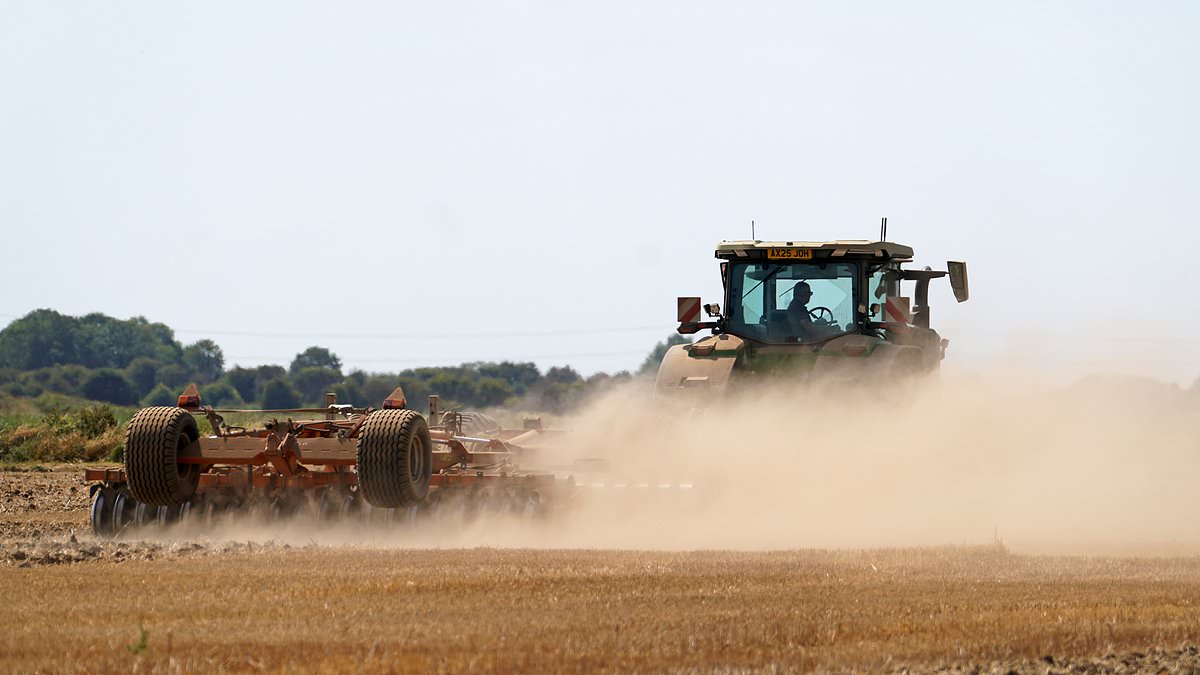
Britain's farmers warn the extreme summer has been 'completely brutal' with 2026 set to be the worst harvest on record – and a sixth heatwave of the year on the way.The exceptionally hot and dry spring and summer could have cut the country's cereals and oilseed harvest by 2.5million tonnes compared to earlier forecasts.This shortfall could be costing UK farmers as much as £390million, according to concerning analysis by the Energy and Climate Intelligence Unit (ECIU) think tank.Forecasts in March and April from European and US agricultural bodies suggested that UK yields were on course to be at or above ten-year averages in 2026.But fresh harvest data from the Agriculture and Horticulture Development Board suggests wheat, barley and oat yields will all be down. Wheat, around half of which has been harvested, will average 6.8 tonnes per hectare, well below the average.If the provisional yield estimates hold, the UK cereal and oilseeds harvest would be 19.5million tonnes - overtaking 2020 as the worst on record since detailed records began in 1984, even after good yields for oilseed rape, the ECIU warned.Even if things pick up, 2026 is likely to be one of the five worst harvests on record – four of which have occurred this decade amid increasingly extreme weather.The UK has already had five heatwaves across May, June and July – and forecast models are now suggesting a sixth heatwave of the year could begin this weekend.Before then, thundery showers are set to batter the North and Scotland - but central and southern England are likely to miss out on most of the much-needed rain. A tractor is shrouded in dust as a farmer tows a disc harrow across a dry field in Kent this week Scorched areas of grassland yesterday following weekend fires at Waltham Abbey in London Families enjoy the warm weather on the beach at Folkestone in Kent yesterday A handful of people on the beach at Tynemouth in North Tyneside yesterday during rainfallTemperatures will cool towards averages for the time of year today after a spike at the start of the week, and there will also be a marked north-south split in conditions.While rain is forecast for northern England, Northern Ireland, Wales and Scotland, there will be little to speak of in other parts of England.A yellow thunderstorm warning is in place for eastern parts of Scotland from 10am to 9pm today, with forecasters warning of a small chance of flooding, with potential for damage to buildings from floodwater, lightning strikes or strong winds.Several flood alerts have been issued by the Scottish Environment Protection Agency, meaning flooding is possible and residents and business owners should be prepared.By tomorrow, outbreaks of rain in the north will sink south, but they will turn more showery, forecasters said.Some of it may reach rain-starved parts of eastern England, though little is expected for central and southern England.July was the driest month ever recorded in southern England – and meteorologists have said there may not be significant rainfall in the area for some time.Parts of London did see a very brief period of heavy rain for a few minutes yesterday afternoon, but it did nothing to alleviate the ongoing drought. Met Office forecaster Marco Petagna said conditions are 'looking pretty dry' for southern England.He added: 'Later on Sunday we could just get a few showers coming down from the North West. But the rain's weakening as it comes into the South East.'Mr Petagna continued: 'Even for the second half of the month (August), it is suggested that rainfall totals are more likely to be below normal than above, with a potential for further spells of hot weather at times as well. The London forecast shows temperatures hitting the 28C heatwave threshold from Saturday'So nothing significant on the horizon for the South East.'The extreme weather of summer 2026 has included two record-breaking heatwaves in May and June that led to more than 2,800 excess deaths.Two more heatwaves in July, the driest July in England and Wales since records began, have fuelled drought and wildfires. UK weather in July: The records broken around the country Here are the key weather statistics for July 2026, including the records broken around the country.All figures are provisional and have been published by the Met Office.– EnglandEngland had its driest July since rainfall records began in 1836.Just 6.5mm of rain was measured across the month, or 10% of the long-term average for the month, less than half of the previous record of 13.4mm set in 1911.Southern England saw not only its driest July since data began but also its driest month ever recorded.Just 1.9mm of rain was measured across this part of the country, narrowly beating the previous record low of 2.0mm in February 1891.Some 19 counties recorded less than or equal to 1mm of rainfall in July: Berkshire, Dorset, East Riding of Yorkshire, East Sussex, Essex, Gloucestershire, Greater London, Herefordshire, Isle of Wight, Kent, Leicestershire, Lincolnshire, Northamptonshire, Nottinghamshire, Oxfordshire, Rutland, Surrey, Warwickshire and West Sussex.Last month was a double-record breaker for England, as the nation experienced its sunniest July as well as its driest.England clocked up 305.6 hours of sunshine across the month, surpassing the previous July record of 294.8 hours set in 1911.It was the sunniest ever calendar month in England.Met Office sunshine data begins in 1910.England saw its second warmest July on record, with a mean temperature of 19.2C, just below the previous high of 19.3C set in 2006.Southern England experienced its warmest July on record, with a mean temperature of 20.1C, beating the previous high of 19.8C in 2006.It is the first time in southern England that any month of the year has seen a mean temperature above 20C.Met Office temperature data starts in 1884.– WalesAs with England, last month was both the driest and sunniest July in Wales since respective records began.Wales had 9.3mm of rainfall across the month, or 9% of the long-term average, well below the previous record of 22.6mm set in 1911.There were 308.0 hours of sunshine, beating the previous record of 297.5 hours set in 1955.It was the sunniest ever calendar month in Wales.Wales also equalled its record for the highest mean temperature across the month, at 17.8C, matching the figure reached in 2006 and 1983.– Northern IrelandWhile no records were broken in Northern Ireland, last month ranks in the nation’s top 10 driest, warmest and sunniest Julys.It was the eighth driest July, with 26.9mm of rain across the month, or 30% of the long-term average.The driest July in Northern Ireland was recorded in 1898, when 15.8mm of rain was measured.Last month was Northern Ireland’s ninth sunniest July on record, with 194.2 hours across the month.The sunniest July since records began occurred in 1955, when 246.9 hours were measured.It was also Northern Ireland’s joint fourth warmest July, with a mean temperature across the month of 16.4C, matching the figure in 1983 and a little below the record high of 17.0C in 2013.– ScotlandScotland was the only nation not to trouble the record books last month.The nation received 72.0mm of rain in July, or 69% of the long-term average, along with 178.6 hours of sunshine, with a mean temperature of 14.5C.The driest July in Scotland was in 1863, with 24.4mm of rain; the sunniest July was in 1955, when 240.9 hours were measured; and the warmest July was in 2006, when the monthly mean temperature was 15.6C.– UKThe UK as a whole saw one record broken last month: it was the sunniest July since data began, with an average of 258.7 hours across the country, surpassing the previous high of 256.9 hours in 1955.It was the third driest July on record in the UK, with 28.9mm of rainfall, or 35% of the long-term average for the month.Only 1863 (27.8mm) and 1868 (23.2mm) saw lower totals for the month.The mean temperature across the UK in July was 17.4C, just behind the record high for the month of 17.8C set in 2006. The fifth heatwave was confirmed on Monday as Pershore in Worcestershire and Cavendish in Suffolk both hit three consecutive days of threshold temperatures.The UK Health Security Agency has amber heat health alerts in place for the East Midlands, East of England, South East and London until 9am today.There are also yellow heat health alerts for the North West, South West, West Midlands, and Yorkshire and The Humber.Now, after the fifth heatwave has ended, forecasters believe a sixth heatwave could be on the horizon from this weekend with the return of 30C-plus heat.BBC lead weather presenter Matt Taylor wrote today: 'Some forecasts are already suggesting that temporary builds of high pressure and southerly winds across parts of the country next week could lift some areas back above heatwave thresholds.'A few areas, especially in South-East England could again see temperatures above 30C.'The end of next week is still a long way off in forecasting terms, so it is not yet clear exactly how extensive any heat will be, how hot it will get and how long it will last.'The extremely hot and dry summer comes after a dry spring, plunging the whole of Wales and half of England into drought.A record dating back to 1995 was equalled yesterday as the UK had its 34th day of temperatures hitting at least 30C (86F) or higher in a calendar year.Another record tumbled on Monday when the temperature reached 33.5C in Wisley in Surrey, marking the 20th day of 2026 when 32C or higher was recorded in the UK.Wisley is also the UK's driest spot with 47 days in a row without measurable rainfall up to Monday, while some other areas have had almost zero rain in June and July.In July, 19 counties across England recorded effectively no rainfall – 1mm or less – across the whole of the month.England as a whole had just a tenth of the average rainfall for the month, while Wales saw just 9 per cent of the average, with both countries seeing less than half of the rainfall in the previous record dry July in 1911.This year is the second in a row of extreme heat and drought, interspersed with extremely wet winters in what has been described as 'weather whiplash'.Martin Lines, chief executive of the Nature Friendly Farming Network (NFFN) and a farmer in Cambridgeshire, warned that there was 'only so much you can do to adapt to these sort of extremes'.He said the harvest this year had been 'a real kick in the teeth'.'After two terrible harvests in a row, the crops this year were looking good and full of potential coming out of spring, only for months of drought and heatwaves to destroy any prospect of a decent harvest,' he said.'I've never known it this dry and hot on our farm. Even farmers I know who were sceptical of climate change are now saying they're really worried about the future of their businesses and production, it's just been completely brutal for our industry.'And with high input costs because of the Iran war, he said planning crops for next year was 'a total nightmare'.'The nature-friendly practices we've deployed on the farm have helped our soils hold on to water for longer, but there's only so much you can do to adapt to these sorts of extremes.'Tom Lancaster, land, food and farming analyst at the ECIU, said there was a danger of UK farming entering a 'climate doom loop', as the green and pleasant land transformed into a 'parched and increasingly unproductive one' in the face of extreme conditions.He added: 'At the start of spring farmers were hopeful of a better year, but the dry April and July and record-breaking heat have left farmers facing down the barrel of a third awful harvest in a row.'Farming is now the sector most exposed to climate change and the risks and damage that it brings.'From the wettest winter on record in 2024, to the hottest summer in 2025 and now unprecedented heat and drought this year, we are in danger of UK farming entering a climate doom loop, as repeated impacts undermine the capacity of farmers to drill next year's crop,' he said.The National Farmers' Union warned earlier this week that the conditions could lead to crop shortages after low rainfall and very hot weather have dried soil.Potatoes are particularly under threat because they stop growing in temperatures over 30C, while Bramley apples are being sprayed with 'suncream' to stop them scorching.Farming leaders have warned it is 'one of the most severe droughts many farmers and growers have lived through', with poor yields, struggles to access water for fruit and vegetables and livestock keepers using winter feed for their animals.Meanwhile major supermarkets have removed disposable barbecues from sale amid warnings of a heightened risk of wildfires.Asda was the latest to start pulling single-use grills from its shelves yesterday as a spell of exceptionally dry and hot weather continues to grip parts of the UK.Firefighters have tackled wildfires across the country, including in Dunwich, Suffolk, and the Cairngorms in recent weeks.
Britain faces worst harvest on record as 'brutal' drought continues with much-needed rain missing and ANOTHER heatwave brewing - while the north and Scotland face flooding and thunderstorms
Full Article
Original Source
Read the full article at Dailymail →KhanList aggregates and links to publicly available news content. We do not host full articles from third-party sources. Always verify important information with original sources.