
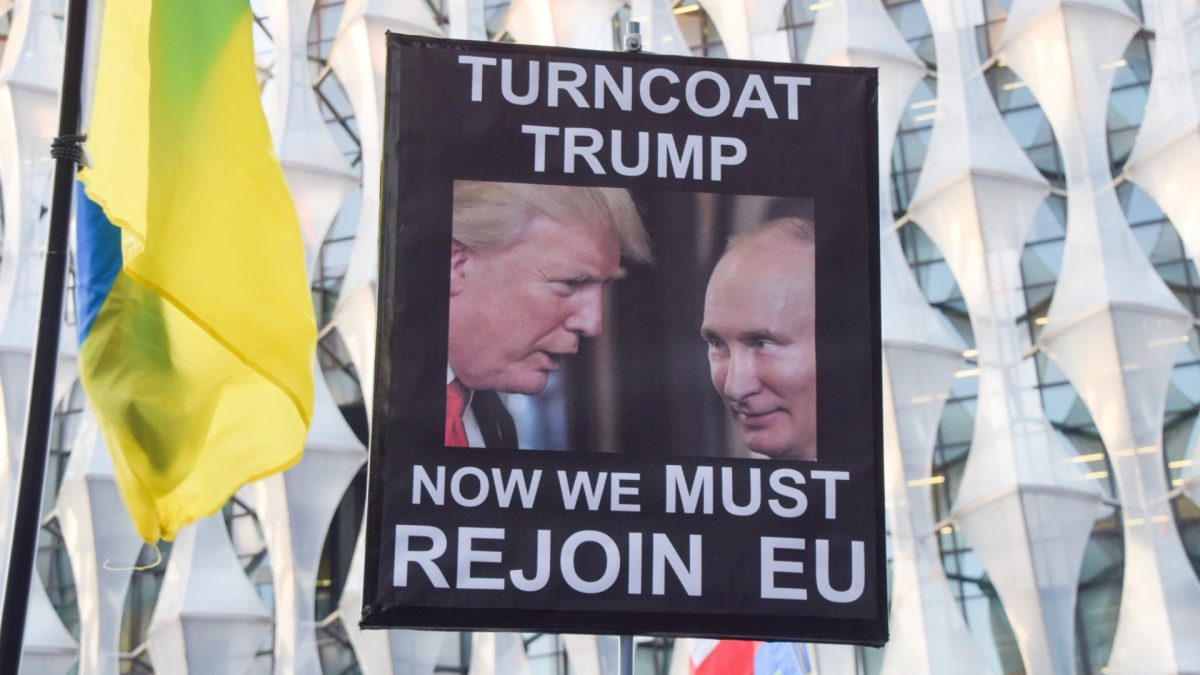
US treatment of Ukraine is a warning to Britain. We should be saddened – but also understand that we have no God-given right to US protection either. The question is whether we respond with hope or a plan, and prime minister Andy Burnham must ensure it’s the latter. It’s time to turn to Europe. The warning signs have been piling up. Trump’s de facto envoy to Russia praised Putin as a “humanitarian”: a man responsible for up to two million casualties in Ukraine and the slaughter of civilians in Bucha. Throttled Starlink and Starshield speeds allowed Russian missiles to terrorise civilians when Ukrainian’s access was restricted for over a week; ditto moving Patriot missiles to the Middle East after a self-inflicted war in Iran. The message out of the White House has been that weapons to protect Ukrainian freedom are available, but only if Europe pays the bill. It’s not the America of old. What Ronald Reagan called the tall, proud “shining city on a hill, whose beacon light guides freedom-loving people everywhere” is sadly missing in action. Instead, Washington is showing that even the most fundamental questions of freedom can become bargaining chips. We must also be clear that this may outlast Trump: JD Vance, for one, has already made clear his scepticism about America’s traditional role in Europe’s security. Russia’s President Vladimir Putin greets US special envoy Steve Witkoff (Photo: Gavriil Grigoriv / AFP via Getty Images) We bemoan the loss. But, put another way – how fortunate we have been to sit under a shield of US defence since the Cold War. UK military spending is too low: back in 1955 we committed over seven percent of GDP on defence; by the end of the Cold war four per cent; today just over two per cent. We have benefitted from protection when we have not been prepared to pay to protect ourselves.Uncertainty over that American protective shield comes at a bad time. In just a few years warfare has transformed. Ukraine shows the change. In 2022, Russian armoured columns rolled down Ukrainian motorways for days, harried by small groups of Ukrainian troops. In 2026, armour in the open has a lifespan of minutes, hunted by swarms of loitering drones. Both sides are racing to further automate the kill chain, identifying, attacking and overwhelming targets with an ever decreasing dependence on humans (Ukraine has already experimented with fully autonomous drones). The strategic vulnerabilities lie in the technology behind the drones: Starlink’s unmatched satellite communications array; world-leading frontier AI models built and controlled by the US and China (and largely no one else). It’s clearly tempting to take Elon Musk’s view with a pinch of salt (“were Starlink to be turned off, the Ukrainian front line would collapse immediately,” he said) – but it’s harder to dismiss front line Ukrainian troops (“God forbid they shut [Starlink] off completely, it would be an absolute catastrophe…I don’t give a damn how much an alternative costs when our lives are on the line,” one said to the BBC). Modern militaries are becoming both more technologically sophisticated – and more fragile. A Ukrainian soldier remotely controls P1-SUN FPV interceptor drone (Photo: Alex Nikitenko/Global Images Ukraine via Getty Images) As Burnham urges people to stock up on water and tinned goods, the same principle must guide our national security: hope for the best, prepare for the worst. But unfortunately, Britain cannot resolve these strategic dependencies alone. Developing frontier AI and building a constellation of satellites demands vast investment, industrial capacity and technological expertise. Who, then, should we partner with? Nato still remains the cornerstone of UK defence. Article 5 is meant to underpin our security – an attack on one is an attack on all, radically increasing the deterrent effect of an enemy attacking a Nato member. But triggering Article 5 requires consensus – and it’s now far from guaranteed the US will respond to the call. Non-US “five eyes” allies – Canada, Australia, New Zealand – are clearly no replacement and so we turn to our own backyard: Europe. The good news: there exists an golden opportunity for a European defence bargain. No European country wants Russian drones over their airports, or worse, Russian tanks on their territory. If the latter sounds far-fetched, it is exactly what the Baltic states are training for, following Russian invasions into Georgia (2008) and Ukraine (2014 and 2022). In the UK, Burnham has made clear his desire for closer integration with Europe. Defence is the obvious bridgehead. He should make defence cooperation the starting point for a new British relationship with the continent. To be clear: none of this requires reopening old wounds over Brexit, or rapidly settling debates over the single market and customs union. Pro or anti-EU, you may still recognise the unavoidable truth of a shared European need for military and technological capabilities that Britain and its neighbours cannot reliably provide alone. Closer European cooperation can deliver joint procurement, industrial capacity, interoperability, military mobility and technology (Photo: Danylo Antoniuk/Ukrinform) Nor is it intended to sideline Nato. Closer European cooperation can deliver joint procurement, industrial capacity, interoperability, military mobility and technology – all strengthening and complementary to Nato preparedness. Our posture with the US need not change – we hope for the best, including working via Nato and being open to close co-operation with the US, which remains deeply entwined at an official level whoever is in the White House. But we prepare for the worst, ensuring we have second options in the event the US makes a political call to turn off support. Europe and the UK are already working to address our vulnerabilities. On communications, the EU’s Iris2 is the closest global competitor to Starlink, due to become operational by 2029. On AI, the UK is building defence tools based on data from Ukraine’s “Avengers AI Labs”, developing advanced drone swarm technology and protection for critical infrastructure; France’s Mistral, for instance, has positioned itself as key to sovereign European AI. And at a personal level – warmer relationships and increased trust are the invisible glue that often makes the difference when that visceral request for assistance arrives: will you stand with us? The scale of Europe’s latent power is striking. European Nato members spent $559bn on defence in 2025 – almost three times Russia’s military expenditure and substantially more than China’s $336bn. EU member states together field 1.3 million active military personnel, a force comparable in size to America’s and larger than Russia’s. Add Britain’s military, technological and intelligence capabilities, and Europe has the resources to become a formidable military power. The aim is not to match the US (or Russia or China) in every capability, but to make an attack on Europe an intolerably costly gamble. The priority now is to turn national defence budgets into collective capability: coordinating orders so industry can produce at scale, building ammunition reserves, closing gaps in air and missile defence, making it easier to move troops and equipment across borders, and developing European alternatives in critical enabling technology such as satellite communications and AI. Britain should use its military, intelligence and technological strengths to help make that happen. In a world dominated by the twin powers of the US and China, Britain cannot stand alone. We must work to wake the sleeping third global giant – Europe – and build a credible, overwhelming deterrent against our would-be aggressors. Deterrence is not about preparing for a war we believe inevitable. It is about making aggression too costly to contemplate. It is the best insurance policy Britain and Europe can buy: the capability to defend ourselves, even if the US chooses not to.
Britain can stop Putin. Brexiteers won’t like how
Full Article
Original Source
Read the full article at Inews →KhanList aggregates and links to publicly available news content. We do not host full articles from third-party sources. Always verify important information with original sources.