
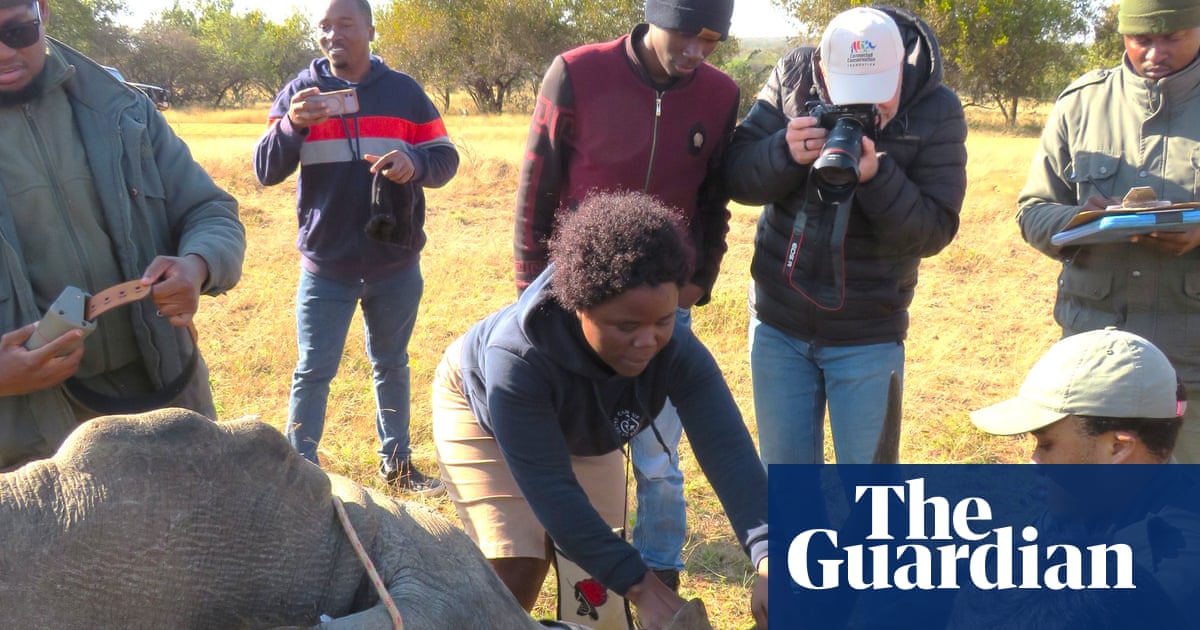
On a bitingly cold night in Lapalala Wilderness nature reserve in South Africa’s Limpopo province, Duncan Kanyakera watches as instructor Jacques Viljoen deploys a thermal drone in search of a lone cheetah. Once the drone has disappeared into the inky sky, Kanyakera, from Tsavo in Kenya, and 20 other conservation professionals from across Africa turn their attention to the open-air screen in anticipation.Many of the students – from 11 African countries as far flung as Benin, Liberia, the Democratic Republic of the Congo and Madagascar – witnessing the demonstration have earned their places at Lapalala after performing well on an online training programme for protected area technicians (PAT) run by the Connected Conservation Foundation (CCF). Also on the course, are five members of Peace Parks staff in training.“Data and technology are critical to modern conservation,” says CCF’s Sophie Maxwell. “Cameras and collars and software like EarthRanger have transformed the fight against poaching … But then an elephant knocks over a pole and you are back to square one.”Students learn how to use, maintain and repair a range of technology used in protecting wildlife. Photograph: Courtesy of CCFSince 2015, the CCF has installed state-of-the-art tech systems in parks across Africa with remarkable success, helping to protect nearly 10m hectares (25m acres). “Parks with tech solutions are safer and more biodiverse and they have better relationships with communities,” says Maxwell.Over the years, the CCF has “identified a critical gap”, says Carien Soldatos who oversees the PAT training programme: “Tech is fantastic, but it all depends on having trained technicians on the ground. Without people who know how to use, repair and maintain them, the fanciest gizmos in the world aren’t much use.” While there are such people in some parks, they are sorely lacking in many parts of Africa.After searching everywhere for a tech course aimed at conservation professionals, the CCF decided to create its own. Their 10-module course, which launched in July 2025, was a global first. In the first year, 680 people from all over the world finished at least one module. Those who completed all 10 modules were invited to interviews, with the top 16 chosen to attend the practical component at Lapalala.In less than 10 minutes, the heat sensor technology in the drone launched by Viljoen locates the cheetah resting with her cubs. Once he has locked its location, the operator sends a pin to the park’s on-duty field rangers, who rush to the scene. “I was stunned,” says Kanyakera. “There was no moon and the cheetah was miles away from us. But we could see exactly what was happening as the rangers got out of their vehicle and checked up on her.”Kanyakera, who works for the Taita Taveta Wildlife Conservancies Association (TTWCA) to support a network of 35 conservancies and ranches in Kenya’s vast Tsavo landscape, recognised immediately how handy a drone would be back home. Human-wildlife conflict is a challenge in Tsavo: “If an elephant gets into a corn field, it causes havoc,” he says. “And then you have the problem of humans retaliating.”Sixteen people were chosen from across Africa to attend this year’s practical course, with a second planned for early next year. Photograph: Courtesy of CCFThe aim, says Kanyakera, is to keep humans and animals apart via designated wildlife corridors. But this gets tricky in the dry season when animals and humans alike are drawn towards water. Currently, if Kanyakera gets reports of an elephant near a village, he has to first work out where the elephant is and which direction it is moving in, before deploying rangers to intervene. This can take hours.“With a drone, we could find the elephant in minutes,” he says. “The noise of the drone alone would probably be enough to scare the animal off. And if that doesn’t work, I can deploy rangers much more accurately.”skip past newsletter promotionafter newsletter promotionThe course featured guest lectures and practicals on subjects including connectivity, communication and monitoring sensors. Photograph: Courtesy of CCFWhile a night-vision drone is the most exciting item on Kanyakera’s Christmas list, the course has also shown him how simple changes could drastically improve the tech “stack” back in Tsavo. This has a lot to do with the course design, explains Maxwell: “Each day, they build a new element of the stack,” she says, “before breaking it down at the end of each day and building it again the next morning to add another layer. It’s all about building muscle memory.”And it seems to be working. “As soon as I get home, I’ll reconfigure our camera traps to make the most of AI,” says Kanyakera who also has his sights set on re-equipping the ops room in Tsavo. “In the past, we would just Google and make a decision. Now I know so much more, I can target what I really want. The learnings from this course can make a big difference to the people and animals of Tsavo.”The course – which featured guest lectures and practicals from nine experts on topics including connectivity, communication, power systems, monitoring sensors, hardware integration and GIS visualisation tools – is having an impact far beyond Tsavo.Effort Zivengwa, who works at the Zimbabwe Parks and Wildlife Management Authority head office in Harare, is part of a tech team responsible for 11 national parks. “We were content with what we were doing,” he says. “But, after completing this course, I think we have to do more. We are already using EarthRanger and we do have sensors, but they are not integrated.“We have park headquarters and lodges that don’t have internet access,” he adds. “Using point-to-point internet can fix that problem easily.” The learning module on solar power further shifted his understanding of what is possible. “We have a lot of remote stations,” he says. “But the sun shines everywhere.”Mabel Nokhuthula Piki plans to use what she has learned to teach her own students how computers can help save animals. Photograph: Courtesy of CCFMabel Nokhuthula Piki, who teaches wildlife monitoring skills at the Chinhoyi University of Technology in central Zimbabwe, has also found the course empowering. “My students didn’t comprehend that tech was important. They couldn’t get the link between saving animals and computers. But now I am going to change their minds,” she says. “It is impossible to understand the value of tech until you have seen it.”The CCF is planning to run a second practical course with another batch of students in the first quarter of 2027. What is more, says Soldatos, “we will be supporting five participants from the first course with internships and/or hardware donations”. The lucky five have not yet been chosen, but Kanyakera, Zivengwa and Piki are all in the running.
Bring on the drones: how a technology revolution is being rolled out across Africa’s nature reserves
Full Article
Original Source
Read the full article at Theguardian →KhanList aggregates and links to publicly available news content. We do not host full articles from third-party sources. Always verify important information with original sources.