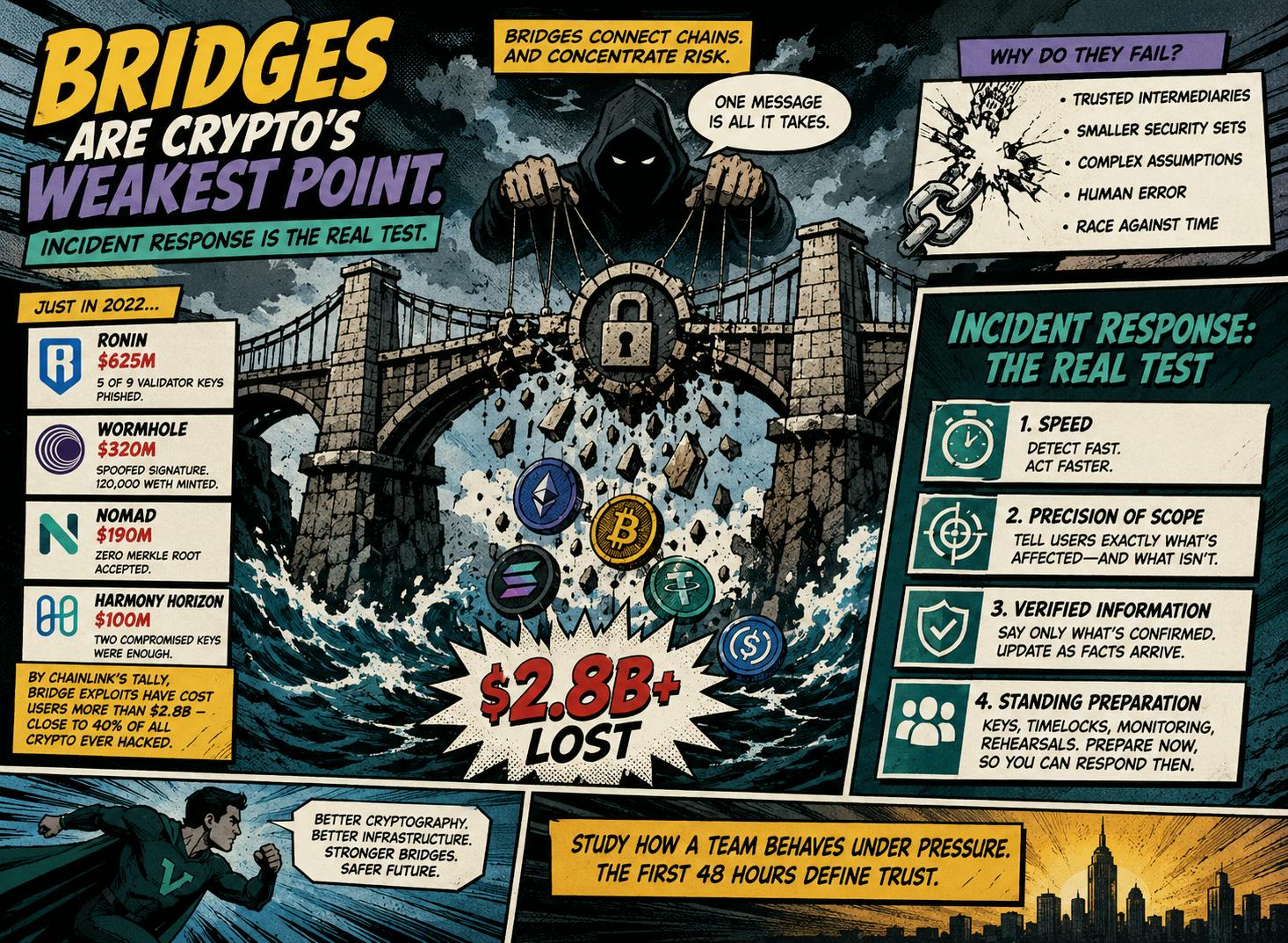
Every complex system has a point where stress concentrates. In a suspension bridge, the load runs to the cable anchors. Crypto has an equivalent, and the name is almost too on the nose. It is the bridge. The numbers here are brutal and well-documented. In 2022 alone, Chainalysis counted $2 billion stolen across 13 separate bridge exploits, which amounted to 69 percent of all crypto stolen that year. Ronin lost roughly $625 million after attackers phished their way to five of nine validator keys. Wormhole got drained of about $320 million through a spoofed signature that minted 120,000 wrapped ETH with no collateral behind it.Nomad's contract accepted a zero Merkle root as a valid proof, which translated to an oversight that cost $190 million. Two compromised keys were enough to take $100 million out of Harmony's Horizon bridge.By Chainlink's running tally, bridge exploits have cost users more than $2.8 billion, close to 40 percent of everything ever hacked in Web3. The pattern has continued into this year, and HackerNoon has dissected it thoroughly, from a practical breakdown of the four most exploited vulnerability classes to a full taxonomy of bridge architectures and their attack surfaces.Why does this one component keep failing across teams that don’t share codebases or architectures?The answer is structural. A blockchain is a closed system. Its security model assumes that everything relevant happens inside its own consensus. A bridge breaks that model by design. It locks an asset on one chain and issues a claim on another, and something in between has to verify that the first part of that transaction actually happened. That verification layer is where all the risk concentrates. It guards hundreds of millions of dollars, yet it is almost always simpler than the consensus of either chain it connects. Usually, it is a small multisig or a validator committee, running software written by humans under deadline pressure.An attacker targeting a major Layer 1 chain has to overcome the full economic weight of its consensus. An attacker targeting a bridge has to falsify one message. Steal enough keys or find one flaw in the verification logic, and the entire reserve is available. Ronin, Wormhole, and Nomad failed in three different ways, yet each attack is essentially the same event. Someone convinced the bridge that a deposit existed when it did not.Here is the part the industry discusses less honestly. This has happened to everyone. It has happened to teams with top-tier backing and multiple audits on file. Ronin was built by a studio running one of the most successful games in Web3. Wormhole was backed by Jump. Audits matter, and we should keep demanding them, but audits examine code. Many bridge failures live outside code, in the way keys are held and validators are operated, and in the assumptions between two systems that were never designed to talk to each other. A clean audit report is a snapshot. An adversary has everything they need.So the honest question for any team operating in a multi-chain world is different. When an incident touches your ecosystem (and eventually one will), how do you respond?I judge incident responses on four things.Speed. The gap between detection and action is where losses compound. Ronin's exploit went unnoticed for days and was discovered only when a user failed to withdraw their funds. A team that can pause a compromised component within hours will have already outperformed most of this industry's history.Precision of scope. A bridge is an application built on top of a network. When a bridge is compromised, the base layer's consensus, its validators, and the assets held natively on it are typically untouched. Being clear about that is their duty to users, who need to know which assets require action and which do not. Vagueness in either direction causes harm, panic on one side, false comfort on the other.Verified information only. The pressure to say something in the first hours is enormous. The discipline is to publish only what is confirmed and to say plainly which questions remain open. Updates come as facts arrive, at whatever pace verification allows. Speculation dressed up as reassurance can destroy more trust than the exploit itself.Preparation. Good responses are built years in advance. Distributed keys held across independent organizations, withdrawal timelocks, circuit breakers, real-time monitoring of invariants, rehearsed pause procedures. These are unglamorous engineering practices, and they are the difference between a contained incident and a catastrophe.Bridges will remain necessary for as long as we live in a multi-chain world, and cryptography is improving. Light-client and zero-knowledge verification will gradually replace trusted committees, shrinking the attack surface that has cost users billions. Until that transition is complete, I would offer builders and users the same advice. Study how a team behaves under pressure. Anyone can publish a roadmap in a bull market. Character in this industry is revealed in the first 48 hours after something breaks, and the teams that keep their discipline through those hours are the ones building infrastructure worth trusting.
Bridges Are Crypto's Weakest Point - Incident Response Is the Real Test
Full Article
Original Source
Read the full article at Hackernoon →KhanList aggregates and links to publicly available news content. We do not host full articles from third-party sources. Always verify important information with original sources.