
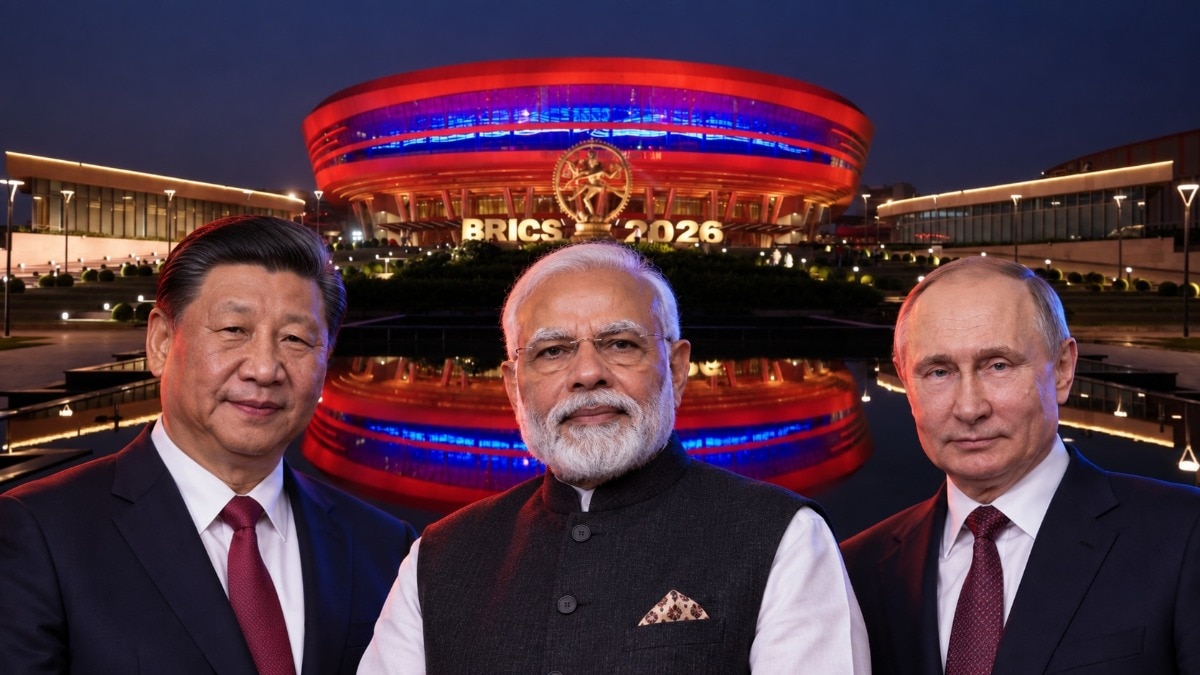
The joint statement of the Brics Delhi Summit is out, and the bloc has taken some hard stands. While it has named Israel while criticising it over Lebanon, it didn't name the United States while slamming DC's unilateral sanctions. Getting the members to agree on a joint statement was a big diplomatic challenge for India, the president and host. Now, it is to be seen how the words are interpreted and the signals from New Delhi received.There is, however, careful diplomacy in the wording. The document does not name the US while criticising non-UN sanctions, nor does it identify Iran while condemning attacks on nuclear facilities. Israel is the exception. It is named in several passages concerning Gaza and Lebanon.Producing the declaration was a major challenge because Iran and the UAE had pushed competing formulations on the war in the Middle East. Its adoption is a diplomatic victory for India, particularly after speculation that Russia and Iran would seek sharply anti-US language that New Delhi and other members of the grouping might resist. In a way, India has succeeded in keeping Brics within its preferred formulation of being "non-Western but not anti-Western".Speaking to India Today TV, India practice head at Eurasia Group and journalist Pramit Pal Chaudhuri said, "The accomplishment of the summit is to actually have a joint statement in the first place”, given the earlier Iran-UAE deadlock. Chaudhari said Brics had long been divided between a China-led camp seeking to challenge Western structures and an India-Brazil camp seeking to "modify" rather than overthrow them."Whenever you and the Chinese get in the same room, it’s all daggers drawn and we can't get anything done," Chaudhari recalled Russian diplomats telling him. Chaudhuri said the US had "massively undermined its own standing", giving Xi Jinping an opportunity to seek convergence with India and Brazil on local-currency trade, digital payments, logistics and connectivity. On Israel, the Brics declaration highlighted its legal obligation to allow humanitarian aid into Gaza and opposed forced Palestinian displacement. On Lebanon, it went further, asking Israel to "withdraw its occupying forces from all of the Lebanese territories" where they remain.'UNILATERAL SANCTIONS' TARGET THE US WITHOUT NAMING ITThe US is present without mention with the New Delhi Declaration condemning "unilateral economic sanctions" and attacks on "peaceful nuclear facilities"."We condemn the imposition of unilateral coercive measures that are contrary to international law, and reiterate that such measures, inter alia in the form of unilateral economic sanctions and secondary sanctions, have far-reaching negative implications," the Delhi Summit declaration said, adding that such economic sanctions end up "disproportionally affecting the poor".Though the joint declaration didn't name the US, it is common knowledge that Washington DC is the non-UN entity that imposes the most sanctions. In fact, it has imposed crippling sanctions against two Brics members, Russia and Iran."We reaffirm our opposition to unilateral coercive measures that are contrary to international law and the Charter of the United Nations, including non-UN Security Council authorized sanctions," the declaration read.Although the US is not named, the formulation clearly reflects the longstanding criticism of America by Russia and Iran of Washington's sanctions architecture and policies.The language is therefore critical of the US in substance, but stops short of turning the declaration into a direct attack on Washington. That's a careful diplomatic position. That compromise would have helped India, the UAE and other members retain important relationships with the US while allowing Iran and Russia to secure language opposing unilateral sanctions.Brics also voiced "serious concerns" about unilateral tariff and non-tariff measures inconsistent with World Trade Organisation rules (WTO). The New Delhi Declaration of the Brics leaders could be read as a broader warning against Washington's use of tariffs and economic pressure, though the declaration again avoids identifying any country.Since US President Donald Trump's return to the White House, US tariffs have hit imports from every Brics member except heavily sanctioned Russia, while Iran has faced both the baseline tariff and extensive sanctions. Trump has repeatedly branded Brics "anti-American", threatened an extra 10% tariff on countries aligning with it and warned of 100% duties over attempts to weaken the dollar.India called Washington's additional tariff over its Russian oil purchases "unfair, unjustified and unreasonable" and vowed to take all necessary steps to protect its national interests.BRICS BACKS IRAN'S CASE WITHOUT NAMING IRANIran had been critical that the Brics, with India as the president, didn't issue statements against the US and Israel over their airstrikes. While Iran is a Brics member, the US and Israel aren't. Tehran was looking for the grouping to back it, and the New Delhi Declaration does that to the extent possible.The passage does not name Iran, the US or Israel. In the context of the war in the Middle East, however, it appears to support Tehran's argument that US-Israeli attacks on its safeguarded nuclear facilities violated international law.Brics also urged respect for the sovereignty and territorial integrity of states and calls for "maximum restraint" in West Asia.Notably, the declaration expresses "serious concern over deliberate attacks on civilian infrastructure and peaceful nuclear facilities under full safeguards" of the International Atomic Energy Agency.Crucially, it prefaced the section by recalling the members' "respective national positions", allowing countries such as Iran and the UAE to sign the same document without abandoning their conflicting accounts of the war.Prime Minister Narendra Modi was seen holding Iranian President Masoud Pezeshkian's hand as the two leaders held talks, underscoring New Delhi's careful outreach to Iran during the Brics Summit.In a striking display of Indian diplomacy's heft, Iranian President Masoud Pezeshkian met UAE Crown Prince Khaled bin Mohamed bin Zayed Al Nahyan on the sidelines of the Brics Summit in New Delhi. The meeting was striking because Iran had fired over 500 missiles and 2,000 drones at the UAE since the war started in February, killing more than a dozen civilians and injuring more than 220.Iran is not explicitly named elsewhere, with Brics strongly supporting its bid to join the WTO. Therefore, the declaration backs important Iranian positions, but its war-related language remains general.ISRAEL CALLED OUT OVER WAR IN GAZA AND LEBANONIsrael received more direct treatment than the US in the New Delhi Declaration. Brics leaders expressed concern over continued violence in Gaza, opposed the forced displacement of Palestinians and supported a sovereign Palestinian state within the 1967 borders, with East Jerusalem as its capital.The declaration also referred to proceedings brought by South Africa against Israel at the International Court of Justice (ICJ) and noted Israel's "legal obligation to ensure the provision of humanitarian aid in Gaza".On Lebanon, the declaration states, "We welcome the ceasefire in Lebanon and call on all parties to strictly adhere to its terms and to fully implement UNSC Resolution 1701. We condemn the continued violations of the ceasefire and of the sovereignty and territorial integrity of Lebanon."In the same paragraph, it said,"We call on Israel to respect the terms agreed with the Lebanese government and to withdraw its occupying forces from all of the Lebanese territories, in which they remain."This is the only place in the entire document where Israel is named in a direct call for the withdrawal of occupying forces from a neighbouring country's territory.The UN Security Council Resolution 1701 ended the 2006 Israel-Hezbollah war and called for an Israeli withdrawal and the deployment of Lebanese troops and UN peacekeepers in southern Lebanon.So has India's position changed? While the declaration's language on a few issues is sharper than India's calibrated bilateral statements, but it does not by itself establish a fundamental policy shift.India has continued to advocate dialogue and diplomacy in the Middle East while supporting Palestinian statehood and maintaining close strategic relations with Israel. Prime Minister Narendra Modi reiterated during his meeting with Iranian President Masoud Pezeshkian that disputes should be resolved through dialogue and diplomacy, alongside protecting navigation, commerce and seafarers.A Brics declaration is also a consensus document, not an exclusively Indian statement. As chair, New Delhi's task was to find language acceptable to all 11 members of the expanded Brics.India has therefore accepted criticism of non-UN sanctions, implicit support for Iran's case and explicit demands directed at Israel. But by keeping the US and Iran unnamed in the war-related passages, it has preserved room for its multi-aligned foreign policy.DOES BRICS JOINT DECLARATION SIGNAL A SHIFT ON INDIA'S POSITION?India has charted a non-aligned foreign policy, but it has, at times, been perceived to be closer to Moscow or to Washington DC depending on the political situation.India's ties with the US had been on the upswing since the turn of the century, and experts saw a definitive leaning towards DC. But Donald Trump's second stint in the White House changed everything. The US President's imposition of tariffs, claims to have brokered a ceasefire between India and Pakistan in May 2025, and action against Indian professionals have dampened ties.With a White House that doesn't really seem to care for friends and allies, most countries are repositioning.India has been doing an excellent tightrope walk all this while. It has been talking to and trading with all the warring sides, Russia and Ukraine, US, Israel and Iran. Even as it backed the two-state solution on Palestine, India has deepened its ties with Israel, the country that backed it during Operation Sindoor.The Brics is, however, a different club altogether. Russia and China, the main counterweight to a US-dominated West, are at its core. As seen during the declaration of the SCO Summit on September 1, India had to make a choice even during the Brics summit.The Brics joint declaration might be a signal of correcting perceptions on New Delhi's alignment. However, one needs to be careful in reading it because, in diplomacy what is left unsaid conveys more than what has been forced into words.Experts have warned against India's very strong Brics association, saying it could be counterproductive.Rajesh Rajagopalan, Professor of international politics at Jawaharlal Nehru University (JNU) cautioned of China's "great ambitions"."India's objective in the BRICS should be to make it ineffective so that it doesn't become a vehicle for China's great power ambitions," Rajagopalan posted on X, sharing his Opinion in The Print.'Forget Brics, look West' was how economist Surjit Bhalla's piece in The Indian Express was headlined on September 11."What should India do to enhance our future? Forget BRICS. Our future is as a global partner of the West — Europe and the US. And note, and remember, who gains if India does not sign a trade deal with America," wrote Bhalla.For India, Brics is a vehicle for non-aligned diplomacy. It has succeeded in getting a joint declaration out despite 11 varying interests, and through it, sent out a signal of its flexible diplomacy.- EndsPublished By: Anand SinghPublished On: Sep 12, 2026 18:26 IST
Brics slams US, backs Iran, calls out Israel. Has India shifted stance?
Full Article
Original Source
Read the full article at Indiatoday →KhanList aggregates and links to publicly available news content. We do not host full articles from third-party sources. Always verify important information with original sources.