
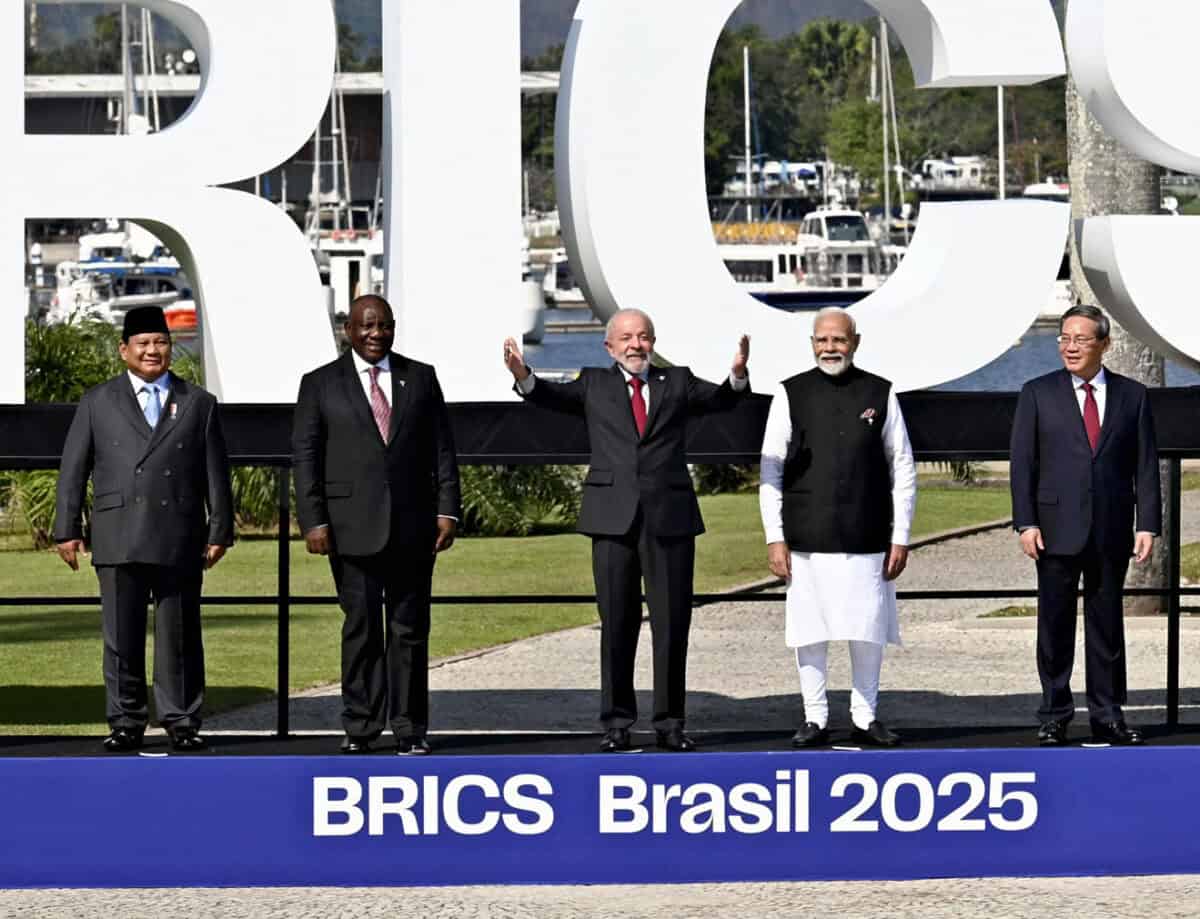
Upcoming Brics summit in New Delhi arrives as conflicts trade wars and sanctions erode traditional global governance mechanisms. The upcoming Brics summit in New Delhi arrives at a moment of profound strain in the international system. Conflicts in Ukraine and the Middle East, escalating tensions among major powers, trade wars, sanctions and widening rifts between the US and its European allies all point to the erosion of traditional mechanisms of global governance. Similarly, institutions built after World War II are losing their regulatory capacity, increasingly replaced by unilateral restrictions, economic coercion and ad hoc coalitions. Against this backdrop, Brics‘ role extends far beyond its identity as an economic bloc of emerging economies. It has become one of the few major platforms where countries with different political systems and economic models can sustain dialogue without first subscribing to a common ideology or geopolitical position. The ability to cooperate despite differences is one of Brics’ defining strengths. Its members are far from uniform: India and China remain locked in competition for influence in Asia and have unresolved border disputes; Iran and the United Arab Emirates diverge on regional matters; Russia, Brazil and South Africa pursue independent foreign policies. Yet these disagreements do not prevent cooperation or exclude partners from dialogue. Brics rests on principles of equality, respect, consensus and recognition of national interests and sovereignty. Holding the presidency confers organisational responsibility, not the power to impose political conditions. This distinction is particularly evident in light of recent developments surrounding the G20. After the Trump administration declined to participate in the G20 summit in Johannesburg last year, Washington announced its intention not to invite South Africa to events held under the US G20 presidency this year. Pretoria rejected this, insisting it is a full member of the G20 and its participation should not depend on bilateral political disagreements. Brics offers a different model of multilateralism than the current trend toward contrived unilateralism. No member can dictate another’s foreign policy or decide who participates. Decisions are taken by consensus. Members are not required to share identical views on Russia’s relations with the West, China’s rivalry with the US, or conflicts in Ukraine and the Middle East. Cooperation rests, instead, on recognising each state’s right to pursue its own path. Of course, Brics’ expansion makes consensus harder; we can’t escape from that reality. A larger group complicates coordination on security, trade, energy, finance and institutional reform. Yet, that Brics continues to function despite diverging interests demonstrates its resilience. In a world marked by fragmentation, this approach has intrinsic value. Brics does not seek to replace the existing international system. Its advantage lies in offering space for cooperation without political diktat or artificial divisions between “acceptable” and “unacceptable” states. As long as it preserves equality, consensus and respect for sovereign choice, Brics can fulfil a role that many traditional institutions increasingly struggle with: keeping dialogue alive. In an era of fragmentation, the ability to continue talking despite disagreements may prove Brics’ most important contribution to a more balanced world order. For South Africa, being a founding member of this bloc is not only a matter of prestige, but of strategic relevance. It affirms the country’s place in shaping conversations about global governance and underscores the importance of dialogue as the currency of international politics.
Brics offers dialogue without diktat as global governance fractures
Full Article
Original Source
Read the full article at Citizen →KhanList aggregates and links to publicly available news content. We do not host full articles from third-party sources. Always verify important information with original sources.