
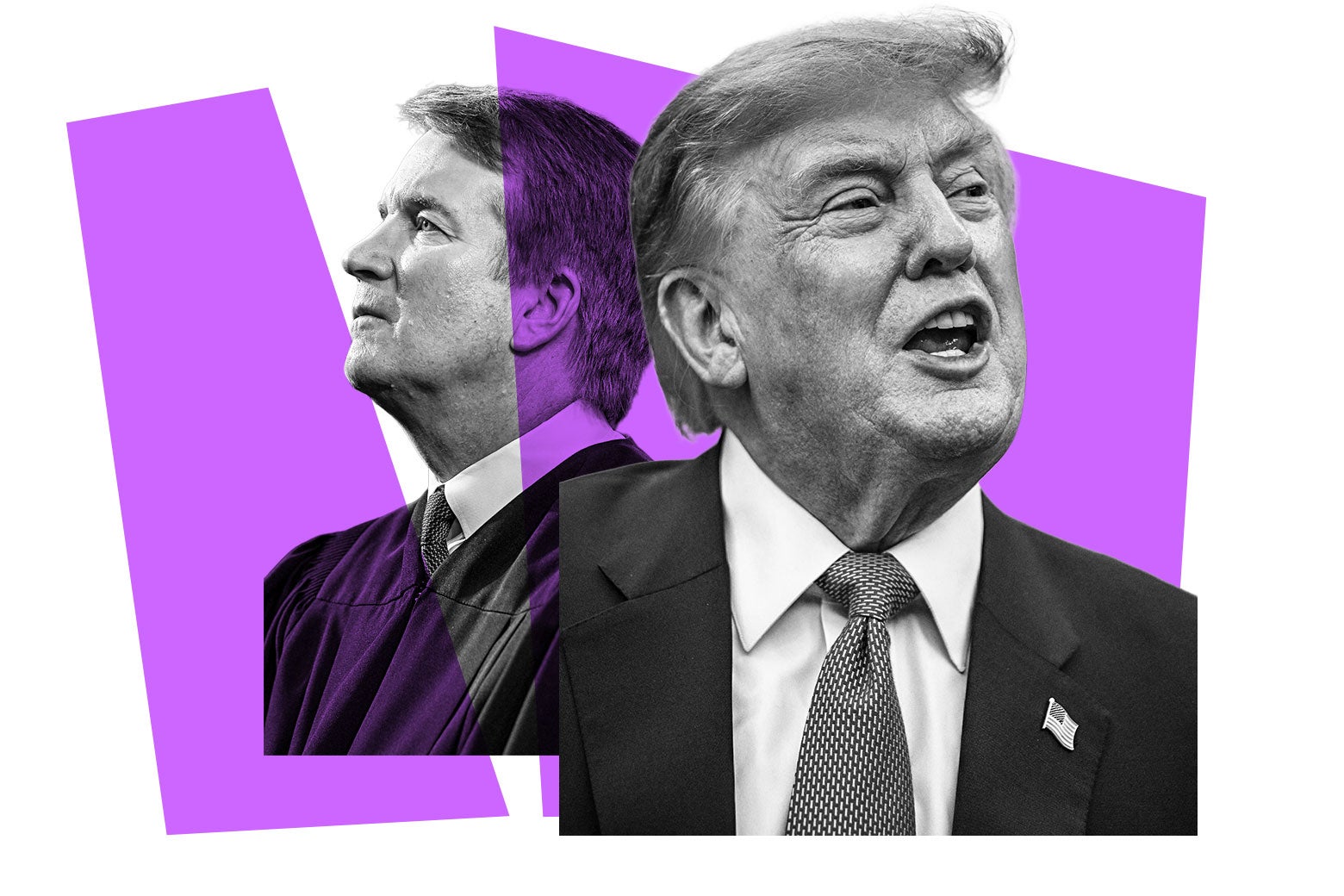
Jurisprudence Kavanaugh opened the door for Trump to pull this. Photo illustration by Slate. Photos by Kenny Holston/Pool/Getty Images and Jim Watson/AFP via Getty Images. Sign up for Executive Dysfunction, a newsletter that highlights one under-the-radar story each week about how Trump is changing the law—or how the law is pushing back. You’ll also receive updates on the latest from Slate’s Jurisprudence team. Last week, President Donald Trump continued his defiant stance against the Supreme Court’s birthright citizenship decision from earlier this summer, firing off two new executive orders about which people born in the U.S. should be declared citizens. Despite losing at the Supreme Court on the legal issue in late June, the Trump administration remains committed to twisting a long-settled constitutional question into a tool to keep Black and brown people out of American life. The conservative legal movement, at first skeptical of Trump’s original executive order attacking birthright citizenship, has now fully embraced the cause. And the cause’s survival can all be traced back to our Supreme Court’s unwillingness to give the Trump administration the overwhelming legal defeats it deserves. In Trump v. Barbara, the court struck down Trump’s first executive order on birthright citizenship. Signed on his first day in office, “Protecting the Meaning and Value of American Citizenship” purported to strip the right to be a U.S. citizen from children born to parents who are in the country unlawfully, as well as parents lawfully but only temporarily in the country. This was in spite of the fact that the 14th Amendment grants birthright citizenship to “all persons” who are born in the United States and subject to its laws. All persons. The only exceptions to this rule that have ever been consistently recognized are for people technically born within the country’s borders but under the legal authority of a separate sovereign, such as children of foreign diplomats. It’s this exception that Trump’s first executive order tries to capitalize on. Trump barely took the effort to even change the name of the order the court had struck down, calling the new one “Continuing to Protect the Meaning and Value of American Citizenship.” This new order seeks to expand the number of people who fall under the foreign diplomat exception. People who would no longer get citizenship would include children whose parents have been named as part of a designated terrorist organization, are foreign government officials, work for foreign-based nonprofits, or are involved with certain international business transactions. The order stretches the birthright citizenship exception as it’s been traditionally recognized beyond recognition. As the American Civil Liberties Union explained in its aftermath last week, “Birthright citizenship is guaranteed by the Constitution. No additional executive order can change the meaning of the Constitution.” Trump’s second executive order focuses on a related citizenship issue: “Ending Birth Tourism.” A longtime pet project of the president, birth tourism is the practice in which companies help foreigners enter the United States, usually under visa applications, for the express purpose of having children in the U.S. who would then be citizens. There are no statistics establishing birth tourism as a wide-ranging problem. At oral argument, Solicitor General John Sauer could only provide anecdotes about newspaper clippings from China, but admitted that “no one knows” the true number. Unbothered by his solicitor general’s concession, Trump continues to repeat with no basis that hundreds of thousands of birth tourists have given birth in this country. Never mind that tourists account for less than 2 percent of all United States births—and that 2 percent figure is all tourism, even before you make potentially ill-founded judgments about whether someone committed fraud to visit this country. The birth-tourism executive order, if it holds up in court, seems likely to lead to frequent ill-founded judgments. First of all, committing fraud in visa applications is already illegal. Border agents already have the authority to question a foreigner’s reason for applying for a visa or entering the country. And in case there’s any question about whether this order might be applied evenhandedly across foreign countries, remember that this is the same administration that is currently taking almost exclusively white South Africans as refugees. And Section 5 of the order allows the secretary of state and Homeland Security to grant any exemptions they want to parents who might otherwise fall within the order’s orbit. All in all, then, the order takes a building of preexisting visa laws and simply paints it over with a coat of whiteness. To understand how these new executive orders push the boundaries of both U.S. and international law, it’s worth taking a moment to appreciate just how deeply ingrained birthright citizenship is in our country’s history. Chief Justice John Roberts’ opinion for the court explained how the long-held understanding of birthright citizenship dates back to the English crown. The idea that nearly everyone born on the land became a citizen was so pervasive as to have a name: jus soli, or “the right of the soil.” Legal scholars in the early 1800s treated this right as both intact and broad. In the words of Supreme Court Justice Joseph Story: When it comes to birthright citizenship, “nothing is better settled.” But in the infamous case of Dred Scott v. Sandford, the Supreme Court did an about-face and declared that formerly enslaved Black Americans were not citizens, even though they were born here. That case wouldn’t just go down as one of the most shameful moments in the court’s history; it was also the legal system’s most significant contribution in devolving the country into the Civil War. Dred Scott weighed heavily on the mind of the reunited country that passed both the 14th Amendment and the Civil Rights Act of 1866, both of which recognized citizenship as a birthright for virtually all persons born in this country. And a later case about a child of Chinese parents, United States v. Wong Kim Ark, confirmed that the 14th Amendment’s citizenship clause applied to people of all races. It’s not unusual for President Trump to try to ignore or twist a legal ruling on an issue he lost on. The better question is why he thinks the effort will succeed. After all, there are other areas where Trump has quietly retreated after a court loss or public outcry. The reason the president persists is that despite all this history, text, and precedent, only five of the nine justices read the 14th Amendment as protecting birthright citizenship in Barbara. The narrowness of that margin was and continues to be a scandal. Justice Brett Kavanaugh sided with Justices Neil Gorsuch, Clarence Thomas, and Samuel Alito in saying they would rule that the constitution does not protect birthright citizenship for children of immigrants who don’t have permanent legal status or are temporary visitors. (Kavanaugh, in a separate opinion joined by nobody, thought the executive order only contradicted a federal statute that Congress could change.) Let’s be clear: This court was one vote away from doing Dred Scott for yet a new group of people who lack political power. All in defense of an order that has been rightly condemned as “blatantly unconstitutional.” Barbara, and now these new orders, is also a symptom of a court that operates in a lopsided manner that favors the administration. This is especially true in the immigration context. In the temporary protected status case, for example, the 6–3 court pulled the rug out from under the Immigration Act of 1990 and the constitutional guarantee of equal protection, letting the Trump administration kick out hundreds of thousands of people from Haiti and other countries. When this court upholds a Trump executive order, it is with the brightest green-means-go signal a majority can muster. But when they rule against the administration, like with Barbara, there isn’t equal force on the other side. Roberts’ opinion for the court, despite being well-written and legally correct, resists critiquing the original order with the forcefulness this issue deserves. And the dissents are littered with both reasons why they believed the Trump administration was right in this case and pathways to future actions that would also be valid in their view. Most obviously, there was Kavanaugh’s road map for a congressional statute that he believed could somehow expand the number of constitutional exceptions to birthright citizenship. Collectively, the lesson that the court gives the administration is clear—just try again. This lopsided approach allows the court to reap the benefits of positive headlines when they rule against the administration, all the while paving a stepping stone for further abuses. This pattern could be seen clearly this term when the court’s conservatives overturned the last remaining plank of the Voting Rights Act that two of them had joined the liberals to uphold just three years ago. Even beyond last week’s orders, conservatives are already meeting to develop a plan to overturn the Barbara ruling altogether. By seeking to overturn Barbara, the anti-birthright legal movement hopes to create a different lopsided relationship between Black and brown children and their government. As the court in Barbara explained, birthright citizenship launches a reciprocal relationship between a person and the sovereign. At birth, the person implicitly agrees to be subject to the laws of the government. In exchange, the government owes that person treatment equal to that of others born on its soil. The Trump administration wants to rupture one half of that relationship. They would like children of immigrants to suffer under fear of violence, imprisonment, and deportation. But they want to relieve themselves of their own obligation to recognize the right of babies who have quite literally only known America from the second they were born. As a businessman who’s spent his life making deals that would screw over the other side, perhaps it’s not surprising that Trump would want to renege on America’s side of the bargain with children of immigrants. What is disheartening, though, is to have a high court that seems on the brink of letting him break that bargain. There have been two eras in our nation’s history in which a coalition of Americans tried to deny birthright citizenship to minorities. In the first era, the coalition temporarily succeeded against Black Americans, leading to a Dred Scott decision that everyone now agrees was an immoral mistake. The second era was against Asian Americans, and that effort failed with a Wong Kim Ark decision that went from settled law to contested precedent in the span of a couple of years. We are now in the third era. Let’s hope that the Barbara decision was the final destination, and not a temporary stop on the way to stripping the right that allows all other rights to flourish. Get the best of Jurisprudence. Sign up for Slate’s legal newsletter. Constitution Donald Trump Immigration Jurisprudence Supreme Court Brett Kavanaugh Judiciary
Brett Kavanaugh Opened the Door for Trump’s Latest Supreme Court Defiance
Full Article
Original Source
Read the full article at Slate →KhanList aggregates and links to publicly available news content. We do not host full articles from third-party sources. Always verify important information with original sources.