
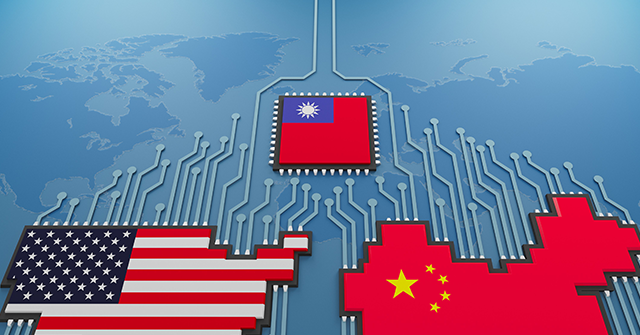
A Booming Economy Still Too Dependent on Imported Technology The American economy is in the middle of an extraordinary business investment boom. And the latest GDP numbers demonstrate just how extraordinary it has become. But there’s a specter haunting the boom: the specter of import dependence created by decades of American neglect in the face of successful economic nationalist policies on the part of our trading “partners.” On Thursday, the Commerce Department reported that the economy grew at a 3.4 percent annualized rate in the third quarter, accelerating from 2.2 percent in the second quarter and beating economists’ expectations. Business investment drove the acceleration. Nonresidential fixed investment grew at a 12.7 percent annualized rate, contributing 1.78 percentage points to GDP growth. Equipment investment surged at a 20.9 percent rate, contributing 1.16 points all by itself. The most impressive numbers came from information-processing equipment. Investment in computers and peripherals contributed 0.72 percentage point to GDP growth. Other information-processing equipment contributed another 0.14 point. So nearly nine-tenths of a percentage point of economic growth came from business investment in information-processing equipment. Of course, we know what’s driving much of this. The Super Intelligence boom is generating enormous demand for data centers, servers, advanced semiconductors, power infrastructure, and the software that makes it all work. Unfortunately, much of the equipment needed to build that infrastructure isn’t manufactured in America. The Great Import Leakage The third-quarter GDP report contained another extraordinary number. Net exports, which measure exports minus imports, subtracted 3.32 percentage points from economic growth. As Harvard economist Jason Furman pointed out Thursday, that’s the third-largest negative contribution from net exports in the history of the Commerce Department’s quarterly GDP series, which stretches back to 1947. The second-largest came in the first quarter of 2025, when businesses rushed to import goods ahead of President Trump’s tariffs. The largest was in the fourth quarter of 1947. Of course, imports are subtracted from GDP because they represent foreign production already included in measures of American spending and investment. The subtraction prevents foreign-made goods from being counted as American output or double-counted in a way that would inflate GDP. But that’s precisely what makes these numbers so revealing. American businesses are building the infrastructure of the future, but foreign factories are supplying much of the equipment. We cannot supply the seed corn that we’re planting in our fields. Imports surged at a 19.7 percent annualized rate in the third quarter. Imports of goods alone rose at a 26.4 percent pace. And what were Americans importing? You already know. We’re bringing in ships loaded with the high-tech stuff we need for the AI boom. The Census Bureau reported that capital-goods imports jumped $14.4 billion in July. Computers accounted for $6.9 billion of that increase, computer accessories another $6.6 billion, and semiconductors $1.2 billion. Capital-goods imports rose another $6.2 billion in August, reaching a record $146.4 billion. Advance Census figures show they jumped another $10.9 billion in September, to a new record of $157.4 billion. That was an astonishing 77.2 percent increase from September of last year. Many of the advanced semiconductors used in artificial intelligence arrive in the United States already installed in servers and other computer equipment. They’re counted as imports of computers or computer components rather than semiconductors. So you have to pull from multiple lines in the government reports to get a look at the full scale of our import dependence. A Federal Reserve study published in July estimated that approximately 90 percent of equipment goods used in high-technology sectors originate abroad, with production heavily concentrated in East Asia. The researchers anticipated that the AI boom would generate substantial additional imports. And that’s exactly what we’re seeing. How America Lost an Industry It Invented Why are we so dependent on imports? After all, the semiconductor industry was invented in the United States. Our engineers developed the transistor and pioneered integrated circuits. The technologies that made modern computing possible, and that now provide the hardware for the Super Intelligence boom, are overwhelmingly American innovations. (Original Caption) September 5, 1961: The tiny device at left is a multiple silicon switching diode, which has been developed by the RCA semiconductor and materials division in Somerville, New Jersey, to help simplify computer design and manufacturing. (Getty Images) So what happened? Back in 1990, the United States accounted for 37 percent of global semiconductor manufacturing capacity. By 2000, that share had fallen to approximately 19 percent. By 2022, it was just 10 percent. How did we lose our capacity to meet even our own demand for semiconductors, much less export enough to meet the rest of the world’s? The tale of decline begins with the migration of consumer electronics manufacturing to Asia during the 1970s and 1980s. American companies had pioneered many of the technologies used in radios, televisions, video recorders, and computers. But manufacturing increasingly moved overseas, and the companies making electronic products are also the customers for semiconductors. As electronics manufacturing moved overseas, demand for semiconductor production increasingly moved with it. Of course, this wasn’t simply a matter of Japanese companies outcompeting their American rivals. Japanese workers are not gifted by nature or God when it comes to creating semiconductors. And it wasn’t a matter of some organic “comparative advantage” that shows up in economics textbooks. It was a matter of economic policy. Japan’s government has long pursued economic nationalist policies and actively promoted the development of its semiconductor industry. In 1976, the Ministry of International Trade and Industry organized a cooperative research program involving major Japanese electronics manufacturers to accelerate the development of advanced integrated circuits. Taiwan also pursued its own nationalist industrial strategy, with even more enduring consequences. In 1987, Morris Chang—a former Texas Instruments executive who had run Taiwan’s government-backed Industrial Technology Research Institute (ITRI)—founded Taiwan Semiconductor Manufacturing Company, better known as TSMC, with a business model that transformed the industry. Instead of designing its own chips, TSMC specialized in manufacturing chips designed by other companies. Morris Chang, chairman and founder of Taiwan Semiconductor Manufacturing Company Ltd. (TSMC), speaks at the company’s annual general meeting in Hsinchu, Taiwan, on June 9, 2015. (Billy H.C. Kwok/Bloomberg via Getty Images) From the start, TSMC was created with the direct involvement of the Taiwanese government and the ITRI. Its founding investors included the government, Philips, and private companies. The ITRI provided technology, manufacturing facilities, and personnel. The Taiwanese government was actively building an industry that would become one of the most important in the world. And it was promoting the TSMC business model designed to lure manufacturing away from the United States. Why didn’t we react? Because Taiwan wasn’t fighting American economic policy. It was collaborating with it. Starting in the 1960s, U.S. tariff rules allowed companies to ship American-made components abroad for assembly and pay duties only on the value added overseas. In the 1970s, Pan Wen-yuan, a researcher at RCA’s labs, was advising Taiwan’s government on how to build an electronics industry. He convinced officials that Taiwan should buy proven technology rather than try to develop its own. In 1974, the ITRI set up an electronics unit, later called ERSO, to carry out the plan. In 1976, RCA licensed its chipmaking technology to ERSO and trained a cohort of Taiwanese engineers in semiconductor manufacturing. The price was a few million dollars, pocket change for RCA. Those engineers went on to build Taiwan’s chip industry; and in 1987, TSMC was spun out of ERSO. In short, RCA, a company created through a deal between the U.S. Navy and General Electric to secure American dominance of international radio, planted the seeds that grew into TSMC a decade later. Twenty years later, Washington championed a global agreement to eliminate tariffs on a wide range of information-technology products, including computers, semiconductors, and telecommunications equipment. American tax policy also encouraged the accumulation of overseas profits and investment abroad. Even the 2017 tax reform originally exempted a 10 percent return on foreign factories and equipment from its new minimum tax on overseas profits, a provision Congress finally eliminated in President Trump’s One Big Beautiful Bill in 2025. Why did American policy move this way? Because it was immensely profitable for American corporations. U.S.-headquartered companies accounted for 53.4 percent of global semiconductor sales last year, their highest share since 1984, even though much of the manufacturing took place overseas. As public-choice theory teaches us, government policy tends to favor those who receive concentrated benefits, even when the costs are dispersed across the rest of society. And we had a Cold War we were trying to win, in part by making our allies wealthy capitalists. It didn’t make a dime’s worth of difference how Americans voted. The leadership of both parties supported this economic arrangement, even after the Cold War justification fell away. All our post-Cold War presidents and their opponents—regardless of whether they were named Bush or Clinton or Dole or Gore or McCain or Obama or Romney—were on board with offshoring until we elected Donald J. Trump. In short, the jobs and the factories didn’t leave because Americans wouldn’t do the work or couldn’t compete. Our rules pushed them out, and our trading partners’ rules pulled them in. Employees work inside a Siliconware Precision Industries Co. (SPIL) facility in Hsinchu, Taiwan, on April 18, 2016. (Maurice Tsai/Bloomberg via Getty Images) The Price of the Great Offshoring The remarkable thing about the offshoring of chipmaking is that it was widely celebrated as economic progress. For decades, the prevailing wisdom was that America could specialize in designing technology, developing software, and owning intellectual property while leaving physical manufacturing to other countries. The fatal flaw in this arrangement is that manufacturing itself produces knowledge. Companies learn to improve products by figuring out how to make them. Factories create demand for specialized suppliers, skilled workers, and new generations of manufacturing equipment. In a 2025 essay in American Affairs, Kenneth Flamm and William Bonvillian explained how modern semiconductor fabrication benefits from enormous economies of scale. TSMC can spread the tens of billions of dollars required to build advanced factories across chips designed by hundreds of customers. Its factories also benefit from the accumulated expertise that comes from manufacturing at scale. The more it manufactured, the better and cheaper it became at manufacturing. There’s a well-established economic explanation for this. Economists call it agglomeration, the tendency of industries to become more productive as they concentrate geographically. Paul Krugman’s pioneering work on economic geography demonstrated that manufacturing concentration can become self-reinforcing. Factories attract specialized suppliers and workers, making it cheaper and more efficient for additional factories to locate nearby, attracting more specialized workers. Rinse and repeat. In other words, the advantages economists observe today are the consequences of industrial policies adopted decades ago. Taiwan’s lower manufacturing costs reflect decades of accumulated expertise, investment, and industrial concentration. Treating those advantages as permanent features of the economic landscape amounts to treating the results of previous government intervention as evidence against future intervention. The result was a vicious circle for American manufacturing and a virtuous circle for Taiwan. What began as an industrial shift became an entrenched competitive advantage. And that brings us back to the extraordinary imports of servers and computer equipment revealed in the latest trade figures. Even as America begins rebuilding semiconductor fabrication, much of the equipment incorporating those chips is still assembled overseas. Rebuilding chip factories is essential. But recovering the full benefits of the AI investment boom will also require rebuilding more of the manufacturing ecosystem around them. The Good News: America Is Beginning to Rebuild So are we doomed? Maybe not. Under President Trump, we’re finally using the might of the U.S. economy to reverse the long decline of American tech manufacturing. TSMC is expanding its manufacturing operations in Arizona. Samsung is investing in semiconductor fabrication in Taylor, Texas. Micron is expanding domestic memory-chip production, while Texas Instruments is investing in new American fabrication capacity. According to projections from the Semiconductor Industry Association and Boston Consulting Group, American semiconductor manufacturing capacity is expected to roughly triple by 2032. The American share of global fabrication capacity is projected to rise from around 10 percent to 14 percent, its first sustained increase in decades. America’s share of global capacity for advanced logic chips is projected to rise from essentially zero in 2022 to 28 percent in 2032. Of course, rebuilding factories is only part of the challenge. “If you build it, they will come” is a nice line from a movie, but it is bad economics. Years of offshoring also eroded the specialized labor force needed to construct and operate them. TSMC’s Arizona project encountered shortages of workers experienced in installing advanced fabrication equipment, prompting the company to bring in specialized personnel from Taiwan. (Those workers, by the way, are apparently horrified by the quality of the U.S. public schools that their children attend.) Signage for Taiwan Semiconductor Manufacturing Company (TSMC) at it’s fabrication plant in Phoenix, Arizona, on March 3, 2025. (Rebecca Noble/Bloomberg via Getty Images) But there’s reason to think the recovery could eventually become self-reinforcing. New factories should help create the suppliers, workers, and technical expertise that make additional factories more competitive. The economics of agglomeration and geographic concentration can run in reverse or at least in our favor. For now, the third-quarter GDP report is a reminder of just how much ground there is to recover. America is experiencing one of the greatest technological investment booms in our history. Yet an enormous amount of the equipment we’re using to support our Super Intelligence boom is coming from countries that spent the last several decades building the manufacturing industries we allowed, and often encouraged, to slip away.
Breibart Business Digest: The AI Boom Is Exposing the Cost of America's Lost Semiconductor Industry
Full Article
Original Source
Read the full article at Breitbart →KhanList aggregates and links to publicly available news content. We do not host full articles from third-party sources. Always verify important information with original sources.