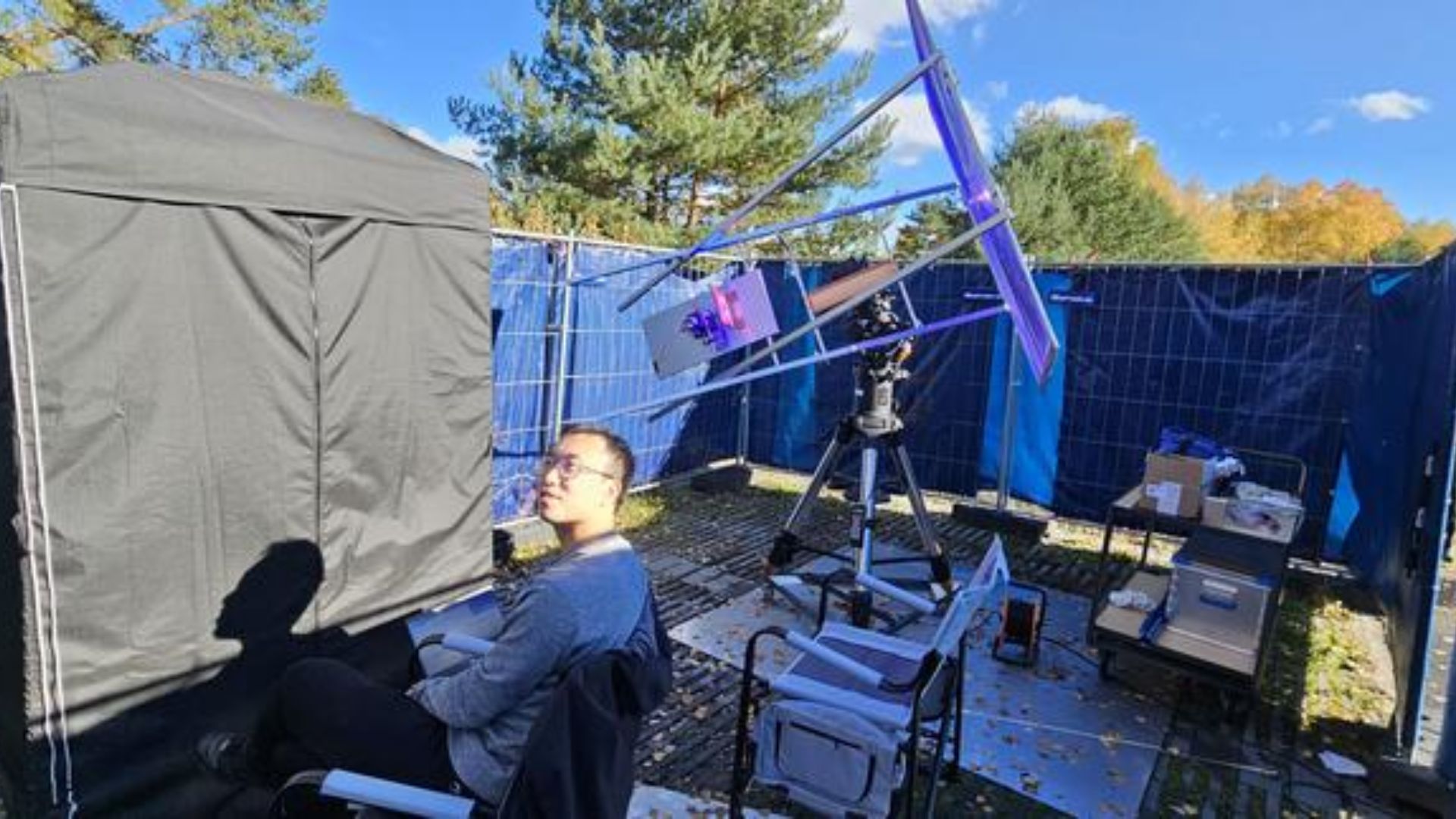
Researchers at the University of Ottawa in Canada have demonstrated that quantum entanglement between photons does not require coherent sources of light like lasers but can be generated using incoherent sources such as direct sunlight too. The research opens up new avenues in quantum technologies where light sources can be deployed and a fraction of energy used. While quantum technologies are still in their infancy, concerns about their high energy use are already on the rise. Ongoing quantum research typically requires two things – ultracold temperatures and highly coherent lasers. Both these ingredients are extremely energy intensive, raising concerns about energy demands if they are scaled in their current forms. Researchers are working on approaches where materials show quantum properties even at room temperature. For the other piece of the puzzle, a team of researchers led by Robert Boyd, a professor of physics and expert in quantum nonlinear optics, worked with an abundant natural light source to see if quantum entanglement could be achieved. Photon entanglement using sunlight Scientists have believed that photon entanglement can only be achieved with coherent light such as lasers. This is because light waves in these sources stay synchronized with their peaks and troughs, making predictable patterns that were thought essential for photon entanglement. In their previous work, Boyd’s team had shown this assumption to be incorrect. The researchers had used LED light, which is incoherent, to generate polarization-entangled photons, thereby demonstrating that light, even though disordered in one property, could still produce photons that are entangled. Now, the research team wanted to take this a step further and use sunlight since it is divergent and incorporates a wide range of colors. “Sunlight-driven entanglement generation could also provide the crucial ingredient needed to scale up quantum computing without adding to the energy burden,” explained Cheng Li, a graduate student at the University of Ottawa who was involved in the work. How did they do it? Using a process called spontaneous parametric down-conversion (SPDC), researchers typically make a pump beam interact with a non-linear crystal and cause photons to split into pairs, which later become quantum entangled. This experiment was different since sunlight is highly polarized but incoherent in space and time. “We designed our experimental setup so that differences introduced by the different colors and propagation directions didn’t influence the photons’ polarization,” explained Li in a press release. “As our theory predicts, if the entanglement lives only in polarization, then it should only depend on the pump’s orderliness in its oscillation direction and not on its direction or color. This allowed us to produce high-quality polarization entanglement from highly spatially and temporally incoherent sunlight.” A challenge the team faced was focusing sunlight on a tiny, millimeter-sized nonlinear crystal. To overcome this, the researchers used a solar concentrator developed by Hanieh Fattahi, a researcher at the Max Planck Institute of Science (MPL) in Germany, that converges sunlight using a Fresnel lens into a optical fiber cable no wider than human hair. In their experiments, the researchers found entanglement generated from sunlight was 94 percent similar to a perfectly entangled state. The team is now working on a field-deployable product by improving brightness and entanglement quality. “This technology could one day enable satellites to create secure encryption keys using the sunlight already abundant in space, reducing the need for onboard lasers and much of the supporting hardware,” concluded Li in the press release. The research findings were published in the journal Optica. Recommended ArticlesGet the latest in engineering, tech, space & science - delivered daily to your inbox.Ameya is a science writer based in Hyderabad, India. A Molecular Biologist at heart, he traded the micropipette to write about science during the pandemic and does not want to go back. He likes to write about genetics, microbes, technology, and public policy.
Breakthrough: Quantum entanglement generated using sunlight instead of lasers
Full Article
Original Source
Read the full article at Interestingengineering →KhanList aggregates and links to publicly available news content. We do not host full articles from third-party sources. Always verify important information with original sources.