
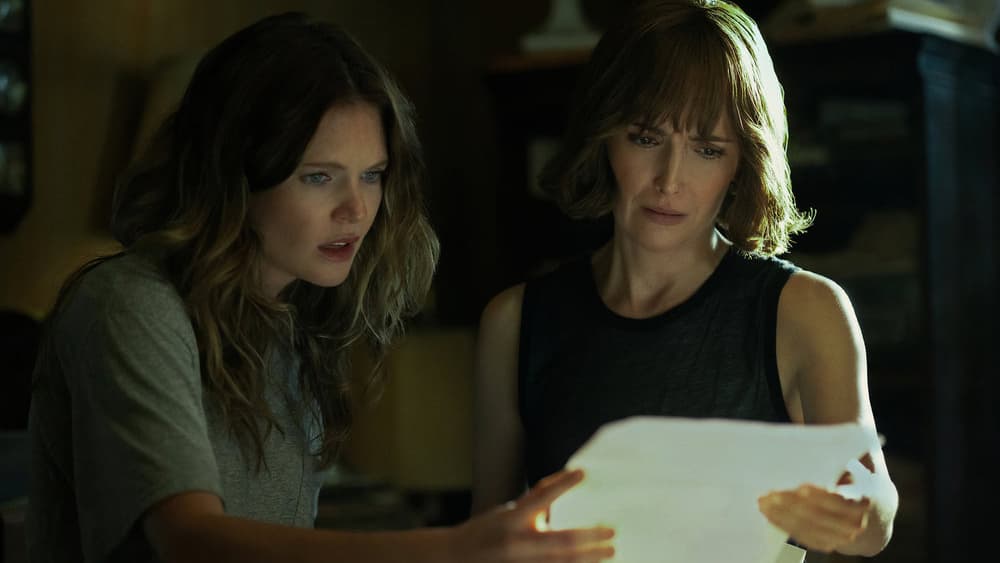
Warning: This post contains spoilers for The Good Daughter finale.Charlie Quinn (Meghann Fahy) is out the farmhouse door before the man on the lawn can reach the porch, her hair flying behind her, her voice barely above a whisper. What is he doing here, she wants to know. Mason “Huck” Huckabee (Jake McDorman) asks whether her sister is home. Her husband is, Charlie warns him. Huck says he is sorry about her father’s death. Behind the screen door, Samantha Quinn (Rose Byrne) has come close enough to hear him add that he has to speak with them both, and it’s important. Huck has been to this house before. The first time, he wore a mask, though Charlie doesn’t yet know that it was him behind that mask.This confrontation opens the finale of The Good Daughter, Peacock’s six-part limited series adapted by Karin Slaughter, who wrote every episode, from her 2017 novel. More than 20 years earlier, two masked men came into the Quinn kitchen in Pikeville, Georgia, looking for Rusty (Brendan Gleeson), a defense attorney who represented the people nobody else in town would. They found his wife, Gamma (Olivia Williams), and his daughters instead. They killed Gamma. Sam took a bullet to the head and was left for dead. Charlie, the younger sister, escaped after Zach Culpepper sexually assaulted her. Police arrested Zach, who went to prison, and they shot dead his brother, Daniel, whom they named as the second assailant. The Culpepper family has always insisted Daniel was innocent, and we learn in the finale that they were telling the truth.In the years that followed, the sisters grew up and then apart, Sam to patent law in New York, Charlie to a public defender’s desk in the town where it happened, until a fight in New York left them estranged. What draws them back together is a shooting at the local school that kills the principal, Doug Pinkman, and a young student named Emma. Kelly Wilson (Shayna Benardo), an intellectually disabled teenager who tends to tell people what they want to hear, is found with the gun in her hand, and Rusty takes her case. Huck teaches at the school, and Charlie had recently spent a night with him. Rusty dies quietly one night in Episode 4, before he can see the case through. By the finale, Sam has taken up Kelly’s defense, and Charlie has at last told her sister what Zach did to her in the woods.The finale, “What Really Happened,” solves both crimes within its first 40 minutes, and the culprits are the same as in Slaughter’s novel. The aftermath is where the series largely goes its own way, changing a prison sentence and letting the sisters find a vital piece of their past together. “I’ve written a lot of crime novels, and one thing I think is very important to readers and viewers as well is this: a feeling that justice has been done, and that there’s hope, and those are very important guiding lights to all my writing,” Slaughter tells TIME. In this finale, whatever justice and hope the sisters find comes only after they have told each other the truth.The second masked manMeghann Fahy as Charlie, Jake McDorman as Mason ‘Huck’ Huckabee Mark Hill/PEACOCKWithin minutes of the episode’s opening, Sam accuses Huck of an older crime: burning down the Quinns’ house more than 20 years ago, shortly before the masked men came. Back then, Huck’s sister, Annalie, had testified that a man raped her. Rusty was the man’s lawyer and, by Huck’s account, tore her apart on the stand. That same week, the family’s house went up in flames. “It was him,” Sam says. “He threw the Molotov cocktail.” Huck turns back with wet eyes. He says the fire was meant as a warning, but Rusty was back in court the next day. Annalie later died by suicide, and Huck, then 17, found her body. He blames Rusty for her death.Ben (Michael Dorman), Charlie’s estranged husband, who has worked as a prosecutor, comes through the door at a run and takes Huck to the ground. “You brought Zach here,” Ben says between blows. “He murdered their mother. He raped my wife.” It was a secret Charlie had kept even from him, and hearing it from him seemingly catches her off guard. “To see Ben ultimately in such fierce defense of her in that moment, I think that somewhere in her, that feels good,” Fahy says.The camera goes to Sam and holds. Byrne says she is playing an older sister’s sense of responsibility in that close-up, one that has grown heavier since the loss of both parents. “Being the eldest sibling is actually a lot of pressure, and I do feel like Sam carries that with her every waking moment of her day,” she says. The memory of that night arrives with the close-up: two hooded men in the doorway, Gamma still chatting, a young Sam who has seen them first. Gamma, as evenly as she can, offers the intruders the $50 in her purse and $200 more from a mason jar if they will only leave.Back in the present, Charlie makes a connection. “You called him brother,” she says. “I called everyone brother,” Huck says. For more than 20 years, that word pointed to Zach’s actual brother, Daniel, and Charlie will later say she is the reason he is dead. Ben has found the rest upstairs, a confession in Huck’s own hand: at 17, he had paid Zach $5,000 to kill Rusty on the night of the attack. Ben sneers that Huck lacked the nerve to do it himself and had to get a Culpepper.Huck’s defense comes out in pieces. He admits he was the second man in the mask all those years ago, but the girls were supposed to be at track practice that day. He says he stopped Zach, and a flashback to the woods shows him turning his gun on his partner as Sam tells her sister to run; it goes off, and the bullet strikes Sam in the head. He pulled Zach off Charlie, then ran six miles to call his parents, who would not let him turn himself in.Neither sister will hear it. Charlie says Zach chased her down like an animal. “He was the weapon that you loaded,” she says. Sam is colder; she tells Huck he should have hanged himself in the barn beside Annalie. Huck answers that he went to war, then came home to teach.Then Charlie goes quiet. “She feels very angry at Huck and very vulnerable because they hooked up at the beginning and she didn’t know, and I think that makes her feel sick,” Fahy says. Sam takes over the questioning, driven by what Byrne calls “her fury at this man who’s still sort of begging for forgiveness.” Huck now has both sisters against him, uniting them “on the same team in a way that we haven’t seen yet,” Fahy says.Slaughter gives Huck this much. “He was a very scared 17-year-old, and he did have a bad thing happen to him,” she says. “Now, it’s not a justification; it’s an explanation.” As for the lifetime of atonement he claims, she says viewers have only his word for it.The secret Rusty kept for a decadeBrendan Gleeson as Rusty, Rose Byrne as Sam Mark Hill/PEACOCKThe rest of what Huck has to say is about Rusty. Sam already knows about the payments, $2,000 a month to Zach’s son so that Zach would never name his accomplice. Huck explains that his parents set them up after the attack, in a bargain brokered by the old Sheriff Coin, whose family still runs the law in Pikeville. Huck heard of it 10 years ago from his dying mother, and after her death he came to the farmhouse to confess. Rusty did not call the police, because he would not blow up his daughters’ lives with new trials, appeals and lawsuits. He made Huck hand over the money and took over the payments himself, then sat him down at the kitchen table to write a confession to the attack, the same pages Ben found upstairs that morning. Asked whether Rusty forgave him, Huck says no: Rusty called him one of two men on Earth he never would.Rusty also told him why he held on to the confession. One day his daughters would have to decide whether to keep paying Zach’s family for Zach’s silence or give the confession to the police, and Rusty did not want the truth to reach them all at once. He put it in the words of an Emily Dickinson poem he and Gamma used to quote, and Sam finishes the line as her eyes fill with tears: the truth “must dazzle gradually.” “So it’s up to you now,” Huck says. “Both of you.” The scene cuts to squad-car lights pulsing blue in the dark. Huck is in handcuffs, arrested for now on a lesser charge: stealing the revolver used in the school shooting.Slaughter says Rusty learned the truth when his daughters weren’t speaking. She also points to Charlie, who said on the night of the attack that she didn’t want anyone to know what Zach did to her. “I know from talking to survivors of assault that what they feel the loss of most is that sense of safety, and that sense that when they say ‘no,’ that will be honored,” Slaughter says. “I think it was really hard for Rusty to honor that, but he did, because that’s what Charlie wanted.”Byrne says Sam finally understands how far her father went to protect Charlie. “I don’t know if she necessarily agreed, but I think he was between a rock and a hard place,” she says.The price of being the good daughterAudrey Grace Marshall as young Sam, Olivia Williams as Gamma Mark Hill/PEACOCKNothing in Huck’s written confession mentions that Zach assaulted Charlie in the woods. So in the kitchen, while Sam deals with the police, Charlie asks Ben how he knew. Ben says Rusty told him shortly before he died, and called his agreement to stay silent the hardest decision he ever made. Charlie won’t let that stand. “It wasn’t a decision. It was a promise,” she says. “It was my secret.” Ben’s answer is gentle. “You only keep secrets when you’re ashamed. And he was never ashamed of you,” he says.So Charlie tells him the rest. There was a miscarriage years ago, on a visit to Sam in New York, that she passed off as an infection. (She had three miscarriages in all.) She believes the assault is why she cannot carry a child to term, and she spent years punishing Ben for failing to guess. Ben asks whether a doctor ever told her so. None did. Then, to make her laugh, he lists his own humiliations, among them that he was the sole member of a Star Trek fan club, and tells her it doesn’t matter to him whether they can have children.“The truth came out, and it’s only when that happens that I think she’s able to realize what keeping the secret did to her and to the people that she loved,” Fahy says. Now Charlie tells the truth, and “everyone’s still there to love her.”Slaughter says the sisters had never really talked about what happened. “They’re hyper-articulate women, but they never say what they need to say,” she says.They say it on the porch steps, where they finally settle what to do about the attack. Charlie wants to leave it alone, and Sam shows her that leaving it alone will be enough. Once the checks stop, Zach will talk. Sam tells her it really is that simple, as long as Charlie is out of Pikeville. It may be the first decision about that night the sisters have made together, and Charlie suspects their father planned it that way. She thinks he sent Sam to the farmhouse to look for an old photograph of Gamma, knowing the search would lead both of them to the record of the payments, and, eventually, Huck’s written confession. Until this week, Charlie had entrusted the truth about the woods to almost no one besides her father and Judith Pinkman (Paula Malcomson), who took her in on the night of the attack and now teaches at the school. Judith, it turns out, has been keeping a secret of her own.A confession over a broken plateKovar McClure as Douglas Pinkman, Paula Malcomson as Judith Pinkman Mark Hill/PEACOCKThe break in the school shooting comes when Sam has Ben bring up the school’s security footage and enlarge the gun until they can make out two arms around it, both in dark sleeves, one showing a sliver of a light shirt. Charlie remembers running into Judith, Doug Pinkman’s widow and Kelly’s after-school tutor, at the dry cleaner two days after the shooting, collecting the light shirt she had on when the shots were fired. Charlie goes to her alone and after dark, her phone recording, while Sam and Ben listen from a car outside. She is about to accuse the woman who sheltered her after the assault. “It’s another heartbreak for Charlie because Judith was there on the night, the worst night of her life,” says Fahy. Judith pours tea and asks for help mending a decorative plate, her grandmother’s, which has broken in half. She runs the glue along the edge and tells Charlie to press the halves together, then lays her own hands over Charlie’s. “Good girl,” Judith tells her.The confession begins in the same even voice. Judith walked in on her husband, Doug, with Kelly in her classroom; Charlie supplies the legal term, statutory rape. When Kelly became pregnant, Doug called it God’s will and informed his wife that they would raise the baby and she would give up teaching. “Little by little, he just erased me,” Judith says. Slaughter says the betrayal went beyond the marriage itself, to Judith’s belief in “this system of marriage.” So Judith “trickled poison” into Kelly’s ear, convincing her that Doug meant to force her to end the pregnancy. On the day of the shooting, Kelly brought her father’s revolver to school and froze. “I stood behind her,” Judith says. “I wrapped my finger around hers, and I pulled the trigger.” Emma died when the two struggled over the weapon. Judith had planned to kill Kelly as well and step forward as the widow who stopped a shooter. “But I ran out of bullets,” she explains. Three times in The Good Daughter, Judith’s hands close over a younger pair. On the night of the attack, she held young Charlie’s hands under a faucet. At the school days earlier, she closed her own around Kelly’s on the gun. Now, at her kitchen table, she steadies Charlie’s on the plate. “Something is broken, and we’re going to put it back together,” Slaughter says of the mending. Sometimes, she adds, people don’t heal.Judith knows she is being recorded on Charlie’s phone. When she has said enough, she loads a gun. Then she takes the phone and dictates a statement: she killed Douglas and Emma, and Kelly is innocent. Charlie pleads with her to keep talking. “This is my decision,” Judith says. She orders Charlie out. The door shuts between them. A shot sounds from inside, out of frame; Judith has turned the gun on herself. On the porch, Charlie collapses, stunned, and Ben reaches her. Sam and Charlie have started making their decisions together, but Judith makes hers alone, and it is final.Five years for Kelly WilsonRose Byrne as Sam Quinn, Shayna Benardo as Kelly Wilson Mark Hill/PEACOCKMorning comes up over Pikeville in violet and pink, and Sam goes to the courthouse to make a deal for Kelly. Two Coins are waiting for her: District Attorney Ken Coin and the current Sheriff Coin. The district attorney concedes that Judith’s confession takes the death penalty off the table and calls any further leniency “gravy.” Sam starts listing what their offices got wrong with the case. No one tested Judith’s hands for gunshot residue or took her shirt into evidence. Huck, who had talked Kelly into handing over the revolver, walked out of the school with it, and no one stopped him. Their deputy chief assaulted her sister in the school hallway. A school resource officer failed to notice a principal abusing a disabled student. Then she wonders aloud what she might find if she looked into the night Daniel died. It was a Coin, Keith, who shot Daniel, and the sisters have come to suspect the old sheriff planted the gun that made him look guilty. The Coins’ answer is to call her “honey” and remind her that her father loved this town. “My Daddy would tell you, fellas, that you’ve got two choices,” Sam says. “You can sign off on five years for Kelly Wilson or you can sh-t in both hands and start clapping.”The line could have come out of Rusty’s mouth. Byrne says the case teaches Sam what she once held against her father: his “empathy for people, for all kinds of people, for the worst kinds of people.”Five years is half of what Kelly receives in Slaughter’s novel, where she accepts a 10-year plea. The character has real-world roots: Kelly is loosely based on Jessie Misskelley Jr., one of the West Memphis Three, the Arkansas teenagers convicted of murder in 1994 and released in 2011 under plea deals. Misskelley, whose IQ was reported as 72, gave police a confession he quickly recanted. Slaughter studied what she calls his false confession while writing Kelly. “There’s a difference between reading something and seeing something,” says Slaughter, adding, “When you see her, 10 years seems like it’s too much, but five years seems fair.”Kelly is less certain. Sam tells her that with good behavior she could be out before her baby starts school, and insists that the choice be hers. Kelly says “it seems like I ought to be punished.” “Does it seem fair to you?” she asks. Sam says it does, and smiles faintly as Kelly signs. Byrne doesn’t think Sam is as sure as she sounds. “It’s so tied into her own trauma and what she went through,” Byrne says. Sam “feels compromised by it,” even if it is the “best version of what she can get for her in that moment,” she adds. Kelly was used by two adults, and she is still the one going to prison. Slaughter hopes viewers ask “what does justice look like for them,” rather than what they would have done in the characters’ place. For Kelly, it looks like five years in prison and, for once, a decision no adult made for her.The photograph Rusty hidMark Hill/PEACOCK Charlie and SamKelly’s sentence is settled. What’s left of the episode belongs to the Quinns. Ben has job interviews lined up at Atlanta law firms, courtesy of Sam, and a question for Charlie: is she still his wife? “Yes,” she says. “Are you still my husband?” He is.At Rusty’s farmhouse, the sisters and Lenore (Harper Steele), his longtime secretary, read through a box of his letters, including one meant for Gamma, with Charlie pulling faces at the intimate prose. Lenore remembers when one of them was written, because she had to bail Rusty out of jail. Charlie is moving to Atlanta with Ben, and she makes Sam an offer: When Sam is ready, she would like to hear more about Anton, the late partner Sam only recently told her about.Slaughter did not want the moment to be purely sentimental. “It’s not some false candy-cane sort of get-together,” she says. “It’s giving each other a lot of crap and sitting around the table and bad-mouthing their parents.” The actors felt the ease in it. “It’s like the roadblocks were removed, and finally they could just see each other,” Fahy says. Byrne puts the change down to the truth Sam has finally been told. “She can finally understand what her sister has gone through, and it just shifts everything,” she says. “It’s like a tectonic kind of shift.”They still haven’t found the photograph they’ve been looking for. Earlier in the season, Rusty told Sam about a picture of Gamma from their first date, a picnic because he couldn’t afford a restaurant, on a day when his heart felt like a kite and she was reeling in the string. He promised that Charlie would know where to find it. In the novel, Charlie comes across it only after Sam has gone back to New York, and emails the image to her. Here, they discover the photo at the same time, in the same place. “I felt it was important for them to find it together because the whole point of the emotional arc of the story is the sisters are separated and then they come back together,” Slaughter says.By now, Charlie suspects there is no photograph, only a ruse to make them search the house as a pair. If the picture exists, she reasons, he left it in the open, like the rest of his secrets. “We need to stop thinking like he was Sherlock Holmes when he was barely Inspector Gadget,” she says. Then she asks why Sam has been carrying a framed photo of their mother in her purse. Rusty had asked her to bring it to the hospital. Sam turns the frame over and peels away the tape. Behind the first picture is the second. “I had forgotten how beautiful she was,” Sam says. “They were beautiful together,” Charlie says. Under the photograph is an envelope marked “Last word,” the sisters’ childhood way of claiming the end of an argument. Charlie says their father finally figured out how to use it.As Sarah McLachlan’s “Long Road Home” rises, a love song about taking the long way back, a childhood memory swims into focus: tall grass, two girls lying beside their mother. Young Sam’s arm settles around young Charlie, and the camera climbs from the arm to their faces. Almost always, The Good Daughter has looked through one sister’s eyes at a time. This memory belongs to both. Then the frame widens on the grown sisters, still talking, the green country quiet around them.The sisters take very different roads to that photograph. Charlie stayed in Pikeville, and spent more than 20 years avoiding what happened to her there. Fahy hopes viewers take something from watching her finally reckon with it. “When you face the things about yourself and about your past that hold you back, you open yourself up to the life that you want,” she says. Sam left for New York and stayed away. Asked what playing the character taught her, Byrne, who is Australian, points to the return. “I left Sydney, and I can relate to that,” she says. To her, “leaving your home and returning” is a tale “as old as time.”It took both sisters to find the picture. Sam had it all along, sealed in a frame she carried to her father’s hospital bed and never thought to open, and it was Charlie, who thinks the way Rusty did, who knew to ask. Their father could not make his daughters tell each other the truth while he lived, but he could leave behind a confession that required them both to decide, and he could hide his happiest day where it would take them both to find. The finale that began on the farmhouse lawn, with a man telling the sisters what really happened on the worst night of their lives, ends at the same house with a snapshot taken before they were born, on a day no one in a mask ever touched, or ever could. For decades, Sam and Charlie kept separate accounts of what happened to them. They finish The Good Daughter side by side, two daughters with one photograph between them, agreeing at last on what they see.
Breaking Down the Hard-Won Ending of The Good Daughter
Full Article
Original Source
Read the full article at Time →KhanList aggregates and links to publicly available news content. We do not host full articles from third-party sources. Always verify important information with original sources.