
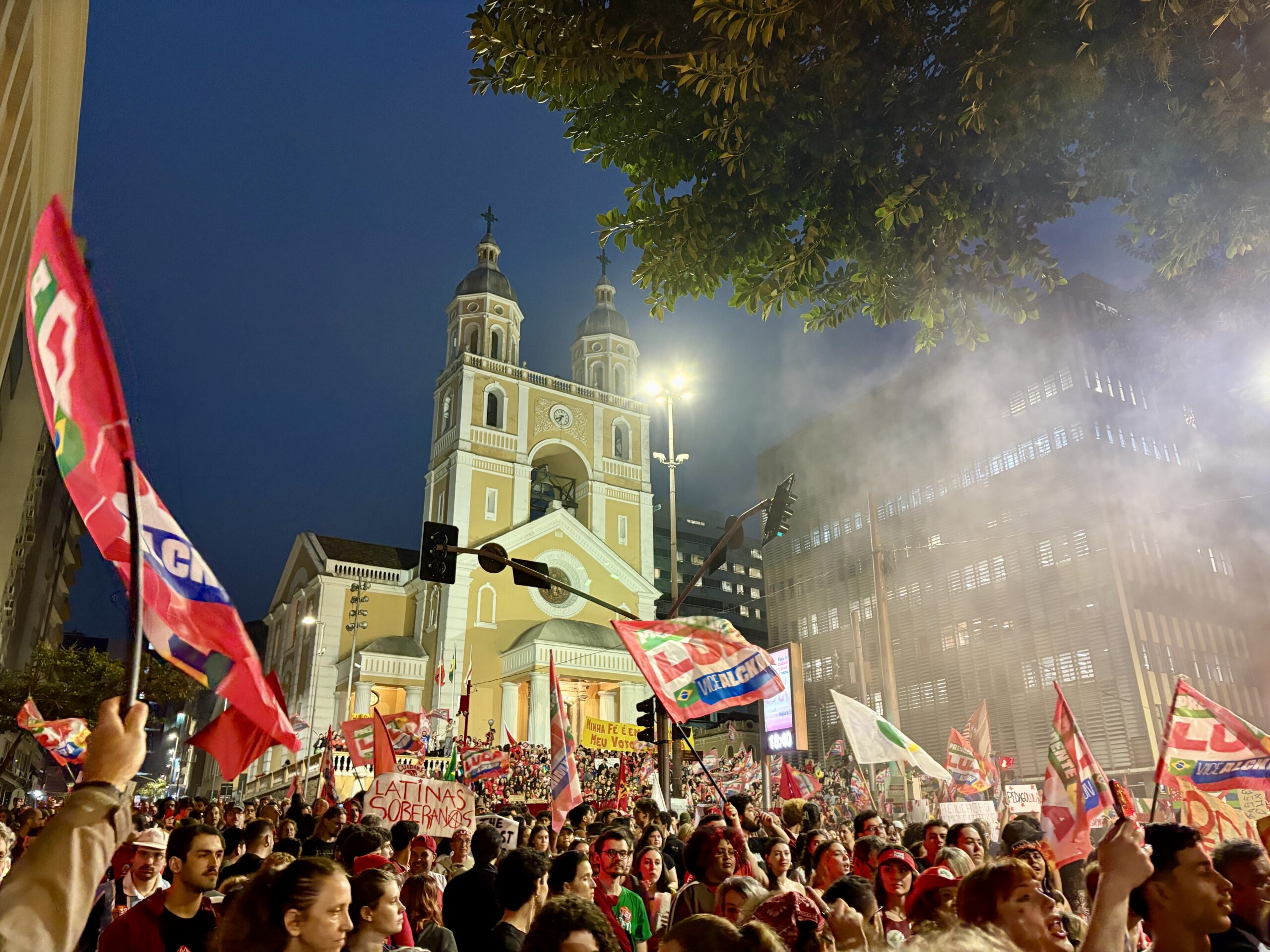
FLORIANÓPOLIS, Brazil (CN) — Supporters of President Luiz Inácio Lula da Silva marched through this Brazilian coastal city on Tuesday evening, urging voters to reelect him.All that in a state where Flávio Bolsonaro won 66.65% of valid votes in the first round, compared to Lula’s 25.04%.This rally in Santa Catarina’s capital was part of a wave of demonstrations across Brazilian cities since Oct. 9 aimed at reversing the first-round outcome.Lula received 45.16% of valid votes on Oct. 4, less than Bolsonaro’s 47.03% and below the over-50% threshold necessary to avoid a second round of voting. He’s now counting on supporters’ mobilization to win the Oct. 25 runoff.A poll released Thursday by Datafolha, one of Brazil’s leading polling firms, has Bolsonaro at 51% of projected valid votes and Lula at 49% — a statistical tie within the survey’s margin of error of 2 percentage points. A week earlier, the candidates stood at 52% and 48%, respectively.On Wednesday, Bolsonaro called on supporters to gather on São Paulo’s Paulista Avenue on Oct. 18. He described the rally as the “final push for victory.”Maria do Socorro Sousa Braga, a political science professor at the Federal University of São Carlos, said the first round showed that both candidates have strong support but face challenges in winning over new voters.Bolsonaro has mobilized support for the political movement led by his father, former President Jair Bolsonaro, even though the former president is not on the ballot, Braga said. Lula retained his strength in the northeast and among lower-income voters but struggled to win over the urban middle class, she added.Bolsonaro needs to win over women who reject him, while Lula must broaden his support among evangelical Christians and get lower-income voters who sat out the first round to turn out, she said.“In such a close and polarized race, victory will be determined by strategic groups that serve as the true guarantors of the election,” Braga said. Those who supported candidates eliminated in the first round and informal workers could also decide the outcome, she added.João Ricardo Matta, a professor of strategy and market intelligence at Fundação Getulio Vargas, said Bolsonaro has built alliances since the first round — winning endorsements from party leaders, former President Michel Temer and state governors.“For Bolsonaro, the big change was breaking out of isolation,” he said.Lula has brought governors from the northeast into his campaign leadership and focused on issues affecting workers’ daily lives. That includes a constitutional amendment to end the six-day workweek and guarantee two days off per week.Brazil’s Senate approved the amendment Wednesday, and Congress formally enacted it Friday. Bolsonaro, who had criticized it, voted in favor.Matta said Lula’s campaign is trying to link Bolsonaro’s plans to cut spending to cuts in social programs. Bolsonaro needs to counter that argument and reassure voters who associate his family name with institutional instability, he added.Lula supporters have also organized online through “Lula’s Army,” a WhatsApp channel created by Congressman André Janones to share campaign content and mobilize voters. By Friday, it had 4.7 million subscribers, compared to just 1.9 million for “Flávio’s Troops,” a channel linked to Bolsonaro’s campaign and led by Congressman Nikolas Ferreira.At this stage, social media primarily serves to mobilize supporters and encourage turnout, Matta said.“Follower counts are not votes,” he said.Supporters of President Luiz Inácio Lula da Silva fill Paulista Avenue in São Paulo during a campaign rally on Oct. 11, 2026. (Ricardo Stuckert/Campanha Luiz Inácio Lula da Silva via Courthouse News)The online campaign has also led to legal battles before the Superior Electoral Court.On Oct. 11, the court’s president, Kassio Nunes Marques, ordered the suspension of “Lula’s Army” at the request of Bolsonaro’s campaign, which accused the channel of spreading disinformation.The order and subsequent reversals exposed divisions within the court over the limits of judicial intervention in campaigns.Vânia Siciliano Aieta, an election lawyer and professor at Rio de Janeiro State University, said “the suspension amounted to prior censorship, and its reversal merely corrected an error that should never have occurred.”The court’s internal divisions could undermine public confidence in its impartiality, Aieta said. Unlike in 2022, when its members were more united, the court is going into this election with deep divisions and its authority under challenge, she said.Lula’s campaign filed a petition with the electoral court seeking equal treatment, arguing that “Flávio’s Troops” had not faced the same restriction.The campaign also filed a complaint with the court against Meta, the owner of Instagram, Facebook and WhatsApp, accusing the company of restricting the reach of its posts and favoring Bolsonaro.On Friday, Brazilian newspaper Folha de S.Paulo reported that Meta employees acknowledged in internal messages that Lula’s posts faced restrictions on paid promotion, while Bolsonaro’s profiles and channels received improper recommendations.The messages contained no admission of deliberate interference, the newspaper said. Meta attributed the incidents to technical failures and enforcement of electoral rules and denied favoring any candidate.“At the heart of this controversy is who has the power to define what constitutes a ‘technical failure’ and whether courts have the technical capacity to verify that definition,” Aieta said.An analysis of public electoral court records by the Sivis Institute, a Brazilian think tank focused on democracy and freedom of expression, identified 334 cases between the Lula and Bolsonaro campaigns before the Superior Electoral Court from Aug. 16 through Oct. 4.By the first round, 82 had rulings on their requests, including preliminary injunctions; the remaining 252, about 75%, did not. More than half sought a right of reply. Another 133 cases have been filed since Oct. 5, the institute said.The volume of content makes manual review impossible and complicates real-time oversight, Aieta said. The court must curb abuses without restricting political criticism or lawful voter mobilization.“The electoral court faces the challenge of balancing two forces that frequently come into tension: freedom of political debate and equal conditions for the candidates,” she said.Courthouse News reporter Marília Marasciulo is based in Brazil.Subscribe to our free newslettersOur weekly newsletter Closing Arguments offers the latest about ongoing trials, major litigation and rulings in courthouses around the U.S. and the world, while the monthly Under the Lights dishes the legal dirt from Hollywood, sports, Big Tech and the arts.Additional Reads
Brazil’s presidential rivals rally voters as runoff tightens
Full Article
Original Source
Read the full article at Courthousenews →KhanList aggregates and links to publicly available news content. We do not host full articles from third-party sources. Always verify important information with original sources.