
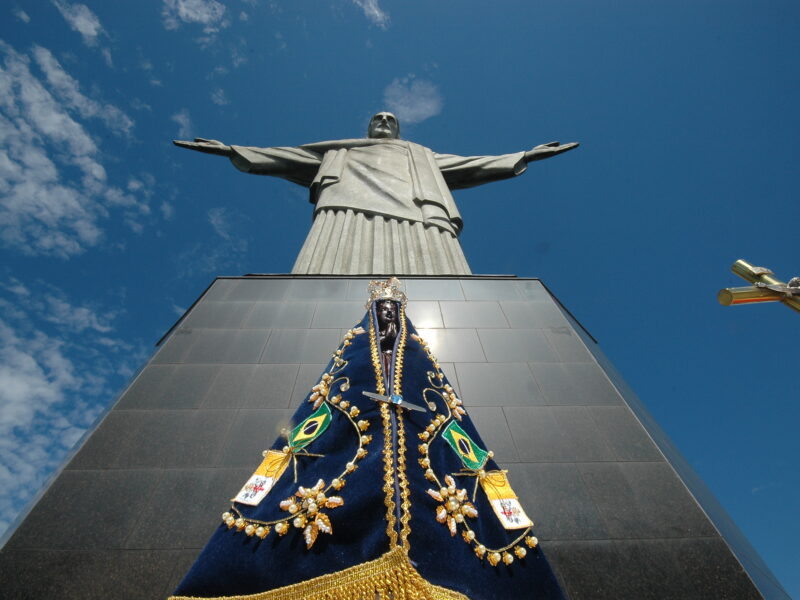
Posts linking Flávio Bolsonaro to removing Our Lady of Aparecida’s title have prompted conflicting rulings as presidential campaigns compete for religious voters.RIO DE JANEIRO (CN) — A dispute over Our Lady of Aparecida, Brazil’s patron saint, has drawn in presidential campaigns ahead of the Oct. 4 first-round election and prompted conflicting rulings from the country’s highest courts.The Superior Electoral Court began voting online Wednesday on orders to remove social media posts suggesting that Flávio Bolsonaro intends to strip the saint of her title. There is no record of Bolsonaro making this proposal. Voting is scheduled to end at 11:59 p.m. Brazil time.Supreme Court Justice André Mendonça, who also serves on the electoral court, voted first, supporting the removal orders and saying they “do not constitute prior censorship."Also Wednesday, Supreme Court Justice Flávio Dino ordered the Federal Police to investigate attacks on religious images.Our Lady of Aparecida is a dark-skinned depiction of the Virgin Mary. She became Brazil’s patron saint in 1930, and a 1980 federal law made her feast day, Oct. 12, a national holiday.João Ricardo Matta, a professor of strategy and market intelligence at Fundação Getulio Vargas, said her cultural and emotional significance extends beyond practicing Catholics. Manyevangelicals grew up in Catholic families and still feel attached to her.Catholics and evangelicals do not vote as unified blocs, he said, “but the margins are so tight that if undecided Catholic voters are unhappy with a candidate’s position, a shift of just one or two percentage points could decide an election.”At a rally in Fortaleza on Tuesday, President Luiz Inácio Lula da Silva said Aparecida would remain Brazil’s patron saint while he was in office. “As long as I am president of the republic, Our Lady of Aparecida will be Brazil’s patron saint,” he said. “Anyone who doesn’t like it should leave Brazil.”A bill introduced in 2007 by a lawmaker who later worked in the government of Jair Bolsonaro, the candidate’s father, proposed changing her designation from Brazil’s patron saint to the patron saint of Brazilian Roman Catholics. The lower house of Congress shelved the bill in 2008.In August, Flávio Bolsonaro said one of his first acts if elected would be to “decree that Brazil belongs to the Lord Jesus Christ.”On Sept. 24, comedian Antonio Tabet posted an image of the saint on X with the caption: “The militia-linked family hates Black women so much that it decided to attack Our Lady of Aparecida.”Bolsonaro’s campaign challenged the post before the Superior Electoral Court, arguing that it repeated false information. The campaign said it had identified more than 2,000 related posts totaling over 21 million views.Mendonça ordered the post removed the next day and later extended the order to other posts. He was acting as an electoral judge overseeing campaign advertising.On Sunday, Dino granted Tabet’s request and overturned the removal orders. Dino noted that the post did not name Bolsonaro and questioned whether there was sufficient certainty that it was unlawful.Bolsonaro’s campaign then turned to another Supreme Court justice, Luiz Fux, who suspended Dino’s ruling and reinstated the electoral court’s orders late Monday. Fux said he was addressing how the case reached the Supreme Court rather than deciding whether the post was lawful.Both justices asked the full Supreme Court to review their rulings, but Chief Justice Edson Fachin left the case off Wednesday’s agenda.Wallace Corbo, a constitutional law professor at Rio de Janeiro State University, said the electoral court’s specialized jurisdiction does not prevent the Supreme Court from reviewing its decisions when they involve constitutional questions.The difficulty, he said, lies in distinguishing political criticism from false information.“What those expressing that view see as criticism of the candidate’s political base, criticism of the candidate himself, was read by the electoral court as a literal statement of fact. And removing this content also ends up interfering with political debate,” he said.Matta said Bolsonaro’s campaign faced a dilemma: Allowing the posts to circulate could cost votes, while going to court could turn a social media controversy into a Supreme Court dispute.“It’s a classic case of the Streisand effect. You try to suppress a subject and end up amplifying it,” he said.Courthouse News reporter Marília Marasciulo is based in Brazil.Subscribe to our free newslettersOur weekly newsletter Closing Arguments offers the latest about ongoing trials, major litigation and rulings in courthouses around the U.S. and the world, while the monthly Under the Lights dishes the legal dirt from Hollywood, sports, Big Tech and the arts.Additional Reads
Brazil’s patron saint becomes an election issue and a court dispute
Full Article
Original Source
Read the full article at Courthousenews →KhanList aggregates and links to publicly available news content. We do not host full articles from third-party sources. Always verify important information with original sources.