
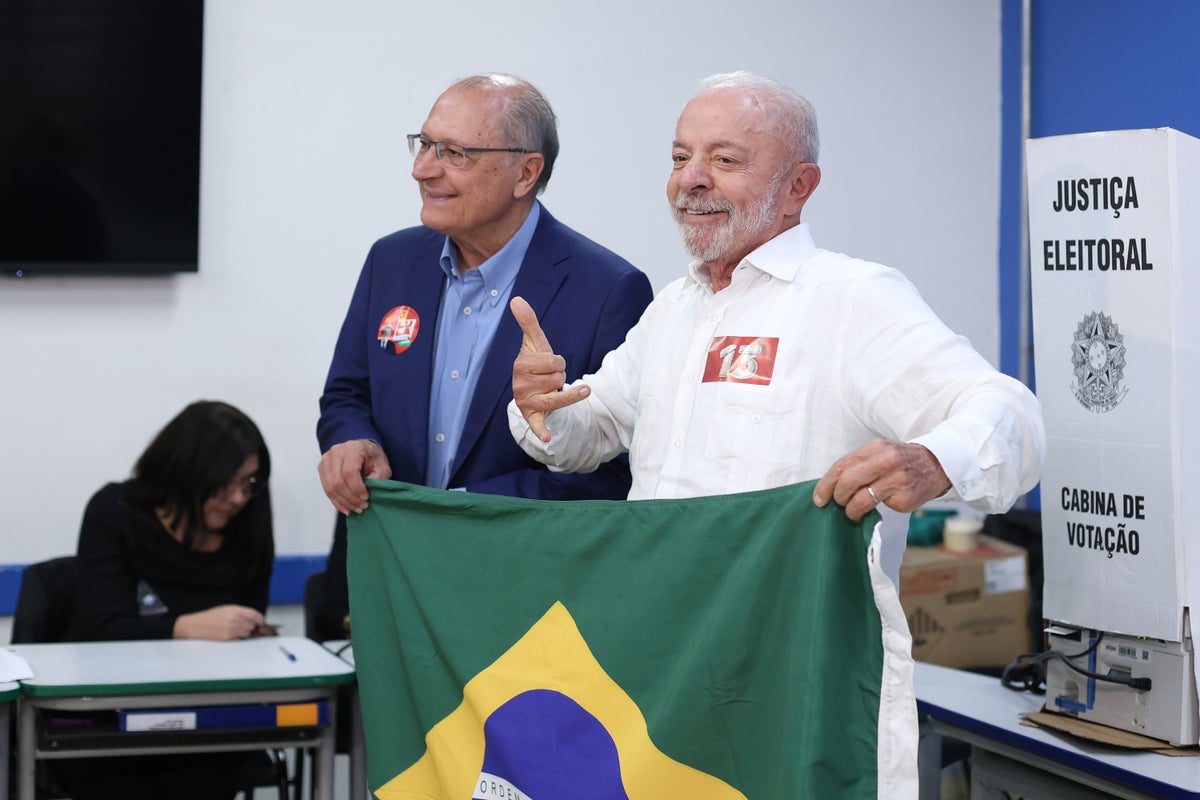
Voting got underway across Brazil on Sunday in a deeply divided presidential runoff between incumbent President Luiz Inácio Lula da Silva and Flávio Bolsonaro, a contest set to decide whether the U.S. will substantially broaden its footprint in Latin America.Pre-election surveys showed a tight race between the candidates, each needing over 50% of the vote to secure leadership of Brazil in January. The ballot contrasts Lula, a veteran left-of-center figure, with Bolsonaro, an ally of U.S. President Donald Trump and the son of imprisoned former President Jair Bolsonaro.Flávio Bolsonaro finished ahead of Lula by upwards of 2.2 million votes during the initial round earlier this month. Even so, more than 33 million of the nearly 160 million eligible citizens abstained, despite voting being mandatory.A sharp ideological divide separates the contenders. Lula and Bolsonaro hold opposing views across a range of issues, including social welfare initiatives, climate change, and U.S.-Brazil relations.Victory for Bolsonaro would mark a rightward pivot for Latin America's largest economy and most populous country, capping a year in which Trump allies secured electoral victories in Chile, Peru, and Colombia.Conversely, a Lula victory would ensure that both Brazil and Mexico, the region's second most populous nation led by President Claudia Sheinbaum, remain governed by left-of-center figures.In many respects, the runoff represents a repeat battle between Brazil's deeply divided political camps, which evoke both fierce devotion and intense hostility. Four years ago, Lula defeated Bolsonaro’s father by the smallest margin since the restoration of democracy in 1985, and polling suggests an even tighter finish this time.Voters wait in line before polls open in Brazil (Getty)Security and cost-of-living concerns Lula, who previously served as president from 2003 to 2010, has navigated a difficult reelection fight centered on public anxiety over security and living expenses. Bolsonaro positioned a hardline stance on crime at the heart of his platform while promising to reduce food costs.Both contenders have been dogged by corruption allegations tied to family members and allies, with Bolsonaro caught up in a major scandal currently sweeping the country. Lula spent over a year behind bars on corruption charges that were ultimately annulled.Shadows have been cast over Bolsonaro's campaign following his admission that he received roughly $12 million from disgraced former banker Daniel Vorcaro to create a film about his father's life. Authorities are investigating him for tax evasion, money laundering, and corruption related to the funds.When Bolsonaro arrived to vote at a Rio de Janeiro school around 8 a.m., his supporters shouted "Lula, thief, your place is in prison" while backing crowds for Lula responded with opposing chants."The time of real change has arrived," Bolsonaro told journalists. "Brazil can’t go on another four years on its current trajectory."Fabianne Borges Santoro, a 45-year-old physiotherapist living in Rio de Janeiro, formerly voted for Lula’s party but now views it as linked to corruption."The Workers’ Party has been in power for a long time and the voice of the people is saying that we need change to see improvements in security and the cost of living," she said.Leading up to election day, Lula repeatedly depicted Bolsonaro—whose father is under house arrest following an attempted coup—as a danger to democratic rule. Bolsonaro has promised to push for an amnesty for his father if he wins.Pending retirements mean the incoming president will appoint at least three of the 11 Supreme Court justices during his term. Bolsonaro has frequently criticized the high court—which faces its own corruption scandal—and vowed to deliver judicial reform.In a bid to win over undecided voters following his first-round defeat, Lula rolled out expensive policy incentives. His administration recently backed a small-business debt relief initiative and pledged free public transport on weekends. The incumbent also secured a boost when the Senate passed a popular government-supported measure to eliminate the six-day working week.Speaking after voting in Sao Bernardo do Campo—the city where he launched his political journey as a labor leader in the 1960s—Lula expressed appreciation for the wave of support he received in the final days of the race."It is a lot of generosity, a lot of care, a lot of love. I will be forever grateful," Lula said."Lula is a man of the people and he knows what it’s like to be poor," said Luzia da Souza, who runs a bar in a middle-class neighborhood of Rio de Janeiro. "I find it impossible not to vote for him."The Trump administration has loomed large Prior to the election, Lula raised concerns regarding potential U.S. interference in domestic politics after the Trump administration levied steep tariffs on Brazilian exports, penalized the Supreme Court justice who oversaw the case leading to Jair Bolsonaro's sentencing, and designated drug cartels as foreign terrorist organizations—a move analysts suggest was calculated to make Lula appear weak on crime.Flávio Bolsonaro has highlighted his close connection to the White House, arguing that Brazil must negotiate more advantageous agreements with the Trump administration, particularly regarding the rare earth minerals sector. Brazil holds an estimated 21 million tons of these reserves, ranking behind only China. He rejects claims that he is receiving assistance from the U.S. government.Balloting across Brazil is carried out electronically, with final outcomes typically available within hours after polling locations close at 5 p.m. in Brasilia.
Brazilians head to the polls to vote in tense Lula vs Bolsonaro runoff election
Full Article
Original Source
Read the full article at Independent →KhanList aggregates and links to publicly available news content. We do not host full articles from third-party sources. Always verify important information with original sources.