
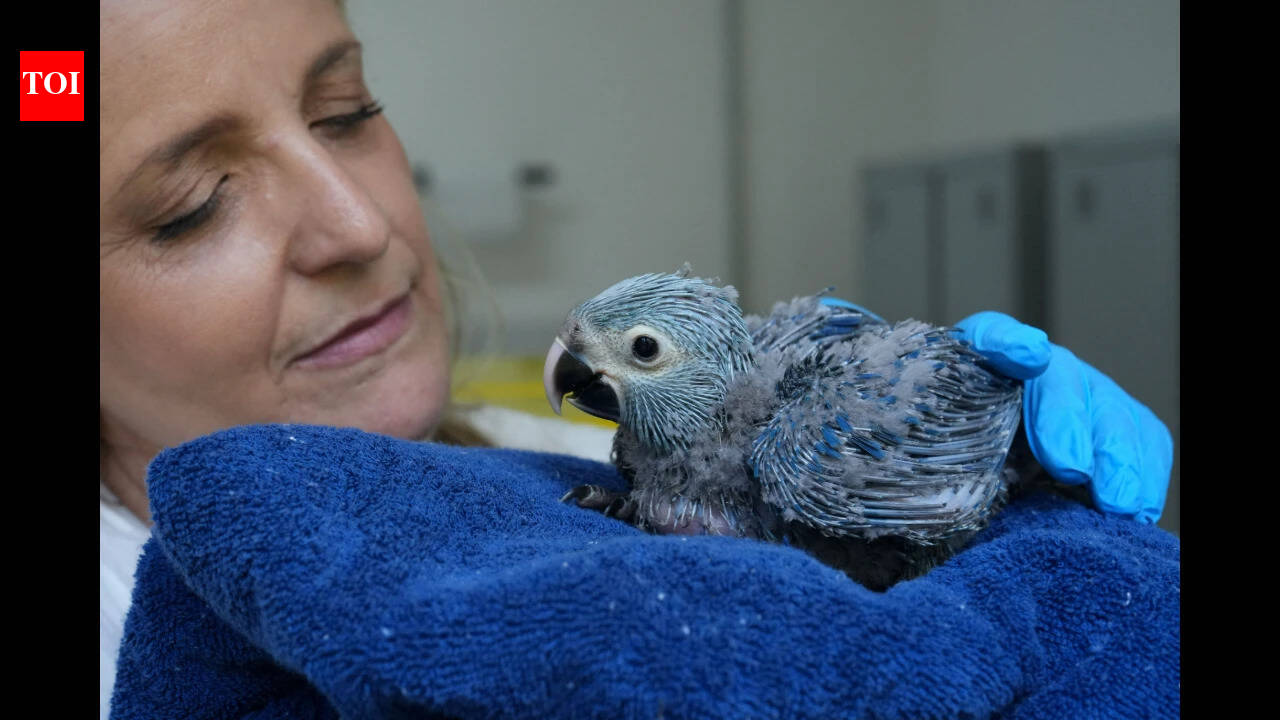
Sao Paulo Zoo's biologist Fernanda Guida shows a newborn Spix's macaw, the "little blue macaw", named Hope and considered extinct in the wild, in Sao Paulo, Brazil, November 24, 2026. REUTERS/Alexandre MeneghiniA rare blue parrot that disappeared from the wild around 2000 has reached a small but meaningful milestone in Brazil. The São Paulo Zoo has announced the first Spix’s macaw chick born in a Brazilian zoo, a female named Hope, who weighed just 12.4 grams when she emerged after an assisted hatch. The announcement, made on 24 November, has been described by Brazil’s environment authorities as an important advance in the effort to secure the future of one of the world’s most endangered birds.Known in Brazil as the ararinha-azul, the Spix’s macaw was once native to the Caatinga region of northeastern Brazil, particularly around Curaçá in Bahia. Decades of habitat loss and trapping for the illegal pet trade pushed the species towards extinction. By the early 2000s, it had vanished from its natural range, and the International Union for Conservation of Nature now classifies it as extinct in the wild.Hope’s birth is therefore more than a heartwarming zoo story. It represents the first time a Spix’s macaw has hatched in a Brazilian zoo, and it offers evidence that the country’s conservation programme can produce results through careful breeding, veterinary care and genetic management. The chick was born on 18 October after a tense 28-day artificial incubation process, as per details shared by Brazil's Ministry of the Environment and a report by Reuters. Read more about this incident here:A difficult beginningHope’s arrival did not come easily. Zoo specialists removed her egg for close monitoring and eventually intervened because the chick was badly positioned inside the shell and had reached the limit of the incubation period. Fernanda Guida, head biologist at the zoo’s bird division, said the team had to help remove her from the egg before she could finally hatch.Since then, Hope has received assisted feeding and remains under constant observation by the zoo’s technical team. At such a small size, a newly hatched parrot is extremely vulnerable, and the first days and weeks of life require precise control of temperature, nutrition and hygiene. The zoo has described the birth as the result of detailed work by staff who study the birds’ behaviour and reproductive needs.The name Hope was chosen deliberately. “We chose ‘Hope’ because we hope we can give a better future to this species,” Guida told Reuters. For the team at São Paulo Zoo, the chick is both a fragile new life and a symbol of what sustained conservation work can achieve.A growing sanctuarySao Paulo Zoo's biologist Fernanda Guida shows a newborn Spix's macaw, the "little blue macaw", named Hope and considered extinct in the wild, in Sao Paulo, Brazil, November 24, 2026. REUTERS/Alexandre MeneghiniThe São Paulo Zoo became part of Brazil’s national effort to protect the species in August 2023, when it received 27 Spix’s macaws from a breeding facility in Minas Gerais that had left the national conservation action plan. The transfer was requested by Cemave, the national centre for research and conservation of wild birds, which is linked to Brazil’s federal conservation agency, ICMBio.What began as a temporary arrangement evolved into a long-term commitment. The zoo built a dedicated Centre for the Conservation of the Spix’s Macaw, inaugurated in May 2024 after an investment of approximately R$5 million. The facility covers 900 square metres and can house up to 44 birds, with indoor and outdoor enclosures, incubation rooms, a temperature-controlled maternity area, veterinary facilities and food preparation spaces.With Hope’s birth, the zoo’s population has risen to 28 Spix’s macaws. That represents roughly 8.5 percent of the estimated 330 individuals currently living under human care worldwide. While the number may sound small, every healthy chick matters in a species with no confirmed wild population and a limited genetic pool.Why the species vanishedThe Spix’s macaw’s decline was not caused by one single event. It was the result of years of pressure on both the birds and the landscape they depended on. Deforestation reduced the Caatinga habitat, while trapping for the exotic pet trade removed birds from the wild faster than they could reproduce.The species became internationally recognisable after inspiring Blu, the main character in the 2011 animated film Rio. That attention helped many people learn about the parrot’s plight, but it came long after the species had already suffered severe losses in its native range.Today, the survival of the Spix’s macaw depends almost entirely on managed populations. Conservationists must maintain healthy birds, avoid inbreeding, understand breeding behaviour and prepare for the possibility of returning animals to suitable habitat in the future. Hope’s successful hatch adds one more individual to that fragile safety net.A pause, then renewed focusSao Paulo Zoo's biologist Fernanda Guida shows a newborn Spix's macaw, the "little blue macaw", named Hope and considered extinct in the wild, in Sao Paulo, Brazil, November 24, 2026. REUTERS/Alexandre MeneghiniThe road ahead remains complicated. ICMBio said that circovirus among previously reintroduced Spix’s macaws led the agency to intervene in the reintroduction programme and temporarily pause efforts to release birds back into the wild. In response, the focus has shifted towards strengthening breeding and conservation work within Brazil.Marcelo Marcelino, director of research, assessment and biodiversity monitoring at ICMBio, said the birth marks a new milestone for the Spix’s Macaw Reintroduction Programme. He stressed that the challenge cannot be solved by one institution alone and highlighted the importance of partnerships with universities, research institutes, zoos and local communities, including people in Curaçá.That local connection is important. The species’ original home is not simply a location on a map, but a living landscape with communities, ecological conditions and cultural history. Any future return to the wild will require not only healthy birds but also secure habitat, disease management and long-term support from the people who share that region.A sign of what is possibleBrazil’s Minister of the Environment and Climate Change, João Paulo Capobianco, said the birth demonstrates the value of public policy built through collaboration among universities, research institutes and the state zoo. He argued that science, national and international partnerships, and sustained institutional effort can help move species away from the edge of extinction.Hope is still a chick, and her future is not guaranteed. But her birth gives conservationists a practical reason for optimism. It shows that the São Paulo Zoo’s specialised facility can support reproduction, that assisted hatching can succeed when a chick is in danger, and that Brazil can play a central role in the species’ recovery.For a bird that has not lived freely in the wild for more than two decades, one 12.4-gram chick cannot restore a population on its own. Yet it can strengthen the foundation on which recovery is built. Hope’s arrival is a reminder that extinction is not always immediate, and that careful, patient work can keep a future open for even the most imperilled species.
Brazilian zoo celebrates first Spix's macaw chick after rare parrot vanished from the wild
Full Article
Original Source
Read the full article at Timesofindia →KhanList aggregates and links to publicly available news content. We do not host full articles from third-party sources. Always verify important information with original sources.