
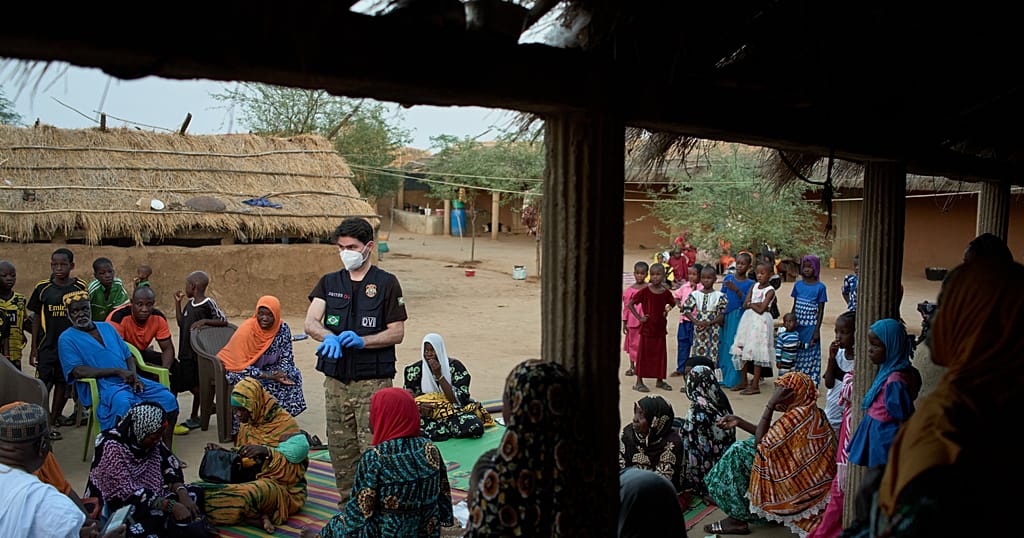
They call them ‘ghost ships’, boats that wash ashore in Latin America and the Caribbean after being swept off course while trying to reach Spain’s Canary Islands off the West Coast of Africa. At least a dozen such vessels have arrived in recent years. Brazilian criminal forensic scientist, Alexandre Deitos, studied a shaky video taken by a fisherman as it panned across the small boat stuck in a sandbank. He sighed. Inside the craft were eight decomposing bodies and a ninth was floating nearby. This latest discovery gave him the grim and difficult task of trying to determine who the people were so their families could be informed. His first mystery would be fairly easy to solve. In analysing the contents of the boat, which included 28 mobile phones and two IDs, Deitos and his colleagues surmised the boat had originated in West Africa carrying migrants to Europe. Something had gone wrong, and the open 13-metre fishing boat had then drifted hopelessly for weeks across the Atlantic. The next part would be harder. Putting names to the bodies. He ran into roadblocks with officials in Africa. Some emails went unanswered and the little information shared led nowhere. So, he decided to go to Africa. Over 10 days, he travelled more than 1,500 kilometres across the Sahara Desert to collect DNA samples from 85 people. "Each person has the right to be identified, and each family has the right to receive the body of their loved one," he said. Without proof of death, families suffer in uncertainty for years. In Mauritania, Souleimane Gassama’s wife, Kadiatou, was prepared for confirmation of the worst as she knew her husband had been on the boat. An immigrant from Congo, she had spoken with him hours before he boarded the vessel and his ID was one of those police had recovered among the remains. For years, she said she tried to convince him to abandon his dream of migrating to Europe. She even threatened to divorce him if he took the perilous voyage. He knew the trip would be dangerous, calling it “the road of death.” Nevertheless, he told his wife it was worth the risk. Several friends had reached Europe and were sending remittances to their families. Kadiatou said she lives in fear of being deported, and separated from her six children. A deal between Mauritania and the European Union to curb migration has led to a crackdown on immigrants like her. Without her husband, she said, she feels exposed and like thousands of relatives of missing migrants, especially wives, finds herself in a legal limbo that complicates their ability to remarry, inherit their husband’s property, or even access bank accounts. Without a funeral or death certificate, the Congolese refugee says she’s struggled to register her six children for school exams, obtain her residency permit, or apply for benefits. "Right now, it's really important for us to discover the body. Even if it is just bones. Especially for the children, for me I try to grieve in my own way but for the children it’s still difficult," she said. His death has since been confirmed by the Brazilian team. Deitos also travelled south to Selibaby, Mauritania, to meet with other grieving families, including Kouna Cissé from Mali, whose son, Sidy, disappeared more than two years before. Looking at forensic photographs, Cissé recognized an X-ray of a broken ankle taken by Brazilian authorities that matched an X-ray of his son’s ankle taken at a hospital in 2020. While Deitos sent the evidence to Brazil for formal expert verification, Cissé found immediate peace. “Since he disappeared, for three years or two years or so, I haven’t slept well at night,” Cissé said. “Now, thank God, I am very grateful for your visit. Even though you gave me sad news, I no longer have doubts about his death.” The men on this boat were no different from the thousands of others who have disappeared in the Atlantic trying to reach the Canary Islands, on what some experts say is the world’s most dangerous migration route. Most of the missing vanish without a trace in what are known as “invisible shipwrecks”. It’s believed that at least 42 men boarded the vessel, though the total number of passengers remains unknown. Deitos and his team in Brazil have so far identified six of the nine bodies recovered. He said he considered the migrant crisis to be an international disaster that deserved more attention. He added that he hoped his work on this case might become “a model for other countries” to follow. The United Nations’ International Organization for Migration estimates that more than 6,500 have died on the route since at least 2020.
Brazilian forensic scientist identifies missing migrants on 'ghost ships'
Full Article
Original Source
Read the full article at Africanews →KhanList aggregates and links to publicly available news content. We do not host full articles from third-party sources. Always verify important information with original sources.