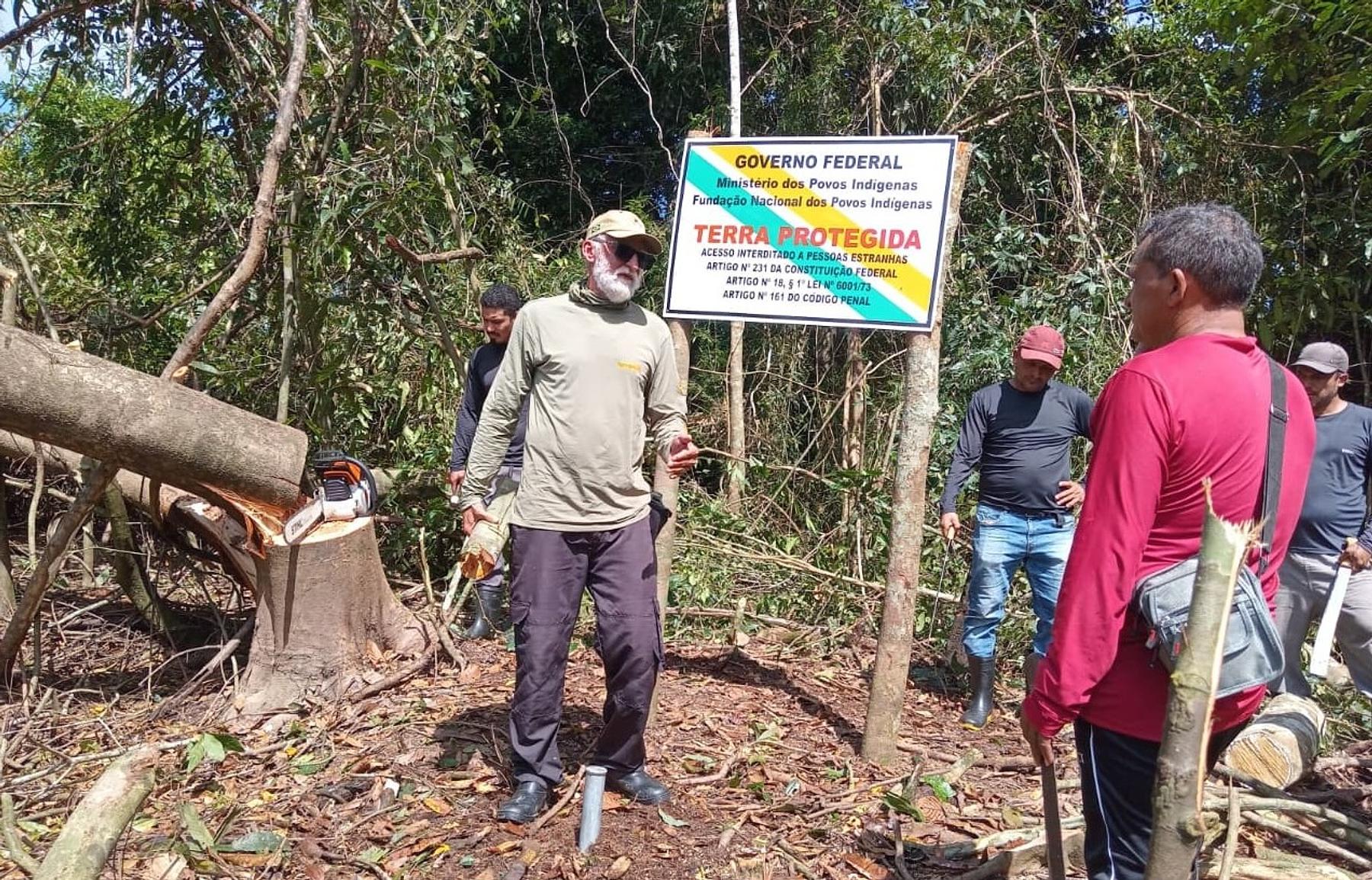
Agents of Brazil’s Indigenous agency, FUNAI, spent 60 days in June and July 2026 physically marking the borders of the Rio Pardo Kawahiva Indigenous Territory. The 411,000-hectare (1 million-acre) area in the Amazon biome of Mato Grosso state is home to the Kawahiva, an isolated Indigenous group. The government agency confirmed the presence of the Indigenous group in 1999 and began demarcating its territory in 2001. “The uncontacted Kawahiva have been under threat in their own forest home for decades, while simply trying to exercise their right to live as they choose without contact,” Caroline Pearce, director of the UK-based NGO Survival International, said in a statement. Still image of a Kawahiva individual taken by federal agents in August 2013. Image courtesy of FUNAI. The territory has been invaded by land-grabbers and loggers, causing deforestation. Historically, the Kawahiva territory was intermittently protected via temporary land protection orders, which faced opposition from logging companies. To officially demarcate the territory, FUNAI agents opened a path around the land and installed roughly 140 signs at strategic locations, FUNAI agents told Mongabay. “Here in our region, all owners of plots of land do this,” Jair Candor, coordinator of the FUNAI unit that safeguards the Kawahiva, told Mongabay in an audio message. “The limits of land are marked by opening a path around that territory, whether it belongs to the white man or to an Indigenous person.” The last of more than 100 signs was placed on July 3, 2026. Image courtesy of Kenedy Vicente da Silva. The last known invasion of the territory was in 2023 when a farmer cleared 4-5 hectares (10-12 acres) of Kawahiva land, Candor said. When confronted, the farmer noted that there were no physical markers identifying the Indigenous land. “The physical demarcation is for this purpose,” Candor said. “So that people can identify that there is an Indigenous land there and a people who inhabits it and needs that territory.” An abandoned Kawahiva camp. Image courtesy of FUNAI. Physically marking the territory is the penultimate step to full legal recognition. The only thing remaining is for President Luiz Inácio Lula da Silva to sign a decree formally creating the Indigenous territory. The president’s office told Mongabay by email that the administration is awaiting Supreme Court decisions concerning the marco temporal, a controversial cutoff date for Indigenous land claims, before proceeding with further land recognition to ensure legal certainty. “If we can keep it the way it is there, without invasions, they will be OK,” Candor said, adding that monitoring expeditions indicate the forest still provides sufficient game, fish, honey and other food sources for the Kawahiva to survive on the land. “They are also human and just need a place where they can live in peace, like everyone else.” Banner image: The first sign demarcating the Rio Pardo Kawahiva Indigenous Territory. Image courtesy of FUNAI. Credits Topics
Brazil marks borders for isolated Indigenous group in the Amazon after decades
Full Article
Original Source
Read the full article at News →KhanList aggregates and links to publicly available news content. We do not host full articles from third-party sources. Always verify important information with original sources.