
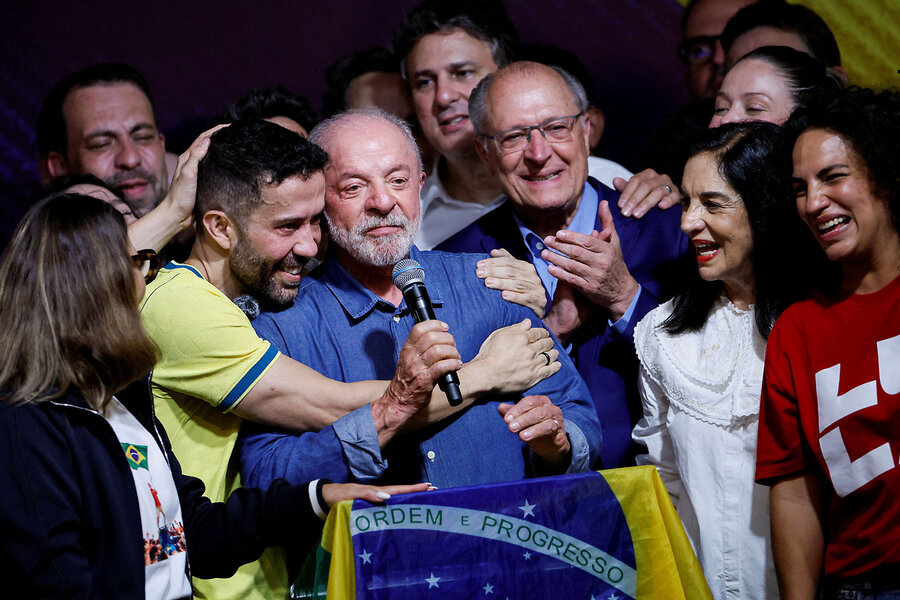
Rio de Janeiro | Oct. 26, 2026, 12:04 p.m. ET | 4 min read The reelection of Brazil’s leftist President Luiz Inácio Lula da Silva to an unprecedented fourth term in the election Sunday bucks a regional trend that has seen a wave of right-wing and far-right candidates win office in Latin America.Lula, as the president is known, pulled off a surprise victory against his far-right rival, Sen. Flávio Bolsonaro, who had bested him in the first round. Lula received 51.79% of the runoff vote compared with 48.21% for Senator Bolsonaro – a difference of nearly 4.5 million votes. Polls had suggested a much closer race, and this is the first time in Brazil’s modern history that the first-round runner-up has gone on to win the presidential runoff.It’s a historic result that strengthens Brazil’s position as a counterweight to the United States’ increasingly assertive presence in Latin America, where President Donald Trump has been exerting political and military influence under his National Security Strategy. The Lula government’s refusal to bow to pressure from the Trump administration, which has come in the form of tariffs and sanctions, has turned Latin America’s largest economy into the main bulwark against Mr. Trump’s interventionist approach to the region. “This is a victory of Brazilian democracy. We are a sovereign country. We are not going to be anyone’s backyard,” says Priscila Nobre, a dog walker in Rio de Janeiro who had covered her dress in Lula stickers. Around her, an ecstatic crowd was dancing and chanting in celebration of the former union leader’s reelection.Lula campaigned, in part, on the defense of national sovereignty, painting his opponent as a threat to Brazil’s autonomy due to his close relationship with President Trump. Rallies in Lula’s support during the runoff campaign often featured signs rejecting U.S. influence and reaffirming Latino identity.Left- and right-wing leaders in the region, from Mexico’s Claudia Sheinbaum Pardo to Chile’s José Antonio Kast and Ecuador’s Daniel Noboa, were quick to congratulate Lula on his victory and express their desire for cooperation. President Trump and his close ally Javier Milei of Argentina, however, have stayed silent so far. “It’s an important election for the region,” says Marsílea Gombata, a researcher at the University of São Paulo. She calls Brazil a kind of “older sibling” to other Latin American countries, modeling what is possible for their politics. Diego Herculano/ReutersSupporters of Brazilian President Luiz Inácio Lula da Silva of the Workers' Party hold up their hands in the sign of the letter L as they celebrate his victory in the presidential runoff election, on the outskirts of Brasília, Brazil, Oct. 25, 2026. When Lula first held office, between 2003 and 2010, he was part of the “Pink Tide” of progressive heads of state coming to power in Latin America at the start of the century. Today, only Uruguay, Guatemala, and Mexico are also governed by democratically elected leftist governments. Seven countries voted in conservative Trump-aligned leaders in recent elections.Lula’s remarkable comeback has been attributed to the huge mobilization of his supporters since the Oct. 4 first round. They campaigned massively on the streets and online to sway undecided voters and first-round abstainers by presenting the election as a vote for democracy and social rights.“People went to vote because we succeeded in convincing them that voting preserves democracy,” Lula said in a victory speech in São Paulo.Speaking from the capital, Brasília, on Sunday evening, Senator Bolsonaro questioned the results and said he would ask for their annulment. “It is impossible to recognize the results of the election in the context in which things unfolded,” he said.He was referring to the voting time having been extended by two hours by order of a Lula-appointed Supreme Court justice, causing some confusion in polling stations where the electronic ballot boxes had already been closed. This unusual move followed requests filed by both campaigns with the electoral court. Lula’s team raised concerns that public transport issues reported in various cities throughout the day had been a deliberate move to prevent voters in left-leaning districts from reaching polling stations. The Bolsonaro campaign requested that voting be extended in some southern states hit by bad weather.Political scientist Mauricio Santoro says Lula’s clear lead made it harder to challenge the results. But, “despite being a very impressive victory, it is a fragile victory,” he says. “Brazil’s international situation remains difficult. Brazil is isolated within South America as it’s one of a few countries that isn’t aligned with President Trump’s political agenda.”And at home, Lula will face a divided country and govern with a hostile legislature dominated by the Bolsonarista Liberal Party and other right-wing parties when he takes office for his final term on Jan. 5. Deepen your worldviewwith Monitor Highlights.Politics with respectGet political stories with respectful analysis.There‘s a world of new ideas in everyBooks newsletter.There‘s more to life, enrich yours withCulture & Learning weekly.Follow humanity‘s discoveries withScience & Nature stories in your inbox.Gain a spiritual perspectivefrom the stories in your inbox.Want to understand the deeper impact of critical events? Learn the Monitor‘s insight.Already a subscriber? Log in to hide ads. That brings comfort to Bolsonaro voter Carlos Eduardo Cavalcanti, an engineer. He hopes the Senate will use its conservative majority to impeach Supreme Court justices, a long-standing demand of the Bolsonarista movement.“They will clean up the Supreme Court, and then our country will improve,” he says, as frustrated Bolsonaro supporters started leaving the bar where they’d gathered to watch the vote count. ALREADY A SUBSCRIBER? LoginReal news can be honest, hopeful, credible, constructive.The Christian Science Monitor was founded in 1908 to lift the standard of journalism and uplift humanity. We aim to “speak the truth in love.” Our goal is not to tell you what to think, but to give you the essential knowledge and understanding to come to your own intelligent conclusions. Join us in this mission by subscribing.
Brazil bucks Latin America’s rightward shift. But Lula victory is ‘fragile.’
Full Article
Original Source
Read the full article at Csmonitor →KhanList aggregates and links to publicly available news content. We do not host full articles from third-party sources. Always verify important information with original sources.