
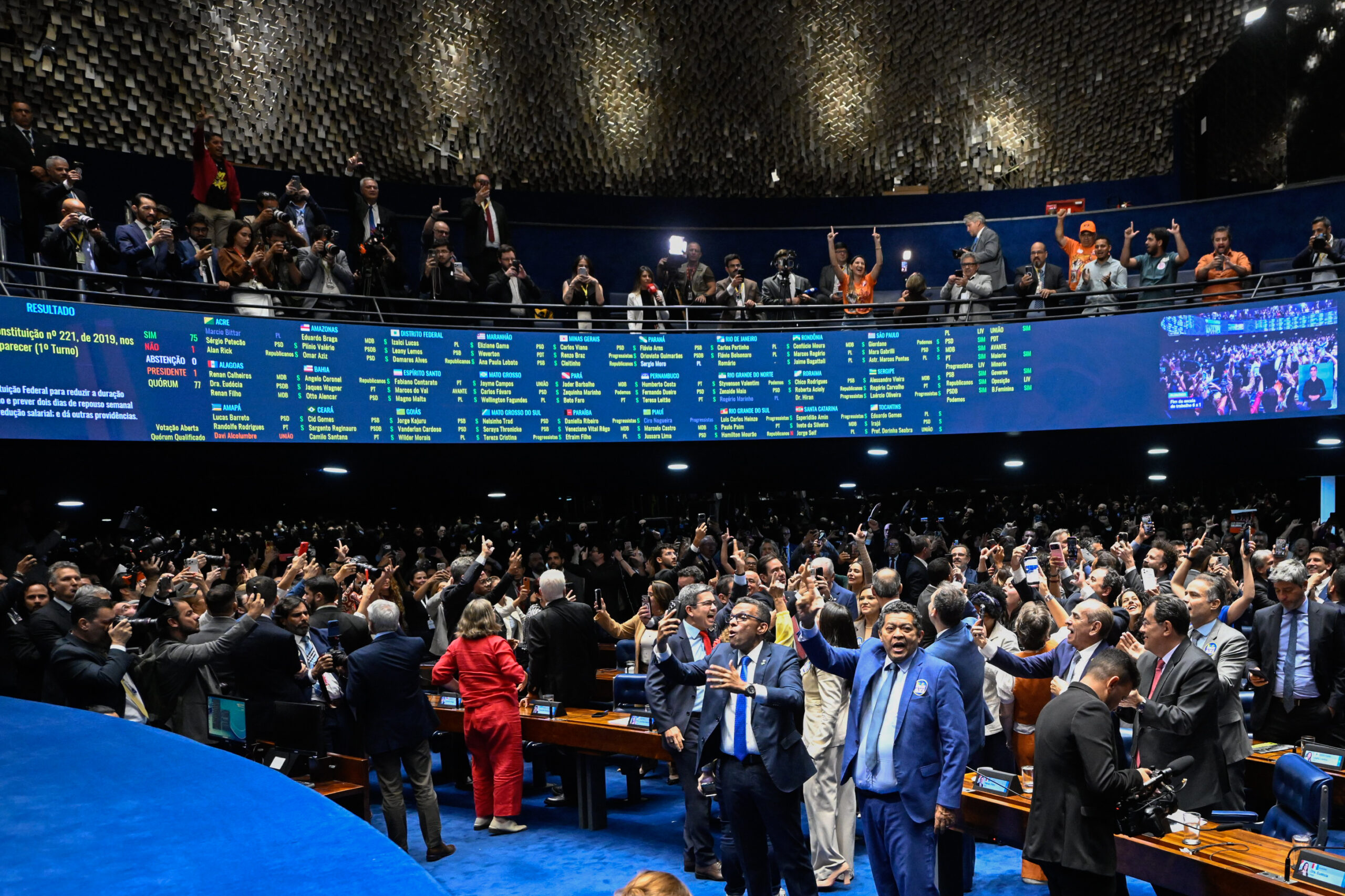
Senators backed the constitutional amendment cutting the standard workweek from 44 to 40 hours and guaranteeing two paid days off, handing Brazil's president a major win 11 days ahead of elections.RIO DE JANEIRO (CN) — Brazil’s Senate on Wednesday approved a constitutional amendment to reduce the standard workweek from 44 to 40 hours and end the six-days-on, one-day-off schedule known in Brazil as 6x1.The Senate approved the amendment 75 to 1; Constitutional amendments require the support of at least 49 of Brazil’s 81 senators in two rounds.“At first glance, it may seem like a subtle change. But for those who wake up early, take a crowded bus, work their shift and return home at the end of the day, this change is enormous,” Senate President Davi Alcolumbre said. “One more day of rest means more time for family.”Because senators approved the same text passed by the lower house in May, the amendment does not require presidential approval and now goes to Congress for formal promulgation.The vote hands President Luiz Inácio Lula da Silva a major labor-policy victory just 11 days before the presidential runoff. After the vote, senators and supporters on the Senate floor chanted “Olê, olê, olê, olá, Lula, Lula.”The vote came one day after Lula’s opponent, Senator Flávio Bolsonaro, reversed his previous position and announced he would support the amendment. Bolsonaro had previously criticized the vote as an electoral maneuver, while members of his Liberal Party had sought to delay consideration until after the Oct. 25 runoff.“The majority of Brazilian workers want the end of the 6x1 schedule, so I will vote in favor,” Bolsonaro said Tuesday.Bolsonaro was campaigning in Porto Alegre during the Senate session, but registered his presence remotely and voted online in favor of the amendment.The amendment marks the first constitutional reduction in Brazil’s standard workweek since 1988, when the Constitution cut the standard workweek from 48 to 44 hours.Sixty days after the amendment is formally promulgated, workers will be entitled to two paid days off per week and the maximum workweek will fall from 44 to 42 hours. It will fall to 40 hours about a year after that.Workers will be entitled to two paid days off per week, one of them preferably on Sunday, and employers will not be allowed to reduce salaries because of the shorter workweek.The text allows collective bargaining agreements to regulate how the two weekly rest days are arranged. Renata Queiroz Dutra, a labor law professor at the University of Brasília, said the provision could weaken the reform.Dutra also noted the constitutional change will not reach a large share of Brazil’s workforce. About 38% of workers are informal and therefore lack the labor protections regulating hours and weekly rest, she said.“Thinking about how to protect the time of those workers seems to me a fundamental issue,” Dutra said.The amendment began as a 2019 proposal introduced by Congressman Reginaldo Lopes, a member of Lula’s Workers’ Party. The original text proposed reducing the workweek to 36 hours over 10 years.The issue gained wider attention in 2023 through the Life Beyond Work movement, led by Rick Azevedo, who was elected to Brazil’s lower house this month. At the time, Azevedo worked as a pharmacy clerk and went viral on TikTok with a video describing his work routine.“When are we, the working class, going to start a revolution in this country over the 6x1 schedule? This is modern slavery. Not modern — outdated,” Azevedo said in the video, which received more than 1 million views.Lula’s government embraced the campaign, advocating for shorter working hours in 2025 and made ending the 6x1 schedule one of his main labor proposals during this year’s election campaign.But opposition like the National Confederation of Commerce of Goods, Services and Tourism said a uniform 40-hour weekly limit could hurt employment, small businesses and labor-intensive sectors.It argued shorter working hours should be negotiated through collective bargaining rather than imposed by the Constitution, and said companies may have to reorganize shifts and revise contracts to maintain operating hours.Adriana Marcolino, technical director at Dieese, a research institute linked to Brazil’s labor movement, said similar arguments have accompanied previous expansions of labor protections.“There is no documented case of shorter working hours leading to higher unemployment,” Marcolino said. “On the contrary, employment increased in several cases. We saw that in Brazil from 1988 to 1989, when the workweek was reduced from 48 hours to 44 and employment grew.”José Dari Krein, an economics professor at the State University of Campinas and a labor economics researcher, said shorter working hours could stimulate other sectors if incomes are preserved, as workers with more free time may spend more on leisure, restaurants and entertainment.“It will be very important for people to be able to organize their lives,” Krein said. “It also opens up more room for social life and time with others.”Courthouse News reporter Marília Marasciulo is based in Brazil.Subscribe to our free newslettersOur weekly newsletter Closing Arguments offers the latest about ongoing trials, major litigation and rulings in courthouses around the U.S. and the world, while the monthly Under the Lights dishes the legal dirt from Hollywood, sports, Big Tech and the arts.Additional Reads
Brazil approves end of six-day workweek
Full Article
Original Source
Read the full article at Courthousenews →KhanList aggregates and links to publicly available news content. We do not host full articles from third-party sources. Always verify important information with original sources.