
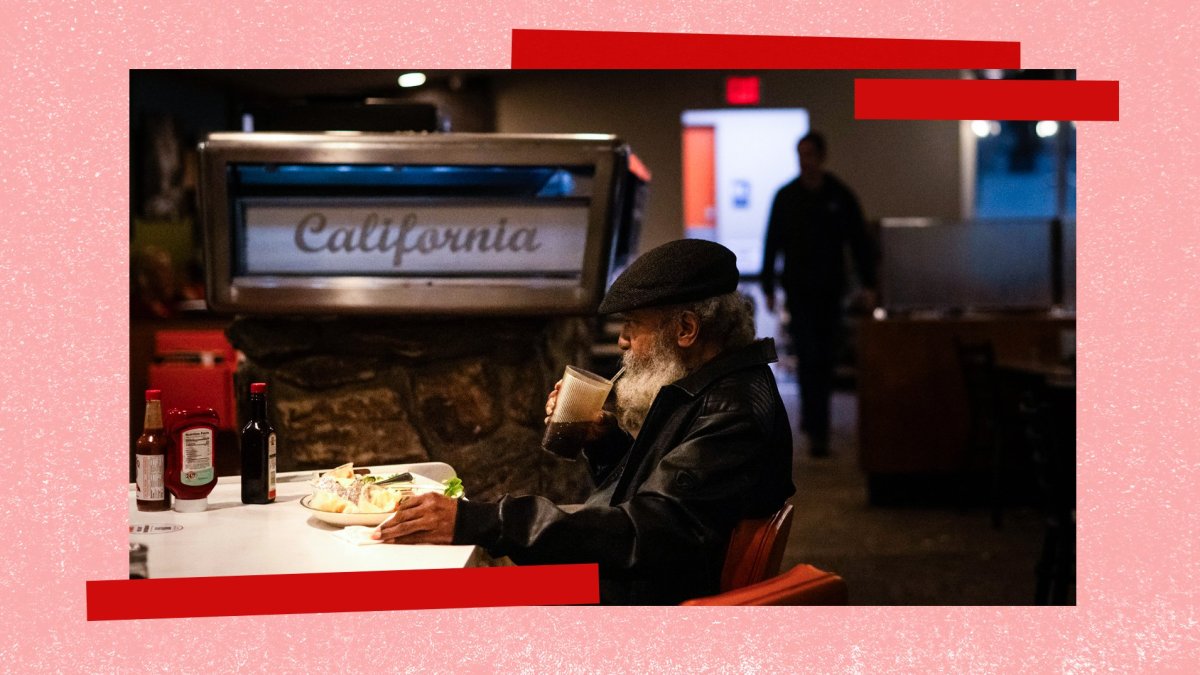
Welcome to Trump’s America, The i Paper’s World Insight series presenting the sharpest, deepest thinking on an era-defining shift in history and politics, investigating how Donald Trump and his administration have changed the US and the world – and where we go from here. • $120,000 should be a great salary. In these US states, it isn’t• The end of the American sibling• The more America spends on healthcare, the sicker it gets If the American dream is all about the successful pursuit of happiness, the American nightmare is loneliness. The United States was founded as an “empire of liberty” but the people of the nation have always been haunted by the miserable downside of individual freedom – the human sense of isolation. Even after he was freed from slavery, the great abolitionist Frederick Douglass wrote of being “seized with insecurity… There I was in the midst of thousands, and yet a perfect stranger”. Alienation, then, is the American disease. And today, in an age of smartphones, AI and endless digital possibilities, the sickness is metastasising. A recent survey from the American Association of Retired Persons found that nearly half of all adults aged between 45 and 59 reported feeling alone, though perhaps surprisingly, the sense became less potent among those over 65. The study also revealed that the rich, or richer, can afford companionship. Among the poor, or households earning less than $25,000 (£18,900) a year, 63 per cent identified as lonely. Moreover, men tend to feel more alone than women: 17 per cent of male adults reported having no close friends. Americans, once famous all over the world for their eagerness to engage in conversation, have stopped talking out loud. In a letter published this year in Perspectives on Psychological Science, US psychologists Valeria A Pfeifer and Matthias R Mehl discovered that their subjects are speaking hundreds fewer words each day than a generation ago. The Covid pandemic forced many into isolation across America (Photo: Drew Angerer/Getty) They estimated that daily spoken output had fallen by nearly 28 per cent – from roughly 16,000 words a day in the mid-2000s to about 12,800 by 2019. And young people, who communicate mostly through their smartphones, are speaking to each other even less. The Covid pandemic, which forced everyone to stay indoors on their devices, proved something of a tipping point for American loneliness. Julianne Holt-Lunstad, a neuroscientist and a leading researcher on the health benefits of physical human connection, argued at the time that the crisis caused “a social recession — a continued pattern of distancing socially, beyond the immediate pandemic, that will have broader societal effects, particularly for the vulnerable”. Holt-Lunstad’s work informed the views of the former US surgeon general, Vivek Murthy, who in 2023 produced a federal advisory document entitled “Our Epidemic of Loneliness and Isolation”. It pointed out that insufficient social connection is associated with a 29 per cent higher risk of heart disease, a 32 per cent higher risk of stroke and a 50 per cent higher risk of dementia in older adults. “The mortality impact of being socially disconnected is similar to that caused by smoking up to 15 cigarettes a day, and even greater than that associated with obesity and physical inactivity,” wrote Murthy.Murthy’s point was that mass individual loneliness had a profoundly corrosive effect on the social fabric of America. He argued that the issue exacerbated the problems of political “polarisation… which threaten to rip our country apart”. His points spoke to a political class still reeling not just from Covid but the Black Lives Matter protests of 2020 and the Trumpist January 6 riot on Capitol Hill. Members of the US Congress duly suggested several pieces of legislation – a Combating Loneliness Act, Social Connection Act, an Office of Social Connection Policy – none of which came to pass. Experts suggest that’s because the loneliness crisis is too profound for mere politics to solve. Many people in America are feeling more isolated and angry (Photo: Charly Triballeau/AFP) Back in 2000, the American political scientist Robert Putnam published his seminal work Bowling Alone, in which he argued that a healthy society depends on the accumulation of “social capital” – i.e. civic engagement, trust and connection. Those forces had all declined rapidly since the 1960s, so much so that Americans now find themselves participating in mass consumer culture by themselves. “Deep-seated technological trends are radically privatising or individualising our use of leisure time,” he wrote. Putnam’s work has proved prophetic, given the advent of the internet. Today, Americans – along with the rest of the developed world – find themselves scrolling alone, connected to everyone but through the isolating effect of a screen. Peter Wood, an anthropologist who wrote A Bee in the Mouth: Anger in America Now, says that “the rise of social media has a lot to do with the reported increase in loneliness. YouTube, Instagram, TikTok, Snapchat, and Reddit create illusions of connection between people, but these are evanescent. They speak to a need to ‘belong’ to a group, which is mostly just an audience”. He also points out that “isolation breeds anger. Some embrace their isolation out of frustration, and validate that choice by expressing constant irritation with a world that ignores them”. This age of rage reflects itself in politics — from the excesses of Trumpism on the right to the “antifa” protests on the left. But how do you solve the issues of an alienated populace? Twenty-first century living in America, Wood says, “provides few pathways to lasting friendships, though abundant ways to become acquainted with people with whom one shares space or interests. Acquaintanceship is mild anaesthetic for loneliness. It can relieve the itch for deeper connection for a little while.” Government officials and leading scientists will continue to try, with limited success, to quantify the existential angst that afflicts modern people. Yet what’s certain is that life, liberty and loneliness now define the American condition. Shorts
Brash America is facing its worst nightmare: loneliness
Full Article
Original Source
Read the full article at Inews →KhanList aggregates and links to publicly available news content. We do not host full articles from third-party sources. Always verify important information with original sources.