
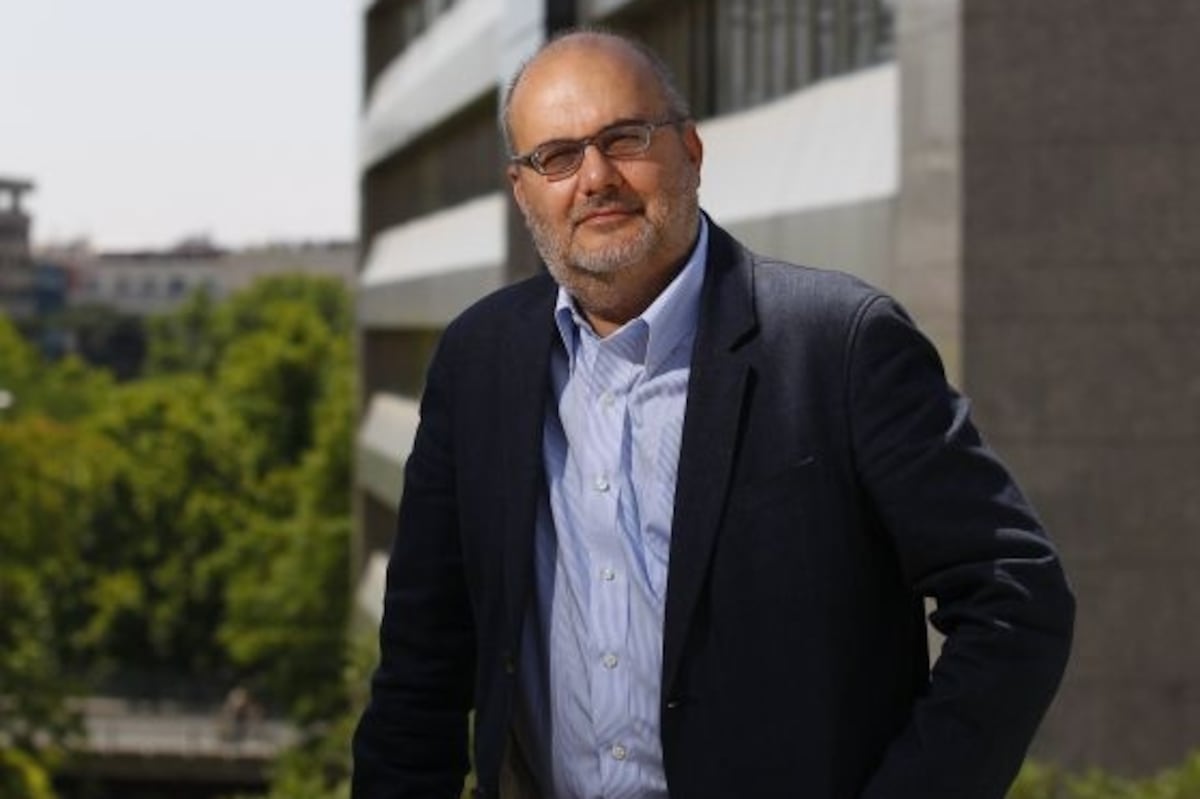
Branko Milanovic dislikes university campuses that are located in idyllic settings, especially those far removed from any urban area. He believes that students — at least those studying social sciences, like economics — should be in the heart of cities, “taking the subway every day, watching how people cross the street, getting cheated out of five dollars… that’s the real world.” Milanovic, 73, belongs to that breed of economists obsessed with keeping academia connected to real life. He’s one of the leading international figures in the study of inequality. For 20 years, he worked as a senior economist at the World Bank. Currently, the Serbian-American researcher teaches at the City University of New York (CUNY). He has his office amidst the bustle of Fifth Avenue, in the heart of Manhattan, a place that could easily provide enough material for several PhDs in macroeconomics.After delivering a lecture on November 6 at the Rafael del Pino Foundation in Madrid, Spain, several young people approached him to ask for a photograph. Milanovic is also one of those economists with rock star status in academic circles. In his interview with EL PAÍS, he addressed current events in the United States, but also the latest global economic transformations. And he used a term that he coined to describe the new ruling elites: “homoploutia.”What does it mean? “Through my empirical work on income distribution in the United States,” he replies, “I realized that, both [in the U.S.] and in other countries, there’s a growing percentage of people at the top who are simultaneously in the highest decile of both capital income and labor income. Now, you could say, ‘well, this is a really good development, because it breaks that contradiction which always existed between so-called earned and unearned income.’ But, on the other hand, you start thinking, ‘well, maybe these guys are now forming an elite.’ They’re hard working, they’re very well educated, they have high labor income and they also have very high capital income. And it’s very hard, maybe, to get into that elite.”The concept, which he develops in his latest book, The Great Global Transformation: National Market Liberalism in a Multipolar World (2025), is different from the aristocracy in the United States formed by the new tech billionaires, who’ve amassed considerable political power under Donald Trump. “First, they’ve become very influential in the media: Jeff Bezos acquired The Washington Post, Elon Musk controls Twitter, Bloomberg obviously controls Bloomberg… I think it’s quite problematic. But we just saw how Musk spent a lot of money in the U.S. midterm elections [to help the Republicans] and failed. So, money doesn’t guarantee that you win,” he points out.The interview with EL PAÍS took place just three days after the U.S. midterms, a veritable Democratic tsunami. This was a major setback for Trump, not only because a Democratic majority in Congress limits his power, but also because of the political message it sends both within and beyond the most powerful country in the world. However, Milanovic notes, “I don’t think it will have much impact on geopolitics. I think the policies with respect to China, the Middle East and Europe will continue, but things might be different for Europe psychologically, because now Europeans will say ‘well, America isn’t so crazy,’” he notes.In fact, in his opinion, the next U.S. president, regardless of their political affiliation, “isn’t going to change policies regarding China; Joe Biden, who came after Trump’s first term, didn’t modify them.”“Trump defined the moment by abandoning neoliberal globalization and going after China… but the same thing would have happened if Hillary Clinton had won the [2016] election, even though he did it in a more extreme way,” the economist adds.In his latest work, he precisely addresses this decline of traditional globalization and the advent of a new order, which he defines as national market liberalism. “The rules of neoliberalism — domestic and foreign — are the same, whether we’re talking about trade, movement of capital, movement of labor, technology… neoliberals would have liked a world without borders. My argument is that now, domestically, we continue with those neoliberal ideas, but externally, a different, mercantilist policy has been introduced… and this combination hadn’t occurred until now,” he states. Milanovic believes that the crisis of globalization stems from a “paradox.” “The success of neoliberalism,” he explains, “was the reduction of global inequality [and] the inequality between countries, but that same success has led to global conflict: it made China much more powerful, which became a threat to American hegemony. And also, Asian people in general have become richer and they’ve taken the positions of the European lower and middle classes. So, there’ve been two effects: conflict between nations and the impoverishment of the middle classes in the developed world.”“The paradox is very important,” he adds. “Positive developments can also have negative consequences.”And what role can Europe play in this multipolar context? “Well, I can give you my opinion, which may be wrong… but I think the problem with the European Union — not necessarily with individual countries — is that it hasn’t moved beyond the mindset of the 1990s. Now,” he acknowledges, “it’s totally understandable, because for Europe, the 1990s were really the best time. But that world no longer exists. And I think Europe’s problem is ideological: it must [learn to operate] in a world [defined by] multipolar competition.” When asked about the model of social democracy that defines a large part of European society, Milanovic responds: “Keep it. But don’t tell everybody that they’re inferior to you because they don’t have it. You know, China isn’t going to have the same model. India is not going to have the same model. Brazil is not going to have the same model. And those are big countries.” Sign up for our weekly newsletter to get more English-language news coverage from EL PAÍS USA Edition
Branko Milanovic, economist: ‘This defeat for Trump will not have a major impact on US policy toward Asia or Europe’
Full Article
Original Source
Read the full article at English →KhanList aggregates and links to publicly available news content. We do not host full articles from third-party sources. Always verify important information with original sources.