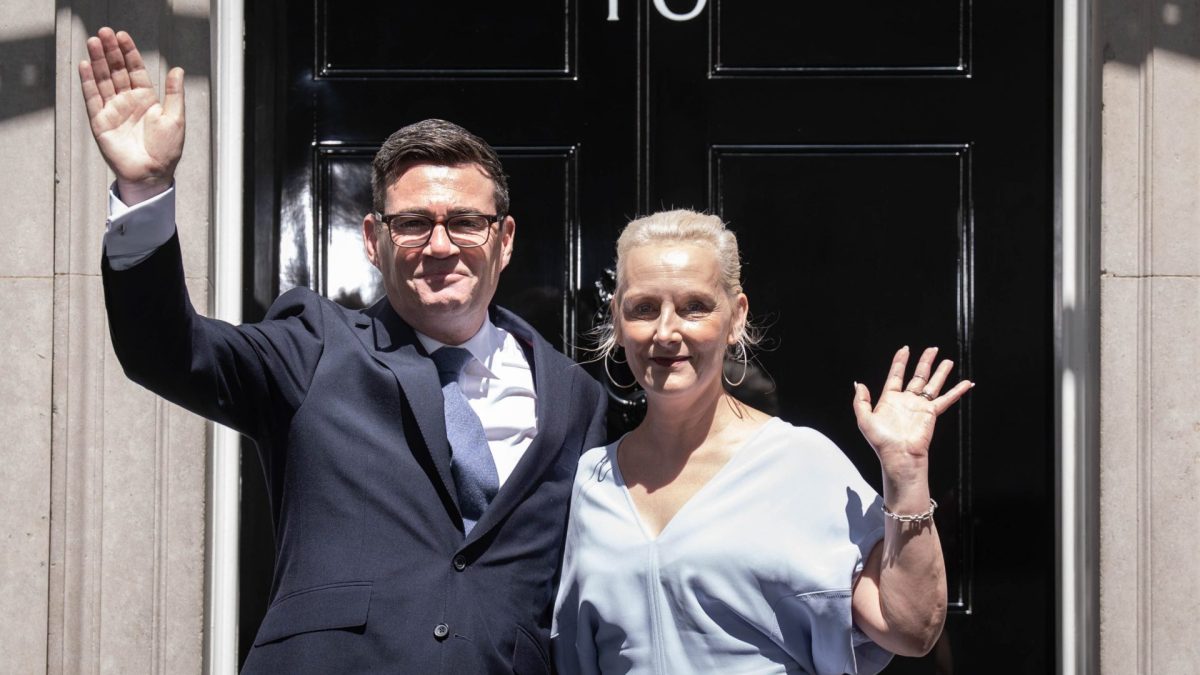
Europeans have always loved British pageantry. Great royal occasions received widespread coverage, as did the arrival of new incumbents through that famous black door in Downing Street. But the royal family isn’t what it was, and prime ministers now come and go so often that the French and Germans might be forgiven for failing to identify them. So it has been with the departure of Sir Keir Starmer and the arrival of the “King of the North”, Andy Burnham. There was some interest in the highbrow mainstream media, but little compared to what might have been before. Shorts What coverage there was tended more to reflect bafflement at the Labour Party’s decision to remove a man seen from afar as doing a competent job. As the respected daily Süddeutsche Zeitung wrote in a commentary entitled “Another one’s off”: “After the crazy Tory years, it seemed the Brits had nothing against a managerial type like Keir Starmer. But when the fury became too great, it was impossible for him to stay.” Starmer was particularly respected for his work in foreign affairs. His close relations with President Emmanuel Macron and Chancellor Friedrich Merz helped Europe present a united front on Ukraine, and in dealing with the twin threats of Donald Trump and Vladimir Putin. The UK’s reluctance to get close to meeting the Nato target of 3.5 per cent spending on defence was causing increasing frustration – but Starmer was given the benefit of the doubt. “British politics may be incredibly unstable, but we’re reasonably confident that in foreign policy there’s a certain consistency, as long as the far-right doesn’t seize power,” one German government official put it to me. Yet the polls hadn’t gone unnoticed – a prime minister at record lows, and Reform UK consistently in front (if weakening slightly in recent weeks). This combination of poor figures for the incumbent and the seemingly inexorable rise of right-wing populists is replicated across the continent. This is where Brand Burnham comes in. Can he pull off a feat that has eluded many of his counterparts in Europe? German commentators noted “Burnham’s German plan” for Britain. His Manchesterism mantra – private enterprise guided by the hand of the state – is like the post-war German social market. Devolution is written into the German constitution; the 16 Länder have considerable, clearly defined, powers. Even in more centralised France, the mayors of regions, districts, even small towns have authority. By contrast, Britain’s patchwork of local and regional government is a mess. Barely a week into office, Burnham’s performative style of leadership is the aspect attracting most attention in European chancelleries. “We’re all watching the way he’s going to handle public opinion and the media,” says an adviser to Labour’s sister party, the Social Democrats (SPD), reflecting a widespread view that mainstream politicians have much catching up to do. France faces biggest threat to liberal democracy in Europe from far-right leader Marine Le Pen, now free to run for president next May (Photo: Reuters/Abdul Saboor) In that, Burnham may have some lessons to impart. Signs are Burnham may have learnt from the woes of those who came before him and who are all around him. He is playing the populists at their own game, using social media effectively, talking directly to voters, producing easily digestible (if so far small) measures to tackle the cost of living crisis – while also planning for the long term, on issues such as social care. Starmer once wondered out loud in my company whether he should model himself on the then Social Democrat leader and German chancellor, Olaf Scholz. I interjected, politely, to be careful what he wished for. So insistent was Scholz that he was always right, so dismissive was he of criticism, so robotic was he in his mannerisms that he was nicknamed the Scholzomat – a play on the word for machine. Macron provided a different model, a throwback to the gilded age of hyper-globalisation of Tony Blair and Bill Clinton. The term that has stuck for him, Jupiter, denotes the God sitting up above the fray. Merz has yet to achieve a single-word descriptor. That may be because he is harder to pin down: a curious amalgam of church-going conservative of the old order – at 70 he is far older than Macron or Burnham – combined with a Trumpian tendency to shoot from the hip. In his long career in politics and in the private sector, Merz has assembled a long list of enemies, on Right and Left. Life is about to get even harder for him in September when the far-right AfD is set to win outright the state of Saxony Anhalt, followed by a strong performance in another eastern region, Mecklenburg Pomerania. One recent poll also pointed to a strong result in the Berlin city-region. It will only get rockier, but Merz has a commendable resilience. His government is hoping that a series of reforms on health, pensions and other areas will begin to bear fruit. It is in France that liberal democracy faces the most direct danger. If Marine Le Pen, now free to fight for the presidency, prevails next May, then all bets are off in terms of the future of the EU, Nato and European solidarity towards Putin. The centrists have still to alight on a single compelling candidate to challenge her. When he took office just over a year ago, Merz declared that the political centre had “one last chance” to get it right. That reflects a broader European reality. The challenges faced across Europe – the financial squeeze on households, climate change (evidenced this summer more than ever), the threats to jobs through AI, and immigration – are shared across the continent. All mainstream governments are looking for examples, large and small, of new solutions. Each new incumbent gives rise to a certain optimism that, finally, a roadmap for survival can be found. The success or failure of the Burnham model, such as it is so far, will play a significant role in determining the outcome of Western European liberal democracy. John Kampfner’s latest book, Braver New World, is published by Atlantic
Brand Burnham’s performative style is making waves in flailing Europe
Full Article
Original Source
Read the full article at Inews →KhanList aggregates and links to publicly available news content. We do not host full articles from third-party sources. Always verify important information with original sources.