
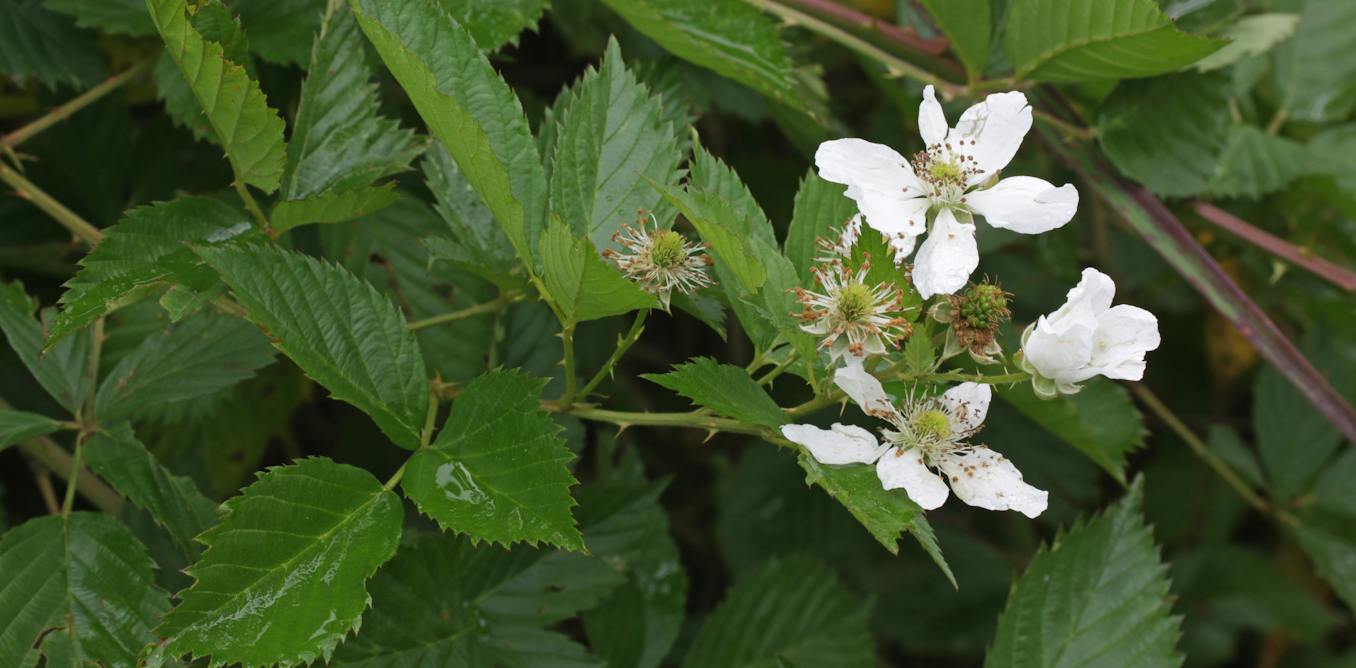
Invasive alien brambles have been spreading across South Africa since the early 1900s, having come from North America and Europe. All brambles fall within the genus Rubus. Their common names in South Africa are braam (Afrikaans), ijingijolo (isiZulu) and monoko-metsi (seSotho). Over the decades, these plants have crept into tree plantations, pastures and native grasslands. Dense, thorny thickets now choke open spaces, and impede livestock and wildlife movement. They restrict access to water, smother young trees used for timber, interfere with plantation management and disrupt roadsides. Rubus sect. Cuneifolii (in the foreground) invading grassland in KwaZulu-Natal. Michal Sochor They have become one of the most widespread and damaging weeds, though it’s hard to estimate how much land they cover because satellite imagery doesn’t capture them in grasslands and they “hide” under forest canopy. Beyond ruining hiking experiences and doing agricultural damage, these infestations also displace native vegetation and negatively affect specialist flower-visitors like butterflies. People have tried to manage invasive brambles, yet traditional chemical and mechanical controls don’t work. This is due to the sheer scale of the invasions, costs that are too high for low-value land, rugged terrain that limits access, and the plant’s ability to resprout from rootstocks or re-emerge from bird-dispersed seeds. Consequently, there is an urgent need for additional management tools. Biological control (biocontrol) has been considered in South Africa, but never tried. My research focuses on biological control of weeds, which works by introducing specialised natural enemies from the plant’s native range (where they came from originally) to suppress its growth or reproduction. Before any natural enemy is released, it undergoes rigorous testing in quarantine to make sure it only damages the weed. By using tested, host-specific natural enemies that cannot survive on any other host, biocontrol aims to restore ecosystems with minimal disturbance. Biocontrol offers a proven safety record that far outweighs the hazards of traditional control methods. The first step is to be sure what the weed is, where it came from, what its natural enemies are and how much of a problem it is. Recently our research team published the results of a study into brambles in South Africa to start answering these questions. Until recently, the most damaging brambles in this country were treated as a single species, Rubus cuneifolius Pursh. Research has since separated the dominant invasive species into three taxa. Our study concludes that biological control of Rubus sect. Cuneifolii and two forms of R. sect. Arguti is feasible and may be a suitable option to manage the impact of the weed in South Africa. Identifying the enemy Establishing a clear identity for the target plant is essential to finding natural enemies. This requirement has been a major stumbling block to bramble biocontrol. In the past, invasion biologists and botanists lacked clarity on which species the brambles in South Africa belonged to, and which ones were driving invasions. This was complicated by the tendency of brambles to hybridise, both across invasive species and between invasive and native species. (South Africa has several native brambles that need to be protected.) Read more: Why plants need an identity Overcoming the identification hurdle and others became the aim of research carried out at the Agricultural Research Council and at the Centre for Biological Control, attached to Rhodes University, from 2018 on. At the same time, a world-leading Czech batologist (a person who studies brambles), Michal Sochor, was conducting studies to untangle South Africa’s bramble diversity, in collaboration with John Manning of the South African National Biodiversity Institute. This work revealed a complex mix of 18 pure taxa and 12 hybrid lines of Rubus in South Africa. It separated the dominant invasive species, previously identified as Rubus cuneifolius, into three taxa (an upright form and two sprawling forms). We then evaluated 91 highly affected forestry, grassland and roadside sites to map Rubus spp. distributions, genetic structures and morphological (shape) traits. Bramble invading a forest plantation. Grant Martin Rubus sect. Cuneifolii invading a roadside. Michal Sochor These revealed that the upright form (Rubus sect. Cuneifolii) was the most widespread invader in the grassland biome, dominating 42 of the 69 accessible sites. In KwaZulu-Natal province, it heavily invades open grasslands and timber plantations as a single, genetically uniform clone. No hybridisation was recorded. The sprawling forms (R. sect. Arguti) were recorded at 26 sites, mainly along roadsides and in disturbed habitats across three provinces (KwaZulu-Natal, Mpumalanga and Limpopo). These plants were genetically divided into five distinct genotypes showing clear geographic clustering. Rubus sect. Cuneifolii. Michal Sochor Rubus sect. Arguti. Michal Sochor Cost-benefit analysis Anyone spending time outdoors in South Africa is likely familiar with wild brambles, having enjoyed picking and eating their fruit, often without knowing which species they were. Foraging from wild populations even supports small cottage industries, such as making jam and preserves, brewing small batches of gin, and selling whole berries in local farm-stalls. To ensure future management strategies avoid potential conflicts of interest, our research included a socio-economic study of the economic value of these Rubus species. This confirmed that alien brambles generate positive private value through wild berry harvesting, dietary supplementation and small-scale processing. But our research found that environmental and management costs outweigh these local benefits. The cost to government of clearing the weeds was 13.5 times greater than the recorded financial benefits (which were all in one province, the Free State). Wild harvesting proved to be a “nice to have” rather than a vital part of local livelihoods or daily nutrition. Decisive control measures are therefore needed. Next, find enemies Biocontrol should provide a helpful tool in the management of invasive Rubus in South Africa, as it has in several other countries. Thanks to a much clearer understanding of where Rubus fits into the plant world, what seemed like an intractable challenge in the 1980s and 1990s is becoming a manageable research project. This is because we can now determine the plants’ exact origin to ensure that the right or most closely associated natural enemies are collected and considered for further testing. The next steps are to track down populations of Rubus in the US which closely match those in South Africa, survey them for natural enemies (preferably an insect that damages the stem or leaf), and select one or more of these for host-specificity trials. It is entirely realistic that an effective biocontrol agent could be released within the next decade for South Africa’s invasive North American brambles, hopefully reducing their vigour and competitiveness while paving the way for cost-effective integrated management.
Brambles are a problem weed in South Africa but researchers are closer to finding a natural enemy to manage them
Full Article
Original Source
Read the full article at Theconversation →KhanList aggregates and links to publicly available news content. We do not host full articles from third-party sources. Always verify important information with original sources.