
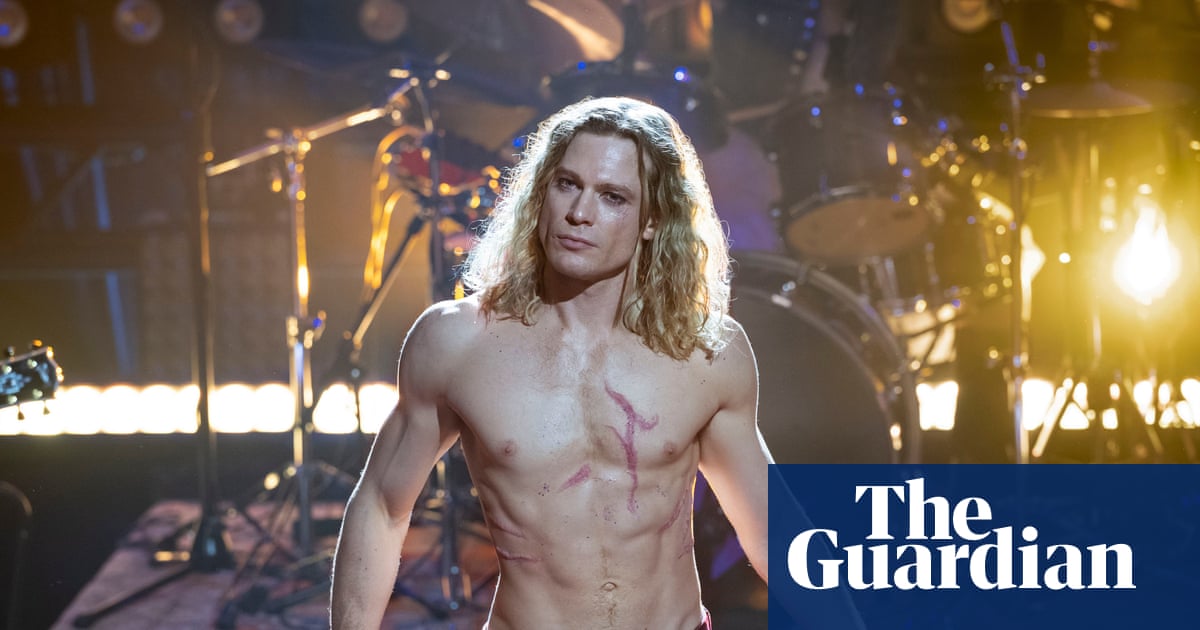
If you want TV audiences to forgive a fictional man for absolutely anything, just sharpen his fangs and stick him in velvet. Case in point? The horny musical drama The Vampire Lestat, which became a cult hit in the US earlier this year. The show has now arrived in the UK and Sam Reid’s searing performance as Lestat has fans on their knees.The first two seasons, which went by the title Interview With the Vampire, were about the “interview” in which Louis (Jacob Anderson) tells a journalist about his toxic relationship with Lestat. Now, the focus has shifted to Lestat – hence the new title and new narrator – as the golden-locked prince of darkness swaps centuries of secrecy for glam-rock stardom.Toxic love … Jacob Anderson as Louis de Pointe du Lac in The Vampire Lestat. Photograph: BBC/© 2026 AMC All Rights Reserved/Sophie GiraudReid turned to bootlegs of David Bowie’s 1974 Cracked Actor tour for inspiration on the “showmanship, magic and mystery” needed to hypnotise an arena, with the result that Lestat now embodies a magnificent “dandy of the underworld” energy. He writhes, growls and grinds on stage as he plays the fiddle and belts out ridiculously campy songs. He wears glittery eyeshadow, his hair is in ribboned pigtails. He appears to have lost his shirt permanently and bares his scarred chest to adoring fans, while singing “Don’t wanna learn another TikTok dance/Wanna stay in bed, eating black liquorice” and “You can’t fuck away the loneliness / It’ll wait til you’re done / Til you come / Like a vampire”. Off-stage he is in a sexual relationship with his mother, gets high off LSD-laced blood and comes out with phrases such as: “I carry with me an immortal erection.”Breakthrough role … Alexander Skarsgård in True Blood. Photograph: Collection Christophel/AlamyIt’s not the first time a vampire has sucked in audiences. Eric Northman’s full-frontal glory as he lounges on an ice peak reading a book in True Blood was Alexander Skarsgård’s breakthrough role, while Lady Gaga’s The Countess in season five of American Horror Story proved that bloodlust is the ultimate couture accessory. Endlessly seductive vamps show up, too, in The Vampire Diaries, Supernatural and the entire cast of What We Do in the Shadows, who are somehow ridiculously hot despite being total buffoons (Matt Berry has ruined normal men for me). Claes Bang in the BBC’s otherwise chaotic Dracula was undeniably easy on the eye, and even Jeff’s fleeting stint as a vampire in Community’s Horror Fiction in Seven Spooky Steps episode sees Annie swoon over her tame bloodsucker, breathlessly sighing, “Look how much I’ve changed you!” when he begins quoting literature at her.High vamp … Lady Gaga as the Countess in American Horror Story: Hotel. Photograph: Suzanne Tenner/APWhy we are so hooked? Vampires embody absolute freedom, power, immortality, beauty and often forbidden love. They can also tap directly into our shadow selves, serving as the ultimate canvas for the toxic romantic tropes we secretly indulge in on screen. (Think about it: pop culture has long conditioned us to desire the romcom hero who relentlessly pursues a female lead despite being told no until he wears her down, such as Joe Fox (Tom Hanks) in You’ve Got Mail or Joe Goldberg (Penn Badgeley) in You.) When it comes to vampires as romantic figures, we’re leaning heavily into the ultimate “I can fix him” trope. What is more intoxicating than a dangerous immortal who wipes out entire towns, yet kneels at your feet?Just look at Spike in Buffy the Vampire Slayer – the ultimate leather-bound bad boy who is quite literally “changed” by the love of a good slayer. On the flipside, you have Angel, whose curse dictates that one night of mindblowing sex with Buffy literally breaks his brain, shatters his morality and turns him back into a psychopathic monster.Mindblowing … Sarah Michelle Gellar as Buffy and David Boreanaz as Angel in Buffy the Vampire Slayer. Photograph: 1997 Twentieth Century Fox Film CorporationAnd there’s even more beneath the surface level of camp leather jackets, bad-boy redemptions and jawlines that could cut glass. In her 2024 book, Vampires: A Handbook of History & Lore of the Undead, Agnes Hollyhock explores how gothic fiction used the vampire to subvert Victorian moral panic. In a society that strictly forbade non-normative intimacy, the vampiric bite symbolised forbidden desire in the form of a total surrender of control, an exchange of bodily fluid and a rejection of polite society.Disrupting heteronormative expectations, vampires exist entirely outside the linear mortal timeline. They don’t participate in conventional family units or rigid gendered expectations. Their power relies on aura and seduction rather than traditional gender roles. Lestat embodies all of this in his flamboyant, powerful and unapologetically queer glory, which is why we can’t stop thinking about his unhinged romance with Louis (that passionate kiss-turned-skull-smashing-murder in season two lives rent-free in fans’ heads). It’s why he’s become a poster-vamp for sexual freedom. And why we can apparently all get on board with his sordid affair with Gabriella (Jennifer Ehle), the lover he turned into a vampire, who also happens to be his mother.Sexy buffoon … Matt Berry as Laszlo in What We Do in the Shadows. Photograph: Russ MartinIs it the danger? The immortal good looks? The need to be set free from societal constraints? The TV vampire is irresistible. No wonder so many of us are queueing up for a bite from Lestat.
Brain-breaking sex, bad boys in leather and queer glory: why TV vampires are so intoxicating
Full Article
Original Source
Read the full article at Theguardian →KhanList aggregates and links to publicly available news content. We do not host full articles from third-party sources. Always verify important information with original sources.