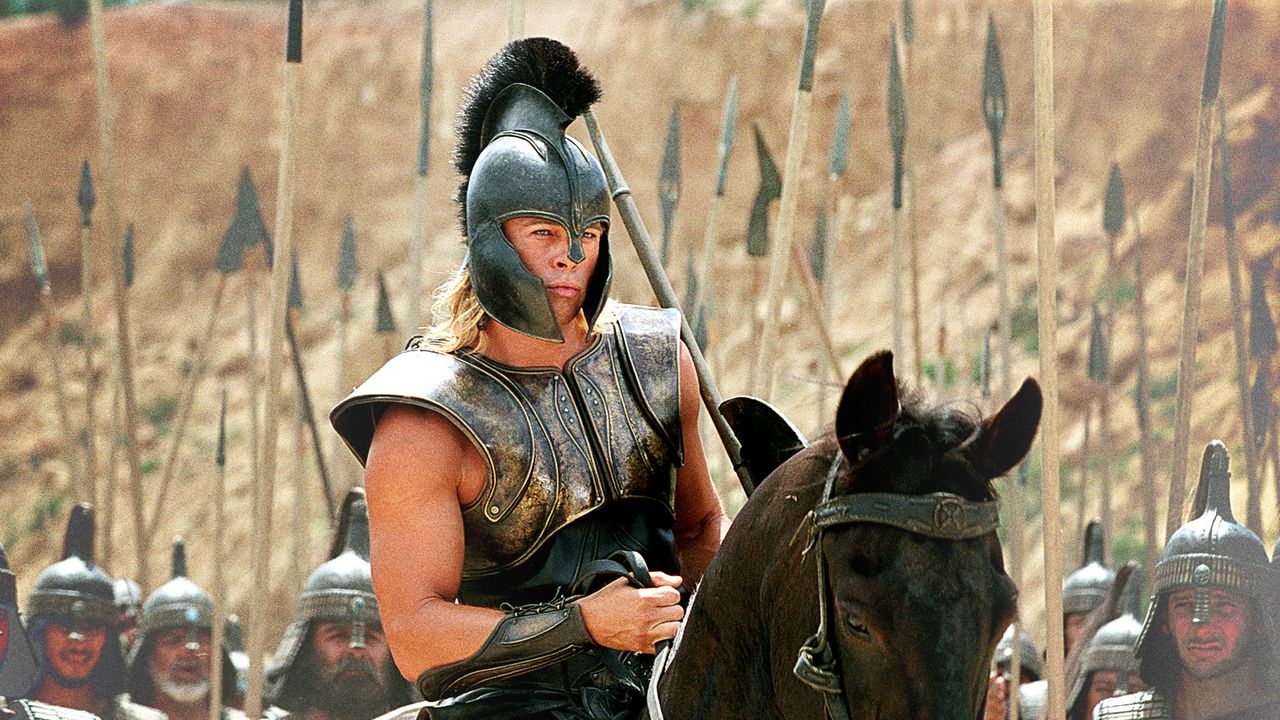
This is an edition of the weekly newsletter Tap In, GQ senior associate editor Frazier Tharpe’s final word on the most heated online discourse about music, movies, and TV. Sign up here to get it free.In another timeline, we would’ve gotten the first true blockbuster adaptation of The Odyssey about 20 years ago, probably starring Sean Bean—one of the all-time great swords-and-sandal character actors (shout out Boromir, shout out Ned Stark)—as the titular journeyman. Alas, that wasn’t the will of the [Hollywood] gods. Wolfgang Petersen’s Troy, a loose adaptation of the Illiad with Bean in a supporting role as Odysseus alongside Brad Pitt’s Achilles, was a commercial hit—one of the highest-grossing films of 2004, in fact—but the reviews were so tepid that everyone involved seems to have pretty much washed their hands of the project, dried them on some loose bills from that half-billion-dollar haul, and moved on. If the reception had been better, I’m almost certain some exec would have cracked the Sparknotes on Homer’s epic and got to work developing The Odyssey as a spinoff for Bean’s Odysseus.The story of Troy’s development is a lowkey Sliding Doors moment for Hollywood that could have drastically altered the blockbuster landscape as we know it had it gone any differently. Petersen, as it happens, only came to Troy after a pretty mid-sounding Batman vs. Superman project he was attached to got canned; when he became available for Troy, Warner Bros. reportedly booted that film’s original director—one Christopher Nolan—off the project. The movie they gave him as a consolation prize? Batman Begins.The rest is history—but in that history, Troy itself has become kind of a footnote, especially now that Nolan's The Odyssey is on track to make a trillion dollars and win a hundred Oscars. Petersen’s film is, comparatively, a blip in the aughts-movie annals that critics, audiences and even some of its own cast even shrug and wince at. It’s understandable, but it’s also too bad, because in my opinion, Troy is and always has been a flawed but pretty fun time at the movies.I saw Troy in theaters when I was still a pre-teen, with my aunt and uncle at whatever the Battery Park movie theater was called before Regal swooped in, and I dug it. In the ensuing years, I’ve developed a frontal lobe (and the elite, discerning taste that powers this column) but I’ve never switched up on Troy. I’ve rewatched it a few times over the years, I cued it up again last year when Nolan’s Odyssey was first announced, and recently, after seeing The Odyssey twice, I ran Troy back again, and the results remain the same: This hits, I’m afraid.The main criticism of Troy is that it’s melodramatic-blockbuster-mid; I’d argue the melodrama is what makes it sing. Brad Pitt and Peter O’Toole have talked down on it since; O’Toole reportedly couldn’t even get through a screening of the finished film. Pitt, reflecting on the experience years later, said “Somewhere in it, Troy became a commercial kind of thing. Every shot was like, 'Here's the hero!' There was no mystery."Brad’s right about that: Troy, via a screenplay from future Game of Thrones co-creator David Benioff, essentially turns The Iliad into a soap opera, reducing the infamous Trojan War from 10 years to what feels like 10 weeks max, sans gods and heavy on petty mortal narrative devices. But that sounds worse on paper than the film Petersen ultimately delivered, a large-scale tale made in the mold of old Hollywood epics that still manages to make the drama feel accessible.Crucially, though, you have to bypass the theatrically-released version in favor of the three-hour director’s cut, where the brutality is left unchecked and certain subplots get a little more time to breathe. The action revolves around Brad Pitt’s Achilles, Greece’s most fearsome warrior, who’s at the very least god-like, commands his own Seal Team 6 within the Greek army, and fells enemies in one swordstroke. Pitt plays Achilles as sullen, brooding, and tortured: the original clout-whore who resents that being Greece’s greatest killing machine is his only path to eternal glory. He’s the increasingly reluctant lynchpin in Agamemnon’s (Brian Cox, tearing through the scenery like a bag of Big League Chew) insatiable quest for power; Agamemnon’s sister-in-law Helen absconding to Troy with Trojan demon-twink Prince Paris (Orlando Bloom, who along with Diane Kruger’s basic performance as Helen, represents one of the movie’s two most indefensible red flags) gives Agamemnon the perfect excuse to invade Troy and make his empire that much wider. Hector, Paris’ older brother, is Achilles’ ideological foil, 1b on the notorious-swordsman list but a guy who does it for love of country versus love of the game. Petersen and Benioff trace an arc that shows Hector and his father Priam (O’Toole) as the last of a dying breed, men powered by nobility and decency who are quickly being outnumbered by the capitalist Agamemnons of the world.Benioff strips all of these story beats to their most melodramatic studs, but the plot and differing motivations feel all the more chewy because of it. And Petersen delivers a compelling epic, with eye-popping costumes, gorgeous set design, and some truly awe-inspiring fight choreography. The movie walks right up to the clichéd concept of Greek Tragedy until the inevitability becomes the point; by the time Achilles challenges Hector to a duel, the moment is heavy with the air of doom and certain death. There’s no suspense in wondering who will win; the drama comes from everyone involved wishing it didn’t have to go down this way. The best scene of the movie is the quiet meeting between Priam and Achilles that follows, and Achilles' tearful apology over Hector’s body. Turning history’s greatest warrior into an emo sadboy is a controversial choice, but at least it’s an inspired one.To compare the two films is largely pointless and reductive—except where they overlap. For one, Petersen and Benioff were criticized at the time for excising the gods from the story, but twenty years and two dumb Sam Worthington movies later, we’ve all realized that was the right choice. Then there’s Agamemnon: with all due respect to my guy Benny Safdie, Brian Cox is just built differently. Benioff strips him of all nuance and ambiguity, and boy does Cox embrace it—between this and X2, it’s a shame we didn’t get more blockbuster on-screen villainy from him. As for the Fall of Troy: Whereas Nolan can barely bring himself to even show one specific slaying on-screen that haunts Odysseus in particular, Petersen’s sacking of the city overindulges in a way that would’ve given the HBO standards-and-practices censors for Game of Thrones pause. In the director’s cut, we see innocents slaughtered, women ravaged, and Greek soldiers all but yelling out “Kobe” before tossing infants out of windows like there’s a paper basket waiting for them. It’s a relentless, 15-minute sequence of watching the villains win, a bold downer note to end the movie on.Troy is hardly the tour de force that Nolan just delivered, but it’s an experience in its own right. This isn’t Pitt’s most interesting work, but he centers the movie in such a way that it would fall apart without him. It’s one of many such aughts-movie cases that show Eric Bana (Prince Hector) deserved a longer leading-man run. But thinking about both films side by side, I keep coming back to Menelaus, Agamemnon’s brother, Helen’s husband, portrayed with brutish zeal here by the great Brendan Gleeson. Jon Bernthal technically does good work in the same role, but watching him I couldn’t stop thinking about Gleeson, and how much fun he had playing the part as a lout who only cared about his wife after he lost her—and how much more I connected with the character here versus Bernthal’s exposition-peddling Menelaus in The Odyssey.Menelaus’ death in Troy is just one of several instances of Benioff deploying poetic license to repackage this story for easy Hollywood consumption. On the other hand, Paris and Menelaus’ duel and Hector’s unsanctioned intervention is one of the most electric moments in the movie. Granted, in some ways The Iliad is the shot and The Odyssey is the chaser; where that actually leaves Troy in a world where Nolan’s Odyssey is the biggest blockbuster of the year is as an unexpectedly fitting companion piece. Nolan’s Homeric adventure blends maximalism and austerity; next to that, the ridiculousness of Troy makes it that much more compelling.
Brad Pitt and a ‘Game of Thrones’ Creator Made a Trojan-War Blockbuster 20 Years Ago (And It Wasn't Half Bad)
Full Article
Original Source
Read the full article at Gq →KhanList aggregates and links to publicly available news content. We do not host full articles from third-party sources. Always verify important information with original sources.