
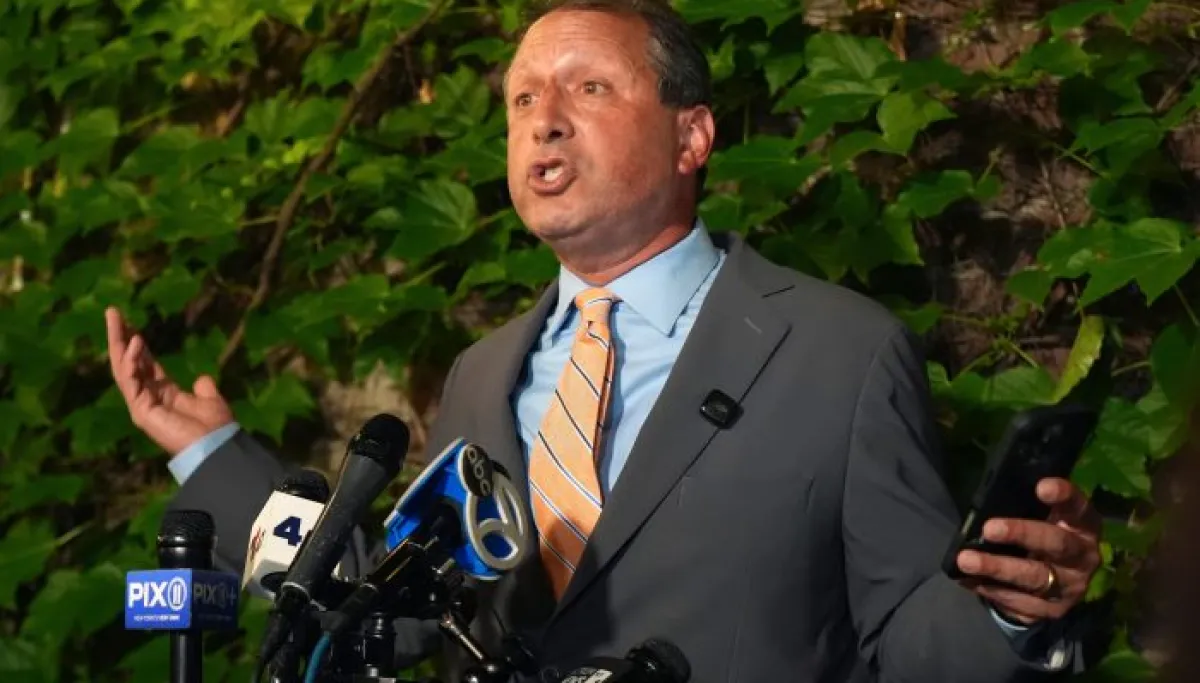
I spent Yom Kippur doing what Jews have done for generations. I fasted. I prayed. I stood alongside other Jews and declared God King. I asked forgiveness. I prayed for my family, my community, the Jewish people, and a better year ahead. Brad Lander spent part of his Yom Kippur at Grand Army Plaza declaring that Israel is committing genocide.That is his right. But “genocide” is not just another political adjective. It is not a synonym for a terrible war, enormous civilian suffering, disproportionate force, or even alleged war crimes. It is a specific legal concept carrying a particular history. And before Lander uses that word again, there is someone I believe he should hear from: Joseph Lemkin.Joseph Lemkin is a relative of Raphael Lemkin, the Polish Jewish lawyer who coined the word “genocide” in 1944 and spent years fighting to make genocide a crime under international law. BRAD LANDER THOUGHT HE WAS AN ALLY. THE MOB JUST SAW A JEWThe Nazis murdered 49 members of Raphael Lemkin’s family, according to Joseph Lemkin’s own account. Think about that number for a moment. Forty-nine.Raphael Lemkin did not invent a rhetorical weapon. He invented a word because the existing vocabulary was inadequate to describe the deliberate destruction of a people. That distinction matters. And it is precisely why the argument over Gaza deserves more intellectual seriousness than slogans shouted on the holiest day of the Jewish calendar.There is unquestionably immense Palestinian suffering in Gaza. Tens of thousands of Palestinians have been killed. Homes and infrastructure have been destroyed on an enormous scale. International investigators have alleged grave violations by Israel, and a United Nations commission has reached conclusions supporting allegations of genocide.Those facts cannot simply be waved away. Neither, however, can the other side of the legal argument.Israel says it is fighting Hamas and other armed organizations rather than seeking the destruction of Palestinians as a people. Hamas began this war with the Oct. 7, 2023, massacre, killing civilians and taking hostages. Palestinian armed groups embedded themselves in a densely populated battlefield. Estimates of how many Palestinian combatants have been killed vary dramatically, making confident claims about the civilian-to-combatant ratio extraordinarily difficult.And raw casualty numbers themselves do not answer the genocide question.Before the war, Gaza had roughly 2.2 million residents. The reported death toll over more than two years of war represents approximately 3% of that prewar population. That statistic neither proves nor disproves genocide. Genocide law contains no mathematical threshold.The defining question is intent: whether prohibited acts were committed with the specific intent required by the Genocide Convention to destroy, in whole or in part, a national, ethnic, racial, or religious group as such.That is exactly what remains contested.The International Court of Justice has not issued a final judgment finding Israel guilty of genocide. Proceedings remain underway. That nuance apparently did not fit comfortably into Grand Army Plaza. What bothered me even more was the day chosen for this declaration.Yom Kippur is supposed to strip Jews of ego. We confess collectively. We remember our dead. We ask God to seal us in the Book of Life. We stand shoulder to shoulder, often with Jews with whom we disagree profoundly, because for one day, the arguments become smaller than the people.Lander sees his activism differently. In an essay published before Yom Kippur, he explained that he regards confronting Israel’s actions as part of the collective Jewish repentance demanded by the holiday. He wrote that his Vidui must confront what he believes is Jewish complicity in Gaza.That is his religious interpretation. Mine could hardly be further from it.For me, Yom Kippur after Oct. 7 carries an additional obligation: to remember that Jewish history has repeatedly demonstrated the danger of believing there are “good Jews” who will somehow be exempted when hatred of Jews becomes fashionable.Political ideology has rarely provided permanent immunity from antisemitism.That is why the casual historical vocabulary surrounding this conflict troubles me so deeply.Words matter. “Genocide” matters. The Holocaust matters. And Jewish historical memory should not become stage scenery for contemporary politics.Which brings me back to Joseph Lemkin.Joseph Lemkin has been fighting another battle over his family’s name. He has publicly challenged the Lemkin Institute for Genocide Prevention, an organization unaffiliated with Raphael Lemkin’s estate or Joseph Lemkin’s branch of the family, over its use of the Lemkin name and its accusations against Israel.The institute rejects those criticisms and says other members of the extended Lemkin family support its work.That dispute itself illustrates something important: Even Raphael Lemkin’s legacy has become a battlefield over Israel and the meaning of genocide.More than 100 Holocaust scholars signed a letter this year arguing that Israel’s campaign does not constitute genocide and objecting to what they regard as misuse of the term. Other genocide scholars and international investigators emphatically disagree.So, here is the conversation I would like to see.Lander and Joseph Lemkin. Sit across a table. No protesters. No microphones being passed through a crowd. No campaign slogans. Talk about Raphael Lemkin. Talk about the relatives his family lost. Talk about why Lemkin invented this word. Talk about Gaza. Talk about Palestinian civilians. Talk about Hamas. Talk about Oct. 7. Talk about what evidence establishes genocidal intent and what evidence contradicts it. And then wrestle seriously with the question of when the most consequential word Raphael Lemkin ever wrote should be used.THEY STOLE A HOLOCAUST SURVIVOR’S NAME. WHEN HIS FAMILY OBJECTED, THEY FOUND ANOTHER LEMKINPerhaps neither man changes his mind. That would be fine. But something has gone badly wrong when one of the gravest accusations human beings can make against one another becomes another piece of political vocabulary.Yom Kippur asks Jews to examine themselves. I did. Lander says he did too. We came away with profoundly different conclusions. But if we are going to invoke the crime Raphael Lemkin spent his life defining, the least we owe his legacy is precision. Because once every war becomes genocide, eventually the word Raphael Lemkin gave humanity risks losing the very distinction he created it to preserve.Warren H. Cohn is founder and CEO of RocketshipPR.
Brad Lander hijacked Yom Kippur to cheapen the word ‘genocide’
Full Article
Original Source
Read the full article at Washingtonexaminer →KhanList aggregates and links to publicly available news content. We do not host full articles from third-party sources. Always verify important information with original sources.