
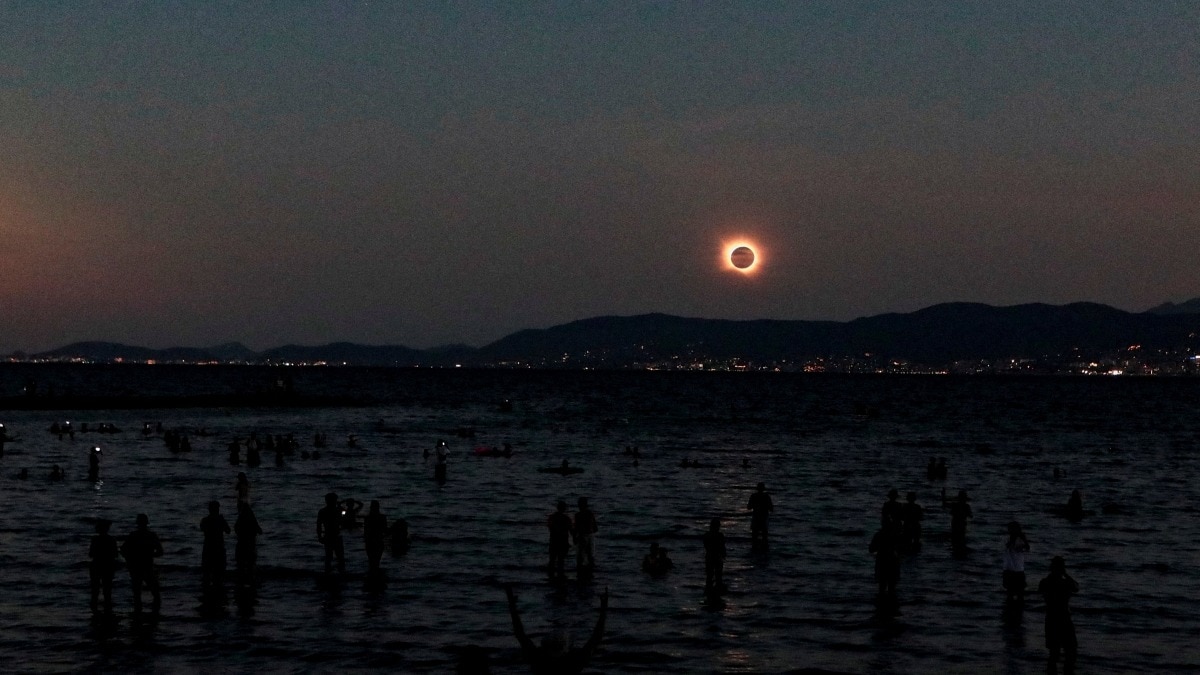
A coronal mass ejection triggered by an August 14 solar eruption is expected to brush Earth's magnetic field on Monday.The "diamond ring" effect appears as the moon moves across the sun during a total solar eclipse, as seen from El Arenal beach in Mallorca, Spain. (Photo: Reuters)A powerful eruption on the Sun has sent a massive cloud of charged particles hurtling through space, with forecasters warning that Earth could be hit by a geomagnetic storm on Monday, August 17.The event began on August 14 when a large magnetic filament erupted from the Sun's surface, triggering a coronal mass ejection (CME), a giant explosion of magnetised plasma blasted into space. Space weather monitoring agencies have since tracked the CME and predict that it will deliver a glancing blow to Earth's magnetic field.According to forecasts, the incoming solar material could trigger a G1-class geomagnetic storm, the lowest category on NOAA's five-level storm scale. While considered minor, such storms are capable of disturbing Earth's magnetosphere and producing spectacular aurora displays at high latitudes.Geomagnetic storms occur when charged particles and magnetic fields carried by a CME collide with Earth's magnetic shield. The interaction can compress the magnetosphere and inject energy into the upper atmosphere, occasionally affecting satellites, radio communications and navigation systems. Forecasters say the August 17 impact is expected to be relatively modest compared to the major solar storms witnessed during the peak of the current solar cycle.However, aurora watchers across northern regions of North America and Europe could be rewarded with enhanced northern lights if conditions align.The Sun has remained unusually active in recent months, producing multiple filament eruptions, solar flares and Earth-directed CMEs. Scientists are closely monitoring solar activity as the star moves through an active phase of its roughly 11-year cycle.Although no significant impacts are expected for the general public, space weather experts will be watching the storm's arrival closely.Even a minor geomagnetic storm offers scientists an opportunity to study how Earth's magnetic field responds to bursts of solar activity and how future, stronger solar storms could affect modern technology.- EndsPublished By: Sibu Kumar TripathiPublished On: Aug 16, 2026 20:03 IST
Brace for impact: Geomagnetic storm from the Sun to hit Earth on Monday
Full Article
Original Source
Read the full article at Indiatoday →KhanList aggregates and links to publicly available news content. We do not host full articles from third-party sources. Always verify important information with original sources.