
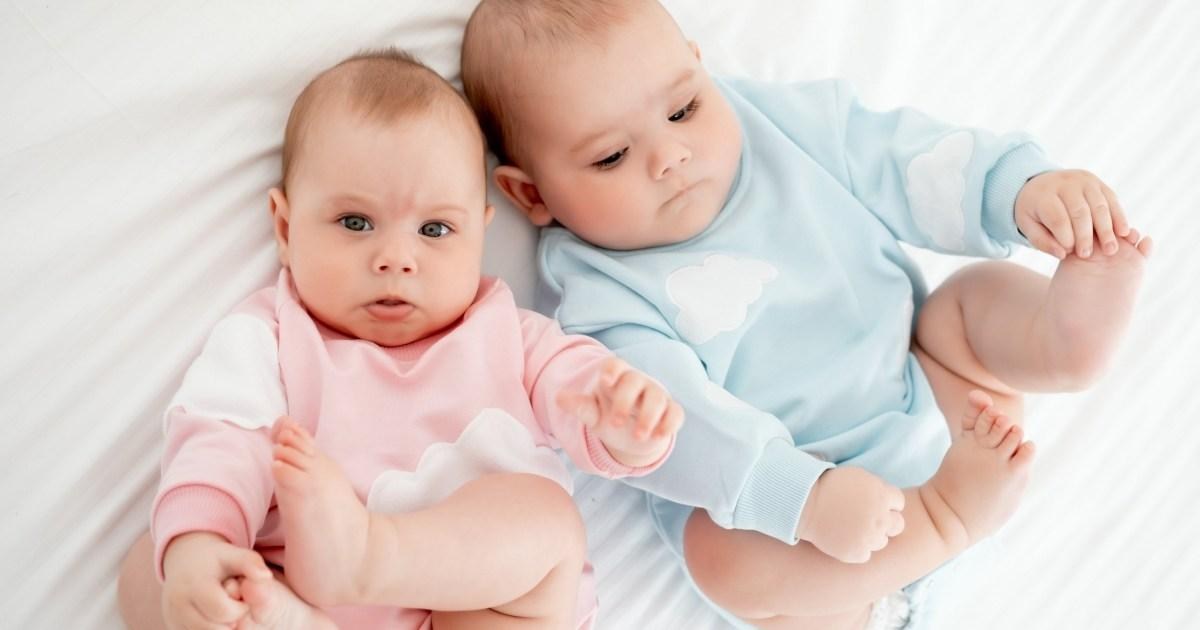
Babies of different sexes are different from birth, a study has revealed (Picture: Shutterstock / ANNA GRANT) The saying goes that men are from Mars and women are from Venus — and it turns out those differences develop sooner than you might think. According to new research, babies show certain personality traits, depending on their sex, within just hours of being born. The study, by the University of Cambridge, studied 130 newborns, in a bid to try and solve the nature vs nurture debate. The aim of the tests was to determine whether the differences between the sexes was present almost immediately — before society had time to have an impact. Published in the journal Biology of Sex Differences, the research found that newborn infants display distinct visual preferences depending on their sex, long before social or cultural influences can shape their development. While a study from the University of Cambridge in 2000 found that girls at birth, on average, looked longer at faces, and boys, on average, looked longer at objects, this new study used more robust methods, the university claims. 130 babies were tested within hours of birth (Picture: Shutterstock / KieferPix) Girls have a great preference for human faces In the study, the babies were shown side-by-side videos containing a human face (a social stimulus) and a a set of metallic balls swinging, known as a Newton’s cradle (a non-social object). Regardless of sex, both boys and girls preferred to look at the human face, but newborn girls showed a stronger preference, and spent more time looking at it. Meanwhile, the boy babies spent a greater proportion of time looking at the non-social stimulus. Ask Metro Use AI to go deeper into the stories you care about – powered by Metro and trusted publications. Since these results were recorded within hours of birth, researchers said it was likely that biological factors (such as hormone levels and genetics during pregnancy) contributed to this difference. Nature vs nurture Prof Sir Simon Baron-Cohen, director of the Autism Research Centre at Cambridge, who supervised the study, said: ‘This study addresses the age-old question of whether nature plays any role at all in shaping sex differences in the human mind and brain. ‘The fact that we observe these differences within hours of birth, before extensive postnatal experience has occurred, suggests that prenatal factors play a role and that these prenatal factors – sex hormones and/or genes – go on to interact with postnatal experience. Boys gravitate more towards construction sets (Picture: Shutterstock / goodmoments) ‘In other words, it’s nature and nurture, not nature or nurture.’ Yumnah Khan, a doctoral student at Cambridge’s Autism Research Centre and the lead researcher, added: ‘Our recent research has also shown that on-average sex differences are present in brain structure at birth and emerge prenatally. ‘This new study tells us that there are not only on-average sex differences in the brain but also in attention and behaviour.’ Links to long-term behaviour The research team has also said they are interested in finding out if these early differences between girls and boys contribute to later differences in a child’s mind, brain and behaviour. Currently, there is a longitudinal study underway, which hopes to unveil the origins of the sex differences. Scientists say this could help better understand neurodiversity, such as autism, which is twice as likely to be diagnosed in boys as in girls. Dr Alex Tsompanidis, an assistant research professor at the Autism Research Centre and a member of the research team, said: ‘Sex differences at birth are important as starting points, but we need to remember that they don’t fully determine how children learn and develop in later life. Newborn girls showed a stronger preference for looking at human faces than newborn boys (Picture: Shutterstock / Julia Zavalishina) ‘This is because biological and social factors always interact, contributing to the rich diversity of human societies.’ However, the experts note that these results were averages of the population, and individual children may fall outside the norms. Prof Carrie Allison, the deputy director of the Autism Research Centre and another member of the research team, stated: ‘There’s a lot of variation within, and overlap between, each sex. Our future research needs to better understand that variation.’ More parenting news from Metro Do you have a story you’d like to share? Get in touch by emailing MetroLifestyleTeam@metro.co.uk Arrow MORE: I gave birth outside KFC, so I’ve named my baby after the chain Arrow MORE: My parents want me to pay £6,500 for their anniversary trip while my brother goes free Arrow MORE: The 12 best pumpkin patches in and around London to visit this autumn
Boys and girls really are different — and it starts within hours of being born
Full Article
Original Source
Read the full article at Metro →KhanList aggregates and links to publicly available news content. We do not host full articles from third-party sources. Always verify important information with original sources.