
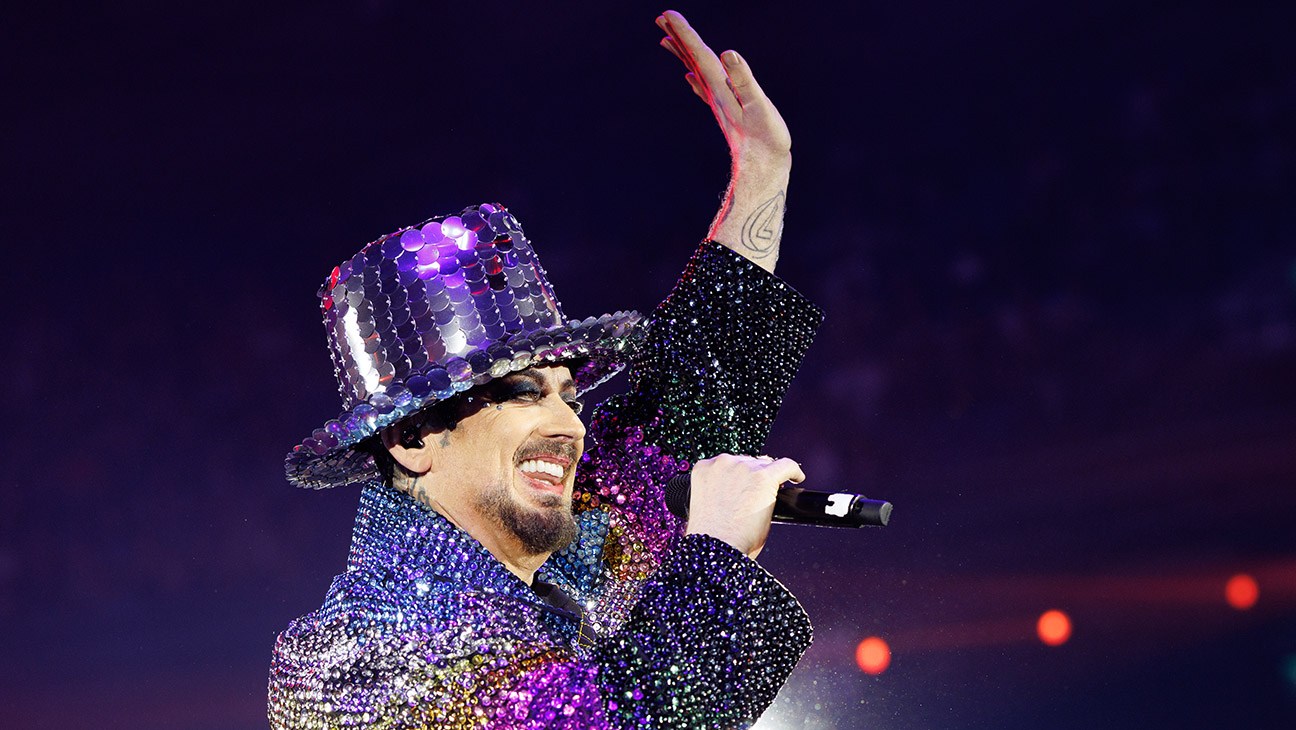
Boy George wrote his new single, “We Will Dance Again,” after visiting the Nova Exhibition in London, an immersive installation that commemorates the Oct. 7, 2023, attacks on the Nova Music Festival that resulted in the deaths of 378 people and 44 people taken hostage. He did it, he says, to send a message to his Jewish friends: “Not everybody hates you. You are loved.” The Culture Club frontman, 65, was not nearly prepared for the massive backlash that ensued, which spilled outside of social media into friendships that went back years. Among them was his collaborator Martyn Ware, the founder of New Wave bands like Human League and Heaven 17, who messaged him: “Shame on you.” Undeterred, he recently visited Israel and played two sold-out shows at Tel Aviv’s Menora Mivtachim Arena on Nov. 4 and 7. He also met with Israeli president Isaac Herzog and Nova survivors. With his single now officially released and available on most streaming platforms, Boy George checked in with The Hollywood Reporter on a stop in Chicago. He opened up about his Israel trip, explained why he used AI to make “We Will Dance Again” and revealed where he stands on the Ed Sheeran/Macklemore controversy that resulted in Sheeran’s entire band walking off of his world tour. What’s a memory you cherish from the trip to Israel? One of the sweetest things to me was people from London saying, “Oh, my aunt’s in Israel, can she come and see you? And will you say hello?” And I met a few friends of mine’s families that they haven’t seen for years. And just meeting the Nova survivors, that was probably the highlight of the whole trip, because you suddenly understand why this journey started in the first place. I saw the Nova exhibition in L.A. It’s a very, very dark exhibit. When you played Israel, didn’t some of the survivors come onstage with you? Yeah. There was about 13 survivors and also people that lost family. So it was a real mix of people. I think it was really beautiful to let people be seen. And obviously, as a performer, you are uncomfortable because you don’t want to hijack someone else’s experience. You want to show it respect, but at the same time, going to Israel was a massive statement, and I had to be bold about it. Somebody that reviewed my show said I should have snuck in quietly. I was like, “That wasn’t an option.” And sneaking in quietly right now is not helpful because nobody else is being quiet. So I don’t think it’s the time to be quiet. I think it’s the time to be clear and to be loving. And I’ve made some mistakes in my communication online. There are people I shouldn’t have bothered reacting to. You’ve said you’ve lost friends over this. Is there anyone you’d name? Martyn Ware, who was in Human League and Heaven 17. I’ve worked with Martyn. I did a version of “I Wanna Be Your Dog” with him, and we sung onstage together. He came out quite early and said, “Shame on you,” and all of that. I just tweeted back, “You’ve lost that loving feeling. “ Most of them I don’t want to name because I don’t want them to have any more attention than they’ve already had from me. You’ve said the music industry has been very one-sided on this. Do you find most people in the industry are anti-Israel? I don’t think they’re anti-Israel. I just think they’re not necessarily informed about history, and it’s become quite trendy to shout certain things out. There’s a lot of pressure to agree with everybody else. Your thought, my thought, are not the deciding factor on what happens in the Middle East. We’ve got nothing to do with it. We’re not going to change it. So what we can do is, in our immediate surroundings, be more loving, be more open, be more kind, respectful, all of those things that you can do. I was getting messages from friends of mine all over the world. Some people I didn’t even know were Jewish. And I’ve had letters from people. So there is a lot of support out there, but it is scared of itself. When I saw you speaking up for your Jewish friends on Ireland’s Late Late Show in May, I knew you had something in your heart that needed expressing. I didn’t realize to what extent it would end up expressing itself. When I decided to make this record, I was sending a message to my friends to say, “Not everybody hates you. You are loved.” And that’s the point I tried to make when I was in Ireland, is that growing up during the punk period, one of my biggest allies was a man called Philip Sallon. One of the first things he ever said to me was, “You look Irish.” And I said, “I actually am.” And he said, “I’m a Jew and a homosexual.” And that was 1976. And when you’re young and impressionable, you don’t forget those moments. And Philip was a big reason why I got to know so many Jewish people because in London, this one knows that one, that one knows that one. I can’t sit here and say every single Jewish person I’ve ever met I’ve got on with. Of course I haven’t. But Jewish people are characterful, they’re kind, they’re passionate, they’re funny, they’re bitchy. They’ve got all the qualities that I love. You said you used AI to make “We Will Dance Again.” What aspect of the song uses AI? The music I wrote with an AI tool. The melody I [wrote], the words I [wrote] And the reason I used AI was because I didn’t want somebody hanging over my shoulder saying, “Oh, you can’t say that. Oh, that’s too harsh.” And that would’ve happened because I’ve had 40 years of that. Forty years of “That’s too gay, that’s too this, that’s too that, that’s not commercial.” I make a lot of music. I put out almost 200 tracks in the last two or three years. So I’m always writing. In respect to “We Will Dance Again,” that line, that’s a hook. You hear it straight away. As a writer, you go, “Got it. I got it. OK, there we go.” Boy George Dean Stocking I saw a video where you were performing a concert and the music cut out and you kept singing a cappella. I couldn’t tell whether it was intentional sabotage or a technical snafu. What happened? I think it was a “technical snafu.” I love that word. I don’t think it was deliberate. There was a couple of moments when the mic went and I wasn’t sure whether I’d pulled out the wire. And also the guitar went out in a really pivotal moment, but I kept my cool. We were in the round, so there was nowhere to hide. When you’re in a proscenium situation, you can always dart off into a curtain for a minute, but in this instance, you couldn’t really leave. What it reminded me of is Ed Sheeran, who went onstage after his band walked out on him and did his show a cappella. In the moment, you always have to remember that people have paid to see you and that you’re there to perform. You can’t get lost in something, but it can really distract your whole evening. I think it’s really important to go, “No, no, no, I have to get through this.” Do you have anything else to say about Ed Sheeran in terms of that whole controversy regarding Macklemore being dropped from his tour? Obviously, the stadium owner, Robert Kraft, I know that he’s Jewish. He spent a long time fighting antisemitism, so he was never going to allow that to carry on where he worked, where he’s an owner. You have a choice who comes and sits at your dinner table, whether you’re a billionaire or a housewife, you make a choice. And if you’ve cooked the meal and paid for the building, you do have a right as a person, as a Jewish person, to say, “No, you can take your freedom of speech over there and do it on the street.” I told my editor that “Do You Really Want to Hurt Me” is like a Jewish mother song. (Laughs.) Absolutely.
Boy George on His Controversial Israel Trip, Ed Sheeran and the Friends He Lost Along the Way
Full Article
Original Source
Read the full article at Hollywoodreporter →KhanList aggregates and links to publicly available news content. We do not host full articles from third-party sources. Always verify important information with original sources.