
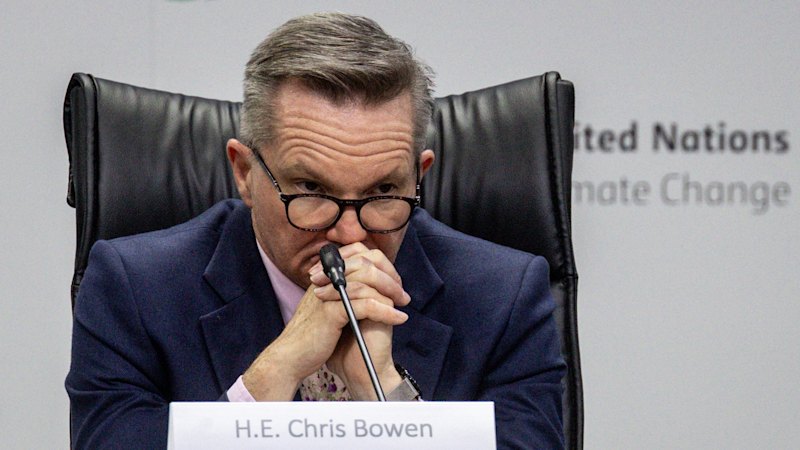
November 22, 2026 — 11:41amGlobal climate talks that should have concluded on Friday remain deadlocked, with negotiators expected to resume discussions on Sunday in Antalya, Turkey, amid questions about the strategy of Climate Change and Energy Minister Chris Bowen in leading the summit.Nations remain at loggerheads over a series of key issues. Small island nations that are vulnerable to climate change, including in the Pacific, insist that any final agreement, known as a cover text, include specific reference to reducing fossil fuel emissions. But that position has been objected to by oil-producing nations led by Saudi Arabia, and supported by Russia and some developing nations.Climate Change Minister Chris Bowen faces a crisis over the coming hours at the COP31 talks in Turkey.Getty ImagesSome nations in the same bloc have objected to a proposed agreement championed by Bowen to have the world commit to making 35 per cent of its energy use electric by 2035.“Things worth doing, in my experience, don’t come easy,” Bowen said during a press conference at the COP on Saturday. “And I’ll tell you what’s worth doing is electrification. Electrification is the key to transitioning away from fossil fuels.”Led by France and Panama, representatives from nations including Belgium, Côte d’Ivoire, Finland, Greece, Guatemala, Spain, Sweden and Vanuatu are demanding more ambitious climate action.“We cannot [tell] the world we are now getting to 1.5 [degrees of warming] and then do business as if nothing was happening,” said France’s minister for ecological transition, Monique Barbut.There is also disagreement over climate finance, and European Union Climate Commissioner Wopke Hoekstra called demands for increased pledges for finance from developing nations hit by climate disasters “dead in the water” before the talks even began.Finance has long between a contentions issue at climate talks, with developed nations wanting to maintain focus on reducing emissions, and developing nations demanding financial assistance to help them insulate their economies from the impact of warming that they did not cause. The dispute is becoming more complex as the talks continue, with donor nations arguing that some countries that were considered poor when the first climate agreements were made have since become more wealthy and should no longer be receiving support.A third area of deadlock in the current negotiations is over reference in the cover decision to the use of carbon capture and storage technology. While UN scientific assessments say that any effort to stabilise the climate will need to include removing carbon pollution from the atmosphere when the technology to do so at scale becomes available later in the century, many say that including reference to it now will simply be used as justification not to pursue emission reductions.If the standoff cannot be resolved, UN rules allow for the talks to be suspended until next year. That outcome would be a blow to Bowen, who created the role of president of negotiations at the talks when Australia failed to secure the hosting rights in a standoff with Turkey.Smoke from a wildfire in France in July. France is one of the countries pushing for greater climate action at COP.AFPThough it is not unusual for COP negotiations, which demand consensus agreement between the almost 200 signatories of the Paris Accord, to extend beyond deadline, they have only ever once been suspended without an outcome, when Kyoto Protocol talks collapsed in 2000.By Friday evening in Antalya, frustrated activists had begun to blame Bowen and his Turkish counterpart, Turkish Environment Minister Murat Kurum, for the failure of the COP to command support for ambitious climate action.“The COP presidents want to tell us this has been a great COP,” said Mohamed Adow, head of the climate group Power Shift Africa at a press conference convened by the Climate Action Network. “Well, I can tell you without any doubt that this has been the worst COP ever.”Dr Bill Hare of Climate Analytics.Others have questioned Bowen’s strategy of allowing nations to insert many ambitious claims in an early draft of the cover decision, and of even insisting that the talks include such a decision in the first place.Leading climate analyst Bill Hare, the director of Climate Analytics – a global non-profit climate science and policy institute – said Bowen made the right call, particularly given the UN’s scientific report published before the COP which said the world was set to miss its 1.5-degree target.“The urgency of the crisis is visible to everyone, and if the COP didn’t do anything visible about the urgency in a political sense, there would be bigger questions about there was any point [in the process] at all,” Hare said.“I think Bowen is right and correct and courageous to say we need to have a cover decision because it anchors things and provides a focal point for making some decent political signals.”Get to the heart of what’s happening with climate change and the environment. Sign up for our fortnightly Environment newsletter.Nick O'Malley is National Environment and Climate Editor for The Sydney Morning Herald and The Age. He is also a senior writer and a former US correspondent.Connect via email.From our partners
Bowen faces climate crisis as clock runs down on ‘worst COP ever’
Full Article
Original Source
Read the full article at Smh →KhanList aggregates and links to publicly available news content. We do not host full articles from third-party sources. Always verify important information with original sources.