
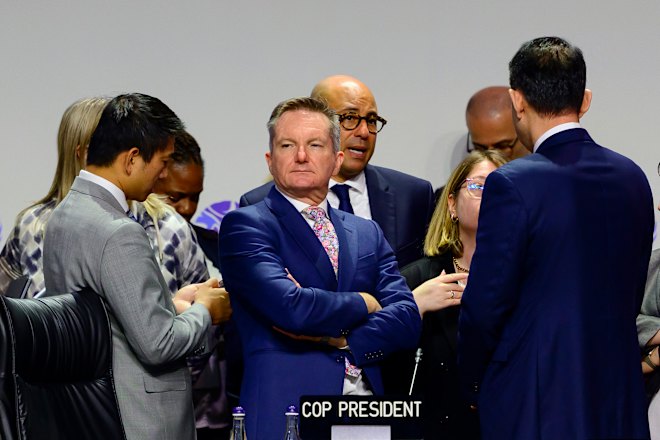
November 24, 2026 — 1:15pmClimate Change and Energy Minister Chris Bowen has defended his role in overseeing international negotiations saying he left “everything on the field” and blaming European and Arab nations for refusing to budge on four words in the final agreement that he described as “largely symbolic”.“It was alive until the end, literally until the last minute and we were very close,” Bowen said in an interview, referring to fraught negotiations that continued for 44 hours after the scheduled end of the meeting before imploding in public recrimination laid out in statements from delegations on the summit’s floor.At the heart of the disagreement was a bitter dispute over language about the world needing to “transition from fossil fuels” the European Union insisted must be in the final agreement. Saudi Arabia, leading a voting bloc known as the Arab Group, said it could not support the wording.Climate Change and Energy Minister Chris Bowen at the end of negotiations in Turkey.REUTERSBowen’s frustration was that the COP – the Conference to the Parties of the United Nations Framework Convention on Climate Change – had already agreed on this issue during a meeting in the United Arab Emirates in 2023.In the dying hours of this year’s talks Bowen, as president of negotiations, made this case to both delegations.“I said at, towards, the end, ‘Hang on, guys, you do realise what you’re calling for is entirely symbolic. We decided this. We settled it. It was a big fight. It was a miracle we got it at that time for a whole bunch of reasons. But we got it’,” he said.“‘If you make a test whether it’s repeated or not, you’re telling people we no longer support the transitional fossil fuels, which is not right... This COP will be gone if that’s your red line.’”As the COP moved deeper into overtime Bowen tried to find alternative language, and even included a reference to the UAE agreement in the preamble of one late draft, but said the European countries refused to shift.“I said, ‘Let’s make it the first thing you read – we recall the UAE consensus on mitigation and adaptation in its entirety.’ I got the Saudis to agree to that because it didn’t cross their red line, but Europe said that was too weak.“They [Europe] said to me ‘after the summer we’ve had, with all the climate crises, the wildfires, we have to be seen to fight for something.’ They said ‘we think no deal is better than a bad deal.’ I said I agree. But a good deal is better than a perfect deal that is unattainable.”Saudi Energy Minister Prince Abdulaziz had already faced criticism for accepting language mentioning fossil fuels in 2023 and was reluctant to do so again.Bowen said the failure of the COP over just four words also demonstrated how damaging the decision of US President Donald Trump to abandon the climate process has been to global efforts. The only reason Saudi Arabia agreed to transition from fossil fuels in 2023 was pressure applied by then US climate envoy, John Kerry.Bowen, who now faces calls from the Opposition to resign over his role in the talks, said he was “pretty pessimistic” about the future of international climate negotiations.“These are the red lines now,” he said.Despite the failure, Bowen believes transition away from fossil fuel is now inevitable due to the falling cost of renewables and batteries, and the increased cost of fossil fuels.“It’s happening, it’s irreversible. There is a transitional point for fossil fuels. The thing I’m disappointed about is that COPs are meant to send a message to boardrooms to keep going, and by making this a red line, we’ve actually sent the opposite message.”He said he did not believe the failure would prompt the government to reverse its course on climate, or alter its policies supporting batteries, EVs and renewables.“We always adjust policies to keep it fit for purpose. You know, and every fiscal event, a budget, any MYEFO [Mid-Year Economic and Fiscal Outlook] is an opportunity for some recalibration. But you know, fundamentally, would this drive any of those decisions? No.”Bowen defended the cost to Australian taxpayers, saying that Australia improved its international standing through its role, successfully bringing 44 of 60 mandated negotiating items to a close, and signing significant agreements with South Korea and China.“I don’t regret having a go. I don’t regret leaving nothing on the field. I don’t regret Australia stepping up as a middle power. I don’t regret any of that, and I wouldn’t walk away from Australia taking on tough jobs internationally,” he said.Get to the heart of what’s happening with climate change and the environment. Sign up for our fortnightly Environment newsletter.From our partners
Bowen defends his role in disastrous climate change talks, blames Europe and Saudi Arabia for implosion
Full Article
Original Source
Read the full article at Smh →KhanList aggregates and links to publicly available news content. We do not host full articles from third-party sources. Always verify important information with original sources.