
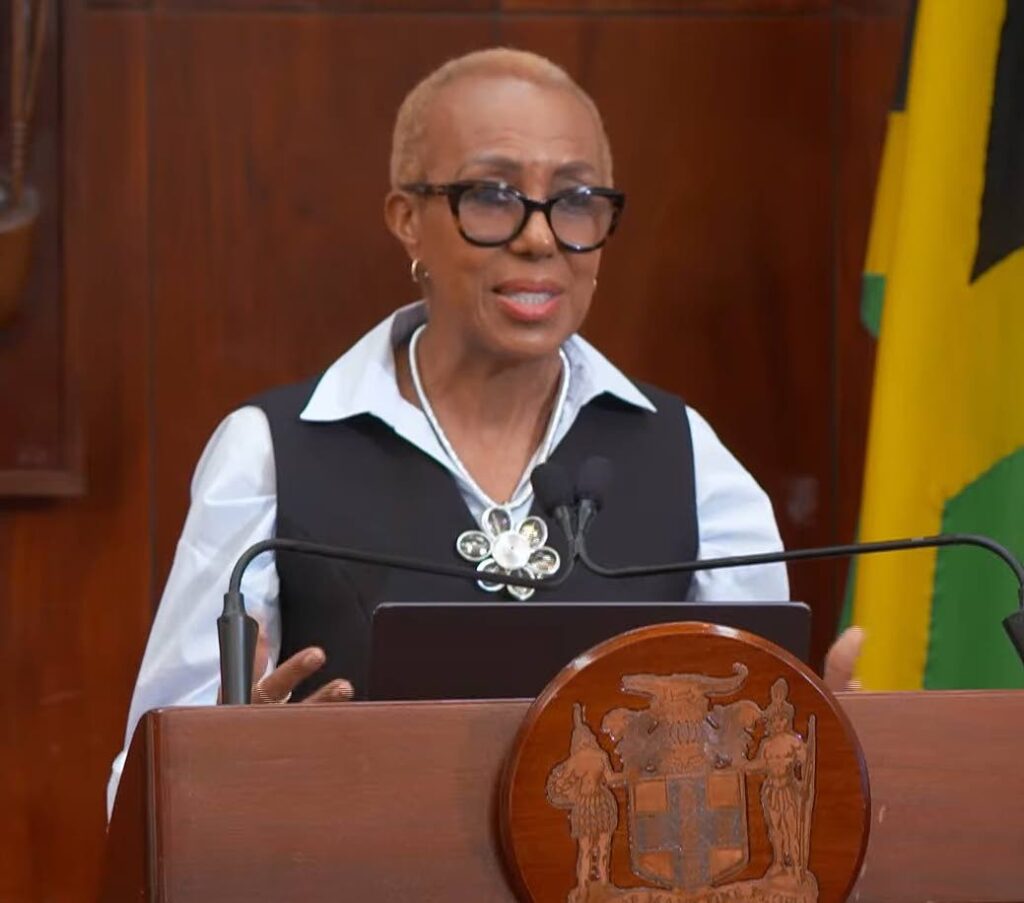
WILLIAMS...I see quarters that are becoming less negative and that is a good sign. CITING data that shows Jamaica 18 months ahead of schedule in recovering from the destruction Hurricane Melissa unleashed on several parishes last year, Finance Minister Fayval Williams on Wednesday painted a rosy picture of the country’s economy. She acknowledged, however, that “not everybody is feeling it just yet”, a nod to critics who have argued that the pace of the recovery and rebuilding is much too slow. During her upbeat PowerPoint presentation, the minister reeled off data to support her claims. “When I look at this chart, I see quarters that are becoming less negative and that is a good sign,” Williams stated. “And, no, this is not a picture of a recession. The Planning Institute of Jamaica (PIOJ) already debunked that notion,” she added. Williams highlighted that in the quarter following the hurricane, the economy contracted 7.1 per cent, then 4.1 per cent in the next quarter and just 2.9 per cent in the quarter, after that. She said the 2.9 per cent projection should be finalised by the Statistical Institute of Jamaica (Statin) by the end of September. The finance minister argued that the shrinking year-on-year numbers are themselves proof that the economy is recovering. She argued further that “an economy in decline produces deepening figures, not improving ones”. Williams urged Jamaicans to remember that immediately after the hurricane, PIOJ projected that the country would not get back to its pre-Melissa level of output until the last quarter of 2028. She noted that the PIOJ now expects that the economy will begin to see growth by the second quarter of 2027 — “six quarters earlier, a year-and-a-half earlier”. According to her, the PIOJ “has been able to revise their forecast because the out-turn keeps getting better”. The finance minister highlighted that where it was projected that the fiscal deficit would have been 3.8 per cent of gross domestic product (GDP) immediately after the hurricane, it instead came in at 2.5 per cent. At the same time the primary surplus was projected to be 1.3 per cent but came in at 2.3 per cent, while public debt-to-GDP was projected to rise to 68.9 per cent but came in at 65.6 per cent. Regarding the public debt-to-GDP number, Williams said, “That number matters, it is not a one-off, it’s because we had stronger nominal GDP, the economy itself is bigger than we assumed, and that is the kind of improvement that will persist.” PowerPoint showing diaspora remittances post-Melissa. She also pointed to the positions taken by the big three international ratings agencies with Moody’s upgrading its assessment of Jamaica just seven weeks after the hurricane, which it described as a “temporary setback”. Standard & Poor’s held its rating for Jamaica in December 2025 and moved the outlook to stable, while Fitch affirmed its BB-rating for Jamaica in February 2026 with a stable outlook. Williams also pointed out that while unemployment rose from 3.3 per cent to 3.7 per cent following the hurricane, it remained at record lows. She acknowledged that unemployment in the hardest-hit parishes was higher. “I want to assure them that the Government continues to work night and day to restore the west — to restore roads, water, housing, all the services, employment, schools and so on,” she said. Williams also noted that the response from the Diaspora helped to stabilise the economy, as is evidenced in the record level of remittances that were sent to Jamaica in the aftermath of the hurricane. A breakdown of the numbers shows that, in November, the Diaspora sent remittances totalling US$273 million, up 16 per cent. December saw a record US$296 million being sent. The figure was up 16.3 per cent for the month. Of note is that all of the hardest-hit parishes received more in remittances than before the hurricane. In the first three months after the storm, Jamaicans abroad sent home US$93 million more than they sent in the same three months a year earlier. On the matter of inflation, the finance minister insisted that, while it was expected that food prices “would run away” following the devastating hurricane, they did not. She pointed out that inflation moved to 2.9 per cent in October 2025, 4.4 per cent in November 2025, and 4.5 per cent in December 2025 — all within the target range for the Bank of Jamaica. This, she said, was because agricultural production recovered faster than expected. “Because of that, the price shock was contained,” the minister remarked. However, Williams acknowledged that by July 2026 the picture had changed completely, with headline inflation surging to 7.5 per cent — the driver being the transportation division, which was up 13.6 per cent. She said based on figures released by Statin on Tuesday, whereas transportation had pushed up inflation in July, it was higher food prices, as a result of the ongoing drought, which drove inflation in August. While transportation is still a factor, the finance minister said the August inflation number is directly attributable to the upheaval in international markets, driven by the United States war on Iran which has pushed up oil prices since February.
Bouncing back fast
Full Article
Original Source
Read the full article at Jamaicaobserver →KhanList aggregates and links to publicly available news content. We do not host full articles from third-party sources. Always verify important information with original sources.