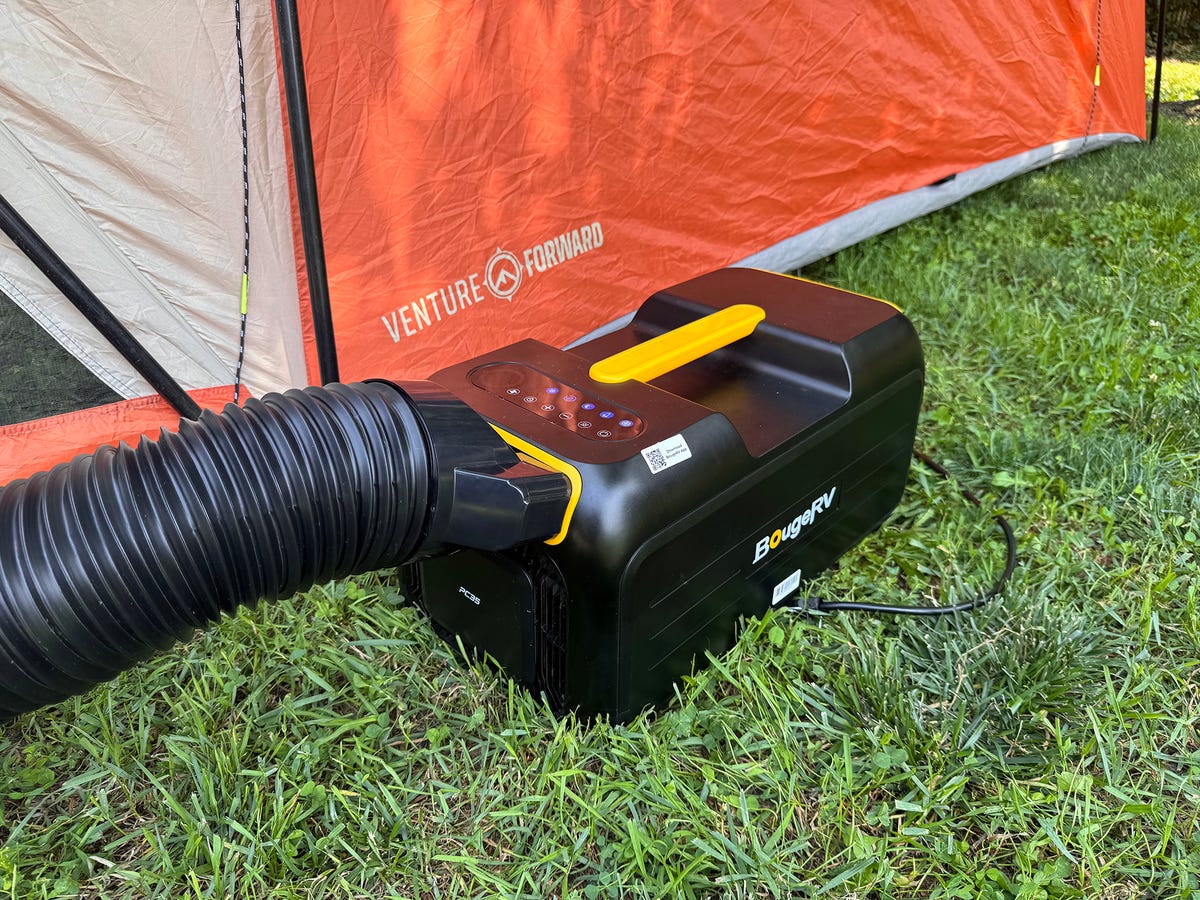
5 min readIt was the Fourth of July weekend, and I had just set up my tent at a campground in the Pocono Mountains of Pennsylvania. It was hot. Not just typical summer hot; more than 100-degree Fahrenheit heat wave hot. Luckily, I had two things going for me: a 20-amp electric hookup at my campsite and a portable “tent” air conditioner by BougeRV. It was the perfect opportunity to test how well I could cool things off.I know what you’re thinking: the whole point of camping is to get out into the fresh air and experience nature, far from the indoor trappings of a climate-controlled world. But when the inside of your tent feels like a sweat lodge—even after the sun goes down—the luddite ambitions of roughing it turn a lot less alluring. For me, that moment of weakness was worth the chance of getting a good night's sleep.ProsQuiet operationLightweight and easy to carry aroundDraws lower power compared to most portable air conditionersConsThe attachable air duct fits too loosely and can easily be dislodgedWon’t cool a vented tent that well in the middle of a very hot dayKey SpecsCooling Power 3,500 BTUCooling Area Up to 212 cu ftVoltage100-120 V (AC)Noise Level55 dBWeight34.17 lbEasy to Use and TransportI’ll be the first to admit that I laughed a bit when I heard someone mention the term “tent air conditioner.” I envisioned something that would be too large and loud to use productively. But the BougeRV PC35 defied my skepticism. It’s fairly compact, lightweight, and has a built-in handle, making it easy to pack for a trip and move around. There’s an attachable accordion-style flexible air duct that’s essential to operation. It’s collapsible and fits easily in a small bag. The A/C runs quietly at 55 decibels, which is less intrusive than any air conditioner I’ve ever used.In terms of power, the PC35 runs on a standard alternating-current outlet (100 to 120 volts) or a power station that can provide at least 2,000 watts of AC surge power (the unit can briefly jump to that when the compressor starts up, though in my test it jumped only to 900 watts). After startup, the power draw levels out at around 400 to 500 watts, which is lower than that of most portable air-conditioning units, though it can increase if you use high-power mode (mine jumped to 600 watts).David DritsasYou can set this unit inside or out. In this setup, the air duct attaches to the rear vent to send the hot air exhaust outside of the tent.There are also several uses for this model. It works as an air conditioner, of course, but also has fan-only and dehumidifier modes. For air conditioning, the temperature can be set between 61 and 90 degrees Fahrenheit, and there’s a “rocket” mode that boosts the cooling power if you’re trying to lower the temperature quickly. The controls for all of this are easy to operate using backlit, touch-sensitive buttons on the top of the unit, or you can control it using a Bluetooth connection and a mobile app.But Can It Really Cool a Tent?With the sweat pouring down like a running faucet, I couldn’t fire this thing up fast enough after I set up my tent. There are two ways to do it: placing the unit inside the tent and venting the hot exhaust air outside through the air duct, or placing the unit outside and sending the cold air in. The PC35 pulls air in from intake vents that are situated just below the output vents.At first, I placed the unit inside the tent, figuring that a more direct approach would cool things down more easily. I attached the air duct to the exhaust vent (which, frustratingly, was never secure enough for my taste—it was easy to knock out of place by accident) and extended it out of the tent through one of the main doors that I zippered closed around it. But after letting it run for about 20 minutes, I changed my mind.David DritsasI set the unit outside in a cooler, shaded area and used the air duct to send the cold air into the tent, through an opening in the zippered door.The interior of the tent was still very hot (it was 103 degrees out and the sun was shining directly on the roof), and I noticed that the PC35 can get quite warm itself, especially near the back, where the exhaust vent is located. I worried that this was causing the PC35 to work against itself, so I reversed the order of operations, moving the unit outside to the shaded side of the tent and switching the air duct over to the output vent to move the cool air into the tent through the door. It was hard to tell if this worked better, but it did seem to keep the unit running cooler.Full disclosure: my 10- by 12–foot cabin tent is a bit larger than the PC35 is rated for, and while I zipped up all the windows and doors, there’s ventilation at the top that cannot be sealed—that setup is imperfect. Even so, my tent does a great job of keeping heat in when I’ve used a small space heater in colder weather, so my hope was that the A/C would come close enough.David DritsasThe air duct attaches to the front or back vent, depending on where you place the main unit. It’s easy to switch, but I found it was easy to knock out of place by accident.It was not quite the case. During the day, even set to 61 degrees, the PC35 was barely able to get the temperature down to anything I could call cool. There was some improvement, but not enough to take a comfortable nap during a heat wave.Luckily, it worked more effectively after sunset, when it didn’t have to fight against the heat of direct sunlight. The nighttime at the campground was still hot and humid, but the interior of my tent lowered to a comfortable sleeping temperature, and once I went to bed, I even used a sheet and a light blanket to keep from getting chilly. I slept soundly, which is more than I can say for some of my neighboring campers, who were jealous of me the next day.Is This Tent Air Conditioner Worth It?I think the BougeRV portable tent air conditioner can work well if you have a smaller tent or one that is better insulated than the one I have. Overlanders who have built-in car inverters or good-sized power stations would get good use out of this, too, if they’re sleeping in their cars. But if you do have a larger ventilated tent, as I do, don’t expect to turn it into a crisp, cool oasis, especially during a heat wave. That observation aside, I’m glad I had it when I did, because the night would have been way too uncomfortable without it.Purchase the BougeRV Portable Tent Air ConditionerOther Editor-Recommended Camping GearYETI YETI Tundra 45 CoolerREI Co-op Base Camp 6 TentBest Ultralight Camp ChairHelinox Chair One Camping ChairDavid is a Reviews Editor for Hearst’s Enthusiast Group, contributing to Popular Mechanics, Runner’s World, Bicycling, Best Products, and Biography. He has over 25 years of experience writing about and reviewing consumer electronics, kitchen appliances, DIY products, outdoor gear, and more. He also spent years covering the ever-changing world of online retail. To relax, he loves experimenting with new recipes, tweaking his smart home setup, and spending time outdoors on his bike or camping.
BougeRV’s Tent Air Conditioner Can Really Help on a Hot Day—Just Don’t Expect a Miracle
Full Article
Original Source
Read the full article at Popularmechanics →KhanList aggregates and links to publicly available news content. We do not host full articles from third-party sources. Always verify important information with original sources.