
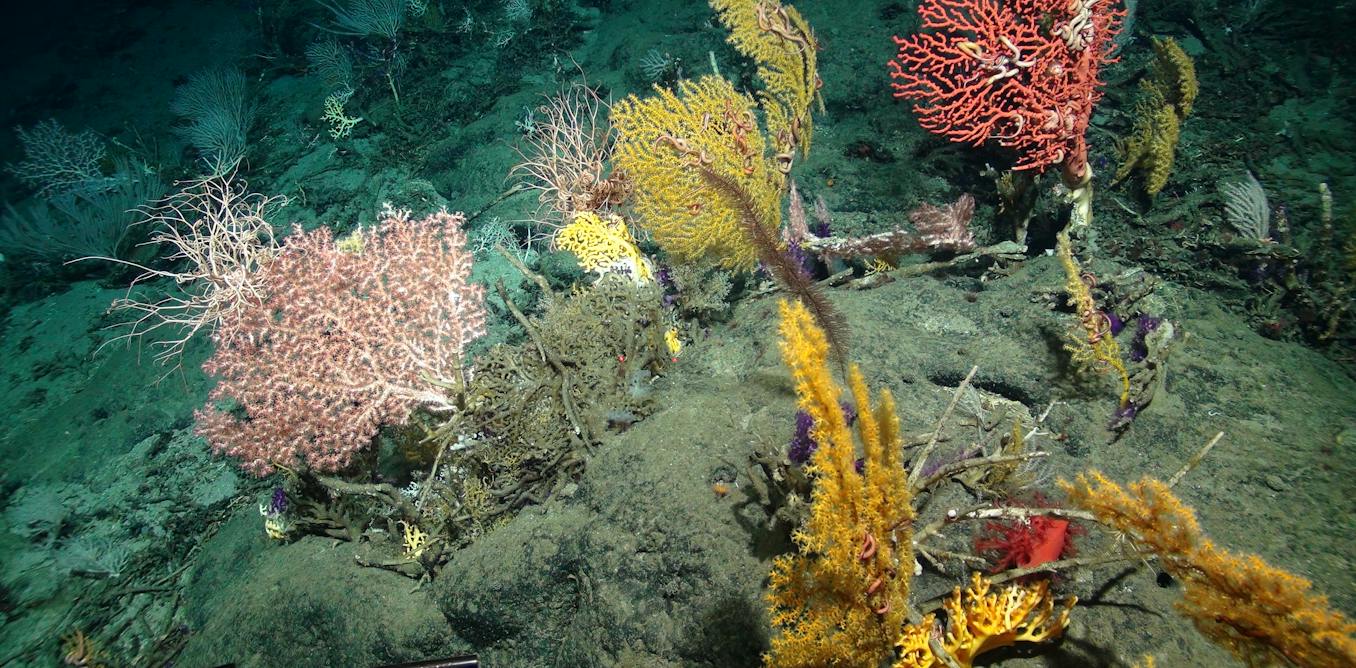
Tens of thousands of underwater mountains dot the ocean floor around the world. A few break the surface, such as the Hawaiian island chain. The rest are seamounts, peaks and pinnacles rising from the deep seafloor. Some lie just a few metres below the surface, while others rest deeper. For many creatures, a seamount is an oasis in the vast open ocean. Deep-ocean currents flow up their slopes, bringing cold, nutrient-rich water towards the surface. These undersea mountains are often home to colourful cold-water coral reefs and gardens of ancient sponges. Fish, turtles, sharks and whales use seamounts as breeding, feeding and migration sites. But these biodiversity hotspots are at real risk. Their abundance of life has made them a magnet for the most destructive type of fishing – trawling. For decades, trawlers have targeted seamounts, towing heavy nets with weighted rollers across them. This week, there’s a chance this highly destructive practice could be phased out across seamounts found in international waters, where no nation has exclusive rights. Seamounts are vital oases in the open sea. NOAA, CC BY-NC-ND What’s the problem with bottom trawling? The goal of bottom trawling is to scoop up commercially valuable species, such as orange roughy and toothfish. But each catch comes at a direct cost to everything else living on the seamount. Trawlers drag enormous fishing nets for kilometres across the slopes and summits of seamounts. These nets can be 80 to 200 metres wide and are held open by heavy metal doors weighing up to five tonnes. Slow-growing deep-sea corals and sponges can live for centuries or even millennia. These species act like shrubs and trees on land, providing shelter, feeding grounds and nurseries. When they are destroyed, their vital ecological roles are lost. More concerningly, scientists have found no evidence that any seamount has fully recovered after trawling stops – even 40 years later. David Attenborough’s recent documentary, Ocean, gave a rare view of the damage trawling can do. David Attenborough’s Ocean documentary captured the damage from trawling. Where is seamount trawling still occurring? It’s been 20 years since the United Nations first called for the protection of vulnerable marine ecosystems such as seamounts. But almost all seamounts in international waters remain exposed to what the UN has called the “greatest current threat to seamount ecosystems” – bottom trawling. This week, nations are negotiating the UN’s Sustainable Fisheries Resolution. On the table is a proposal to phase out bottom trawling on seamounts in international waters by the end of 2027. The proposal is significant. It’s the first concrete measure – with a deadline – offering a pathway to protection. Protecting seamounts is not only possible, but already progressing. Bottom trawling is no longer allowed on seamounts of fishable depths in the Northwest Atlantic. Seamounts have also been closed to trawling in other parts of the Atlantic and the Indian Ocean. But these represent a small fraction – just 1.5% of known seamounts are currently protected. In the South Pacific, seamounts and underwater ridges such as the Lord Howe Rise, lying off the east coast of Australia, are still trawled. Bottom trawling catches lots of fish – but can damage entire ecosystems. Laura Ragsdale/Getty Momentum has been building Momentum has been building since nations signed the 2022 Global Biodiversity Framework, which set a goal of protecting 30% of the oceans by 2030. Over the last two years, conservation authorities such as the International Union for Conservation of Nature have pushed for seamount protection. The UN Convention on Migratory Species responded by adopting a new resolution on seamount conservation. The High Seas Treaty (formally known as the BBNJ Agreement) also came into effect this year, ushering in better protection for marine life in international waters. Scientific evidence has continued to accumulate. Over 400 scientists have signed the Seamounts Proclamation, urging governments to act on the science by ending bottom trawling on seamounts in international waters. For major ocean nations such as Australia, these negotiations represent a rare chance to progress a phase-out. Australia has long taken a strong stance on bottom trawling in international waters, and has played an instrumental role in fisheries management in the South Pacific. The question is whether this momentum and scientific evidence will translate into a firm agreement to phase out this destructive practice – and begin protecting these oceanic oases. Dr Lissette Victorero, Deep-Ocean Stewardship Initiative Fisheries Working Group lead, contributed to this article.
Bottom trawlers do huge damage to life on undersea mountains. Could an end finally be in sight?
Full Article
Original Source
Read the full article at Theconversation →KhanList aggregates and links to publicly available news content. We do not host full articles from third-party sources. Always verify important information with original sources.