
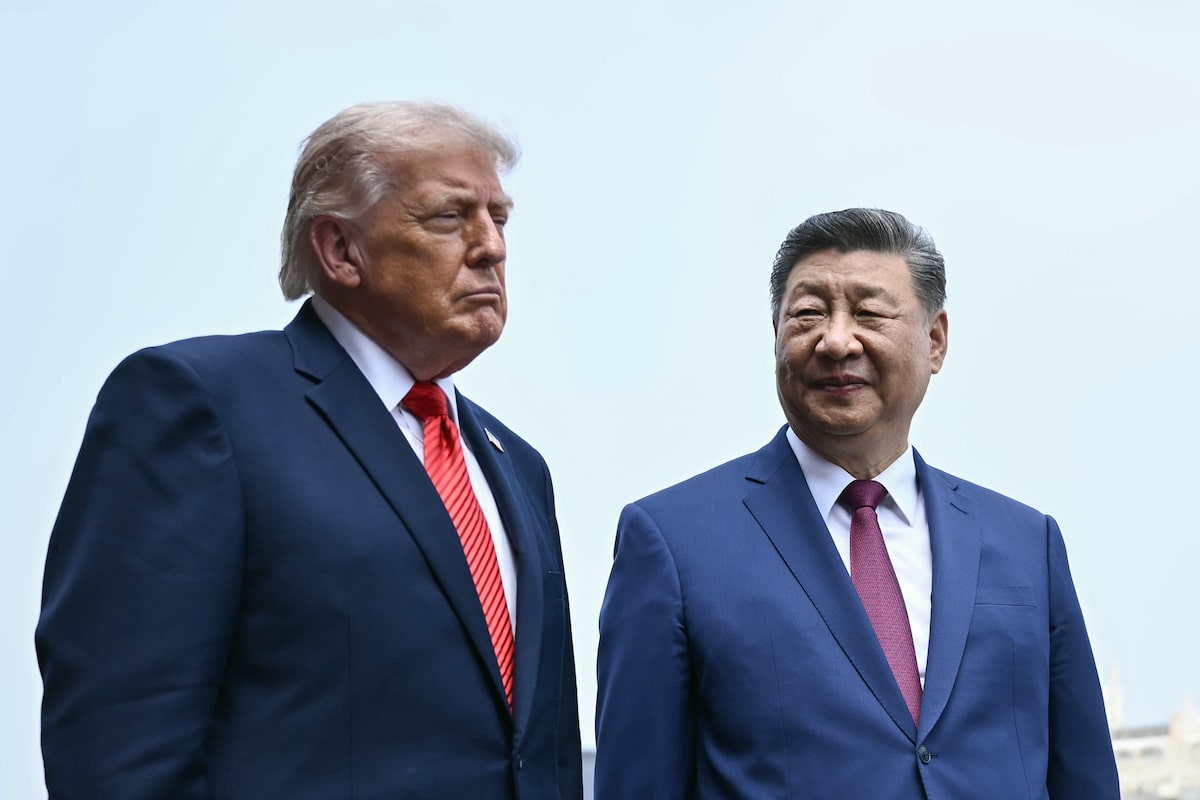
Open this photo in gallery:China's President Xi Jinping and U.S. President Donald Trump visit the Temple of Heaven in Beijing, May 14.Brendan Smialowski/The Associated PressChinese President Xi Jinping is heading to Washington this week for his first state visit to the United States in a decade, arriving in a vastly stronger position than when he met with then-President Barack Obama in 2016.President Donald Trump is bogged down in Iran, a war that has caused the price of oil to surge and created critical shortages of food around the world. He is facing plummeting approval ratings at home. And while both Beijing and Washington have been keen to avoid any major disruptions to the relationship, after a tariff dispute last year that threatened to spiral out of control and cut off almost all trade between the world’s two largest economies, the chances of a major breakthrough in trade talks at this meeting are slim. How have previous visits gone? As China’s leader, Mr. Xi has visited the U.S. six times, though only the 2016 trip was a state visit, with all the pomp and ceremony that we will see this week. Other trips included a stopover at Mar-a-Lago during Mr. Trump’s first term in 2017, where the two men shared what Mr. Trump described as a “beautiful piece of chocolate cake” while he signed off on missile strikes against Syria. But Mr. Xi’s connection to the U.S. goes back even further, to when he was a 31-year-old junior official in 1985, when he led an agricultural delegation to Iowa and stayed with an American couple, Thomas and Eleanor Dvorchak, in Muscatine. Open this photo in gallery:Members of the U.S. military rehearse for Chinese President Xi Jinping’s official visit to the White House on Sept. 16 in Washington, DC. President Donald Trump is expected to welcome Xi to Washington on Sept. 24.Chip Somodevilla/Getty ImagesLast year, Chinese state media hailed Mr. Xi’s “four-decade bond” with the Dvorchaks and many other friends in Iowa with whom he has stayed in contact, saying it was an example of the “extensive common interests and broad space for co-operation” between the U.S. and China. Meeting with the Dvorchaks during a stopover in Iowa in 2012, when he was still Vice-President, Mr. Xi told them, “To me, you are America.” This personal fondness for the U.S. has not stopped Mr. Xi from taking a tough stand against Washington, however. During his almost 15 years in power, as China has assumed true superpower status, tensions have grown significantly across a host of issues, from trade and allegations of Chinese economic malpractice to Beijing’s ambitions in the South China Sea, Taiwan and now the new frontier of artificial intelligence. Trade After returning to office last year, Mr. Trump almost immediately launched a trade war with China, imposing tariffs on a host of goods. But while many other countries − including, initially, Canada − tried to negotiate with Mr. Trump, Beijing called Washington’s bluff and matched the U.S. levy for levy. Eventually, both sides agreed to de-escalate the situation and have been hashing out a more comprehensive trade arrangement ever since. Families of Jimmy Lai, Min Zin plead for release ahead of Xi’s U.S. visitWhen Mr. Trump travelled to Beijing in May, he said the relationship would be “better than ever before.” But there has been little tangible progress, and analysts are skeptical there will be any breakthroughs this week. “There is a huge incentive to keep strategic stability going and have regular meetings − but not do anything at them,” said Antonia Hmaidi, an analyst at the Berlin-based Mercator Institute of China Studies (MERICS). “I think, in general, both sides are really happy to kick the can down the road and get what they need done domestically. Until then, it’s about how to manage what is really a decoupling relationship.” For its part, China has been working since Mr. Trump’s first term to reduce its reliance on the U.S. and shore up its economy against pressure from Washington. This strategy was made easier after Mr. Trump’s aggressive trade policy prompted many U.S. allies, including Canada and the European Union, to repair relations with China, despite their own longstanding concerns about trade imbalances and export controls. Open this photo in gallery:President Donald Trump and Chinese President Xi Jinping, sit as they pose for photographers before a meeting at Mar-a-Lago, April 6, 2017, in Palm Beach, Fla.Alex Brandon/The Associated Press“Xi is not really looking for anything tangible. He wants to extend the gentleman’s agreement with Trump so that China has time to fortify itself,” said Jon Czin, a former China director at the U.S. National Security Council.Mr. Trump’s war in Iran and on-again-off-again global tariff regime has already raised prices at home, so there is little incentive for Washington to reimpose levies on China that would be met with tit-for-tat tariffs.On Sunday, U.S. Treasury Secretary Scott Bessent said a board of trade agreed to by both sides earlier this year − essentially a rehash of a dialogue that existed under President Joe Biden but was scrapped by Mr. Trump − is now operational. However, while this is likely to produce agreements on agricultural products and other less controversial goods, few observers expect the body to secure breakthroughs on issues such as rare earths, computer chips or export controls.Taiwan The self-ruled island of Taiwan, which China claims as its territory and the U.S. has commitments to protect, is always a thorny issue when the leaders of both countries meet. Under Mr. Trump, serious questions have been raised about whether Washington would intervene to defend Taiwan against a Chinese invasion, and many observers were alarmed when Mr. Trump paused a planned arms sale to Taipei around the time of his Beijing visit in May. Opinion: China’s scared, too: Behind every power, domestic insecurity lurksThat sale still hasn’t gone through, something Ms. Hmaidi said was typical of U.S. policy of avoiding any major disruptive moves in the months leading up to a Chinese state visit. It’s unclear whether Mr. Trump will finally sign off on the sale after Mr. Xi leaves or continue to hold off, given the possibility of a second visit to China this year, for an international summit in Shenzhen in November. Open this photo in gallery:Chinese Defence Minister Dong Jun leaves the stage after delivering the keynote speech at the opening ceremony for the Beijing Xiangshan Forum in Beijing, China Sept. 16. Dong Jun pointedly did not mention Taiwan.Florence Lo/ReutersChina’s messaging on Taiwan is often hard to parse. Beijing has never ruled out seizing the island by force, but even with U.S. forces in Asia reduced and resources stretched by the war in Iran, there are no indications that China is preparing for an invasion in the near term. And indeed, Iran’s successful resistance to the U.S. and Israel has demonstrated the risks of assuming that a larger power can easily steamroll a smaller one. Mr. Trump has previously suggested that arms sales to Taiwan could be a “very good negotiating chip” in trade talks. But he has also made more forceful comments opposing any formal declaration of independence by Taipei than previous U.S. leaders, alarming some in Taiwan. “A shift in the U.S. narrative around Taiwan would be a key win for Beijing,” said Mikko Huotari, the executive director at MERICS. “The Chinese will be pretty straightforward in making their demands, but I don’t think the U.S. will cave for any kind of business relationship. It would be a major loss for the U.S. side to give up anything on this issue.” In a speech last week, Chinese Defence Minister Dong Jun pointedly did not mention Taiwan, something Wang Yiwei, the director of the Institute of International Affairs at Renmin University in Beijing, said was indicative “that Taiwan is not a current focus of China-U.S. discussions.” Iran If the U.S. doesn’t want to talk Taiwan, then the topic Mr. Xi would most likely wish to skip is Iran. Since the start of the latest U.S. war in the Middle East, Mr. Trump has been trying to get China to pressure Tehran, a key trading partner, to come to the table or accept a peace deal that Iran’s leaders view as unacceptable. But while Beijing opposes the war and warned both sides against allowing it to spread to the wider region, Mr. Xi has made clear that he will not be pulled in and that this is a mess for the U.S. to clean up, even as Mr. Trump has threatened “tremendous economic consequences” for ongoing Chinese trade with Iran. Despite this rhetoric, last week Mr. Trump brushed aside reports that Iran used Chinese satellite imagery in an attack on a U.S. base in Jordan, and there has been no indication he is willing to risk relations with Beijing over this issue. AI Open this photo in gallery:U.S. Treasury Secretary Scott Bessent speaks to the media after meeting China's Vice Premier He Lifeng, at JPMorgan Chase's global corporate headquarters in New York City, US, Sept. 20. Bessent says that U.S. and Chinese negotiators were moving forward on a new AI safety notification mechanism.Vincent Alban/ReutersOne area of potential co-operation, rhetorically at least, is on the issue of artificial intelligence. Both China and the U.S. have expressed concerns about the misuse of AI, particularly when it comes to national security. Mr. Bessent said Sunday that U.S. and Chinese negotiators were moving forward on a new AI safety notification mechanism, similar to the hotline established by Washington and Moscow to reduce the risk of unintentional nuclear escalation during the Cold War. How such a mechanism would work in practice is unclear, however, and comparisons between AI and nuclear disarmament are flawed, Ms. Hmaidi said. “With nuclear weapons it’s relatively simple to verify broad claims the other side makes − it’s hard to hide huge numbers of nuclear weapons somewhere. With AI, this isn’t the case,” she said. While leading AI figures have recently issued a call to “pace the frontier” − that is, slow down the development of advanced models − this has not attracted much support in either Washington or Beijing. “As long as either side believes that developing more AI or better AI could give them a decisive advantage, there is no incentive to pace in a real way,” Ms. Hmaidi said. “Even if they have an agreement, if you don’t trust the other side − and currently the trust on a government level is so low − how do you not get into an arms race on development?”With files from Alexandra Li in Beijing and Reuters
Both Trump and Xi will be eager to avoid certain topics at their meeting this week
Full Article
Original Source
Read the full article at Theglobeandmail →KhanList aggregates and links to publicly available news content. We do not host full articles from third-party sources. Always verify important information with original sources.