
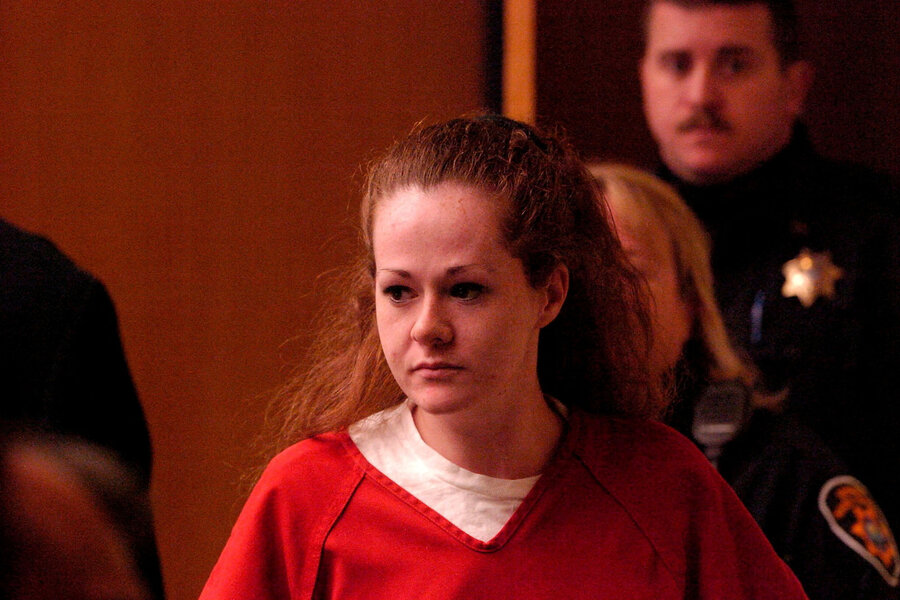
The United States is at a crossroads on the divisive question of capital punishment after a botched execution of a Tennessee woman was followed this week by the Trump administration’s announcement of plans to livestream an upcoming firing squad execution.Tennessee saw its second bungled execution in six months on Sept. 30, when a lethal chemical failed to kill Christa Pike, a convicted murderer. Just over a week later, Defense Secretary Pete Hegseth announced that military death row inmate Nidal Hasan, who killed 13 soldiers and wounded 32 others at a U.S. Army base in Texas in 2009, would be put to death via firing squad. The Pentagon has said it will be livestreamed for the public.The events, taken together, have fueled a new phase in the public debate about the overall use – and moral implications – of the death penalty. Mr. Hasan’s execution would be the first military execution since 1961. “It’s not unheard-of to find some way to have people see [an execution], but to have it actually public, this would be an entirely new thing,” says Michael Trotti, a legal historian at Ithaca College and author of “The End of Public Execution: Race, Religion, and Punishment in the American South.”“It is just so far down the list in terms of what most people think of as being the most humane that it seems like the purpose of it is to shock.” Brigitte Woosley/AP/FileThis courtroom sketch shows Nidal Hasan during his court-martial, Aug. 6, 2013, in Fort Hood, Texas. Mr. Hasan represented himself against charges of murder and attempted murder for the 2009 attack that left 13 people dead at the U.S. Army base and openly admitted during the trial to carrying out the attack. A military jury convicted him on all counts and sentenced him to death. While several Republican lawmakers said Friday that they welcomed a livestreamed execution as a deterrent, other GOP members rejected the Pentagon’s proposal as a corrosive spectacle. “Public executions are what oppressive dictatorships like Iran and Afghanistan do,” said Republican Sen. Thom Tillis of North Carolina. “It should not be happening in America.” Vice President JD Vance said, “If livestreamed, I’m not going to be watching.”Witnessing graphic executions could end up being a public spectacle, an effective deterrent for other would-be criminals, a matter of public revulsion, or all three, says Michael Radelet, a sociology professor emeritus at the University of Colorado Boulder, who has studied the history of botched executions. One possible consequence, he says, is that graphic public executions “would likely fuel anti-death penalty sentiment.”Current capital punishment lawThe death penalty is legal in 27 states, plus under federal and U.S. military law, though four states have governor-imposed moratoriums on capital punishment. Once public spectacles, executions now occur privately inside prisons, with only a handful of official witnesses and a press pool. While lethal injection is the national norm, states vary; South Carolina defaults to electrocution, and Idaho uniquely mandates the firing squad as its primary method. Nine states authorize the electric chair, while only five – Idaho, Mississippi, Oklahoma, South Carolina, and Utah – allow firing squads. On March 7, 2025, South Carolina executed Brad Sigmon by firing squad, marking the first U.S. use of the method in 15 years. George Walker IV/APChrista Pike's attorneys Luke Ihnen (center) and Randy Spivey (left) speak to reporters after a court hearing Oct. 7, 2026, in Nashville, Tennessee. At the hearing, a judge granted their request for the Tennessee Department of Corrections to preserve all evidence related to the failed execution of Ms. Pike. In the recent case of Ms. Pike, the debate around death penalty practices erupted after two injections of a strong sedative failed to complete a jury’s order of death for her role in a 1995 murder.Her lawyers are now arguing that subjecting her to another execution by a method that she survived amounts to a violation of the Eighth Amendment’s ban on cruel and unusual punishment. “The state can’t guarantee that would be avoided the second time,” says Christopher Slobogin, director of the Criminal Justice Program at Vanderbilt Law School.“If she wins that, lethal injection would be off the table,” adds Professor Slobogin. “This is such a mess that the right move is probably to commute the sentence, because that would nullify the hullabaloo about whether the state is able to carry out any execution completely.”Execution politicsAmericans are divided on their views of the death penalty. Overall support for capital punishment has been declining since the early 1990s, according to Gallup polling. Support peaked in 1994 at 80%. By 2025, Gallup data showed support had dropped to a five-decade low of 52%.In the last decade, four states have repealed the death penalty, and another, Washington, took this sanction off its statutes after the state Supreme Court struck it down. Meanwhile, a few other states, such as Florida and South Carolina, have stepped up the pace of executions. John Gaps III/AP/FileTimothy McVeigh, identified as a suspect in the bombing of the Oklahoma City federal building that killed 168 people, is led out of the Noble County Courthouse in Perry, Oklahoma, by state and federal law enforcement officials, April 21, 1995. Mr. McVeigh was later convicted and executed by lethal injection on June 11, 2001, in Terre Haute, Indiana, for planning the fatal bombing. As for public exposure, there are precursors to the possible livestreaming of Mr. Hasan’s execution. The execution of the Oklahoma City bomber, Timothy McVeigh, was streamed via a closed circuit so survivors and family members of those killed could watch. And in the mid-1990s, talk show host Phil Donahue, who opposed the death penalty, tried to get approval to show an execution videotape on live TV. But the Supreme Court denied his request.Executing Mr. Hasan publicly might turn out to be a moment for Americans to reevaluate capital punishment practices more directly, some legal experts say. “If we really want to kill people in a competent way and do things efficiently, a firing squad might be the best way to go,” says Professor Slobogin. Lethal injection might seem less cruel, he says, but it also presents possible complications. Another question, says Professor Trotti at Ithaca College, is whether a public execution portrays strength or provokes horror.Adds Professor Slobogin, “This is the conversation we’re having.” ALREADY A SUBSCRIBER? LoginReal news can be honest, hopeful, credible, constructive.The Christian Science Monitor was founded in 1908 to lift the standard of journalism and uplift humanity. We aim to “speak the truth in love.” Our goal is not to tell you what to think, but to give you the essential knowledge and understanding to come to your own intelligent conclusions. Join us in this mission by subscribing.
Botched execution and talk of livestream reignite death penalty debate
Full Article
Original Source
Read the full article at Csmonitor →KhanList aggregates and links to publicly available news content. We do not host full articles from third-party sources. Always verify important information with original sources.