
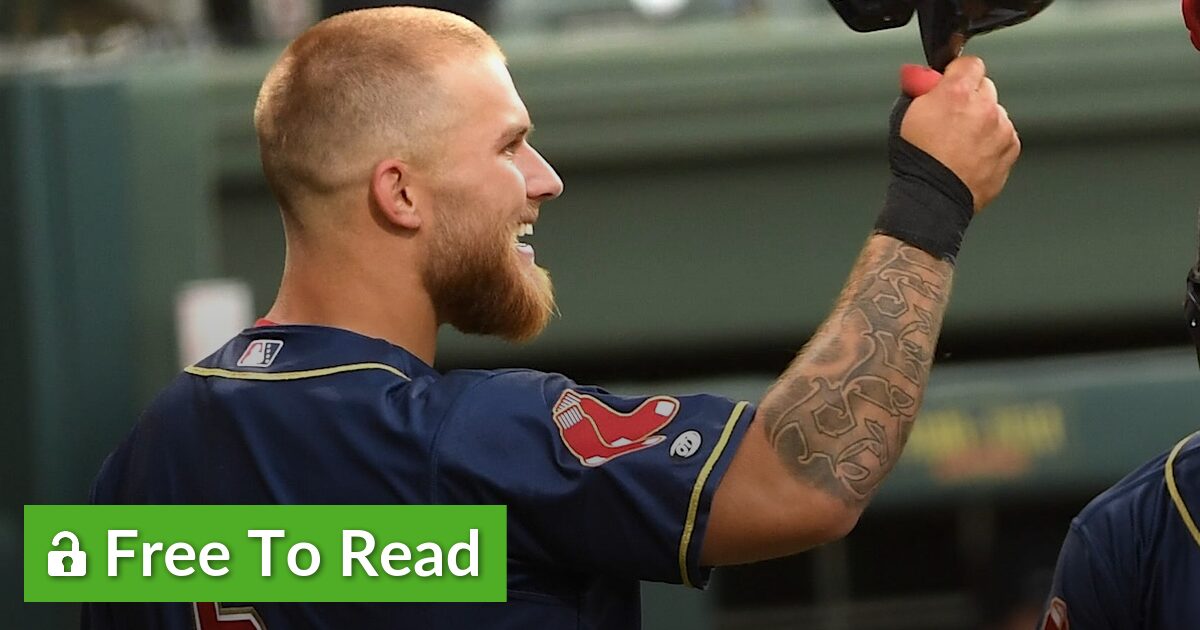
ALEX HICKS JR./STAFF / USA TODAY NETWORK via Imagn Images Brooks Brannon raised his prospect profile this season, and atypically he did so despite sliding down the defensive spectrum. Breaking out with the bat was the reason why. Now a first baseman after primarily wearing the tools of ignorance for his first four professional seasons, Brannon bashed 22 home runs while putting up a .280/.355/.560 slash line and a 133 wRC+ over 398 plate appearances with Double-A Portland. His slugging percentage led all qualified Eastern League hitters. The positional change didn’t come as a surprise. As Brendan Gawlowski and Eric Longenhagen wrote when ranking him 29th when our 2026 Red Sox Top Prospects list came out in mid-May, Brannon “had been developed as a catcher throughout his career, though most scouts expected him to wind up at first base, which has finally come to pass.” With a caveat that strikeouts remain a concern — Brannon went on to finish the season with a 28.9% strikeout rate — our prospect analyst duo opined that he “could have a productive, bat-only prime.” Again, Brannon broke out with the bat. Now ranked 22nd in the system with a 40 FV — not to mention a 70 grade for raw power — Boston’s ninth-round pick in the 2022 draft out of a Randleman, North Carolina high school has emerged as a prospect with more promise than he’d previously possessed as a bat-first backstop. Brannon discussed his evolution, both positionally and as a hitter, in the final month of the regular season. ——— David Laurila: This is your fifth year in the system, yet you’re still just 22 years old. I have to admit I thought you were older than that. Brooks Brannon: “I was a younger draft pick out of high school — I’d just turned 18 a month or two prior — so I’m blessed to have been in the org for quite awhile and still be on the younger side. But yes, I’m just 22.” Laurila: Had you been drafted out of college, the numbers you’re putting up this year would draw a lot more attention than they are. With that in mind, what might your development path been like had you gone the college route? Brannon: “It’s hard to say, because one thing the Red Sox are — and it took me awhile to appreciate this — is very analytical. The way they approach hitting is like blackjack almost. It’s, ‘This is what is expected to happen, so we’re going to live and die on this hill. Mathematically, this should happen.’ Air-pull being the optimal launch angle, focusing on hitting the ball hard in the air, making the right swing decisions and drawing walks to get on base… that’s what you want. I always prided myself on being a hitter, so it took time for me to understand what the most optimal way is to help the team win games. “This past offseason was the first offseason where I really bought in to everything they were preaching. It has helped me tremendously. So, had I gone to college… you know, a lot of colleges are still kind of on the old-guard way of hitting. I don’t think I’d have had the growth I’ve had, even though it admittedly took awhile for me to realize what was optimal.” Laurila: This year was a turning point for your career… Brannon: “Yes. My first couple of years I had a lot of injuries, and then for a few seasons I wasn’t doing what I knew I could do. I knew that what I was doing wasn’t working, so something needed to change. Having conversations with our hitting coordinators and coaches, learning who moves like me — how people who have my skills and strengths play the game — and molding that into my game to the best of my ability… I mean, I couldn’t have been able to do that without their help.” Laurila: Approach aside, there would have been mechanical changes, as well. Brannon: “Yes. For the majority of my life — the majority of how I’ve been swinging — I have always been a big forward-move hitter trying to hit the ball the other way. Hitting the ball hard for backside singles at 113-114 mph… they’re still singles. Right? They’re not doubles, home runs, extra-base hits. Not only that, I wasn’t walking, because all I wanted to do was hit the ball hard the other way. Having the conversations with our coaches, it was, ‘Hey, you hit the ball hard, but maybe we should try hitting it in the air as often as possible. And if they don’t want to throw to you, then just take your base.’ “Like I said, in years prior I had a big forward move. I would get on my front leg a lot and crash. This year, I’ve kind of been going in the opposite direction, staying back, getting a hinge, staying in a hinge, and rotating through the middle of the field. That allows me to sit back, let the ball come to me, and make decisions a little bit later. It also lets my strength play.” Laurila: What about moving away from the catcher position? Has that made a meaningful impact on your better offensive performance? Brannon: “Absolutely. I mean, first base is still tremendously hard. It’s like that scene in Moneyball where Ron Washington — the [actor] playing him — is told that it’s not hard, and he says, ‘No, it’s extremely hard.’ So, learning first base has been difficult, but I’ve gotten better as the season has progressed.” In the scene, A’s general manager Billy Beane is trying to convince Scott Hatteberg to make the same transition that Brannon made this year, and brings Washington, the team’s infield and third-base coach, to help. Beane tells Hatteberg, “It’s not that hard,” to play first base, before turning to Washington for backup. “Tell him, Wash.” Immediately, Washington says, “It’s incredibly hard.” Brannon: “As far as [increased production], my body definitely feels better after making the conversion from behind the plate to first base. Mentally, the load of just having to focus on hitting has also helped out. So yes, being able to focus on my hitting has definitely helped.” Laurila: That said, how difficult was the decision to change positions? Reports suggested you weren’t strong defensively, but along with there being less pressure to perform with the bat, you’d been coming up through the system as a catcher. That was your position. Brannon: “I’ve been catching my whole life, but it’s been clear that I had some work to do. I came to realize that I wasn’t as good as I’d thought I was behind the plate. As the years have progressed, I’ve felt like I have been moving toward a different position, probably first base, more and more. This spring training I had hamate surgery, so I missed the first three weeks [of the] season. When I was rehabbing, I was having conversations with the coordinators where it was like, ‘Hey, I know where this is going. I know that my stick is going to carry me, and I can also see the writing on the wall. What do you say we just make the move now?’ They were like, ‘For sure. Let’s do it.’” Laurila: Now that your primary focus is on hitting, and you’ve bought into the value of pull-side power, what are you looking at from a statistical standpoint? Brannon: “Instead of looking at average, slug, and OPS, one thing I’m doing differently this year is prioritizing xwOBA and other expected hitting statistics. xwOBA heavily prioritizes hitting the ball in the air and walking more, and in order to have a good xwOBA, I need to prioritize those two things. That has helped me increase everything: average, OPS, homers, doubles. Everything.” Laurila: How does that translate to what you’re doing in the batting cage to prepare for what happens on the field? Brannon: “When I’m in the cage, I don’t hit the ball to right-center. If I do, it’s an accident. If a pitch is on the outer part of the plate, I prioritize hitting a backspun line drive in the air to center field. Then, if a pitch is in, I’m turning, but turning tight. I’m turning through the middle so that I can keep it fair. Whatever you do in the cage, at least for me, you might be a tick later in the game. So, if I’m consistently pulling the ball, backspinning and staying through it, whenever I get in the game I’m letting that pitch travel a little bit. Now it’s a home run to center field or a line drive in the gap for a double. If I’m perfectly on time, it’s a home run over the scoreboard.” Laurila: It sounds like you want to take your A-swing most every time. Brannon: “One thousand percent. Yes sir.” Laurila: Playing devil’s advocate, trying to get your A-swing off every time can result in a grooved swing, and/or a lack of adjustability to certain pitches and locations. Is that fair? Brannon: “It depends on what your definition of an A-swing is. If I can hit a ball over 110 mph, I feel like that’s my A-swing. I can take my swing on a pitch in the zone — let’s say a fastball on the outer part of the plate — and hit the ball 110 to right-center. That’s an A-swing just as much as the hanging slider that I turn on and drive out of the park to left field. “We’re trying to get our A-swings off prior to two strikes. Once we get to two strikes, the only objective is to get on base, in whatever way necessary. With two strikes you have to cater to the pitcher. Not to say that he is in control, but instead of having two or three [pitches] to play with, you have one. But [before two strikes], it’s get your A-swing off and do damage.” Laurila: Do you know what your longest home run has been this season? Brannon: “There was one that was 464 [feet] against Hartford. That was here [in Portland]. I hit another one that was 113 [exit velocity] and 35 [degrees launch angle] that somebody said went onto the highway. But we didn’t get a distance read on it. I think that might have been the farthest ball I’ve ever hit.” —— Earlier “Talks Hitting” interviews can found through these links: Jo Adell, Jeff Albert, Greg Allen, Pete Alonso, Nolan Arenado, Aaron Bates, Jacob Berry, Alex Bregman, Bo Bichette, Justice Bigbie, Cavan Biggio, Charlie Blackmon, JJ Bleday, Bobby Bradley, Will Brennan, Jay Bruce, Jake Burger, Triston Casas, Matt Chapman, Michael Chavis, Max Clark, Garrett Cooper, Gavin Cross, Jacob Cruz, Nelson Cruz, Paul DeJong, Brenton Del Chiaro, Josh Donaldson, Brendan Donovan, Donnie Ecker, Rick Eckstein, Drew Ferguson, Justin Foscue, Michael Fransoso, Ryan Fuller, Joey Gallo, Paul Goldschmidt, Devlin Granberg, Gino Groover, Matt Hague, Andy Haines, Mitch Haniger, Bryce Harper, Robert Hassell III, Austin Hays, Nico Hoerner, Jackson Holliday, Spencer Horwitz, Rhys Hoskins, Eric Hosmer, Jacob Hurtubise, Tim Hyers, Walker Jenkins, Connor Joe, Jace Jung, Josh Jung, Jimmy Kerr, Heston Kjerstad, Steven Kwan, Shea Langeliers, Trevor Larnach, Doug Latta, Dillon Lawson, Brooks Lee, Royce Lewis, Evan Longoria, Joey Loperfido, Michael Lorenzen, Mark Loretta, Gavin Lux, Dave Magadan, Trey Mancini, Edgar Martinez, Don Mattingly, Marcelo Mayer, Kevin McGonigle, Hunter Mense, Owen Miller, Paul Molitor, Colson Montgomery, Tre’ Morgan, Ryan Mountcastle, Cedric Mullins, Daniel Murphy, Lars Nootbaar, Logan O’Hoppe, Vinnie Pasquantino, Graham Pauley, David Peralta, Luke Raley, Julio Rodríguez, Brent Rooker, Thomas Saggese, Anthony Santander, Drew Saylor, Nolan Schanuel, Marcus Semien, Giancarlo Stanton, Spencer Steer, Trevor Story, Fernando Tatis Jr., James Tibbs III, Spencer Torkelson, Mike Trout, Mark Trumbo, Brice Turang, Justin Turner, Trea Turner, Josh VanMeter, Robert Van Scoyoc, Chris Valaika, Zac Veen, Alex Verdugo, Mark Vientos, Matt Vierling, Luke Voit, Anthony Volpe, Joey Votto, Ryan Waldschmidt, Christian Walker, Jared Walsh, Jordan Westburg, Jesse Winker, Bobby Witt Jr. Mike Yastrzemski, Nick Yorke, Kevin Youkilis
Boston Prospect Brooks Brannon, No Longer a Backstop, Talks Hitting
Full Article
Original Source
Read the full article at Blogs →KhanList aggregates and links to publicly available news content. We do not host full articles from third-party sources. Always verify important information with original sources.