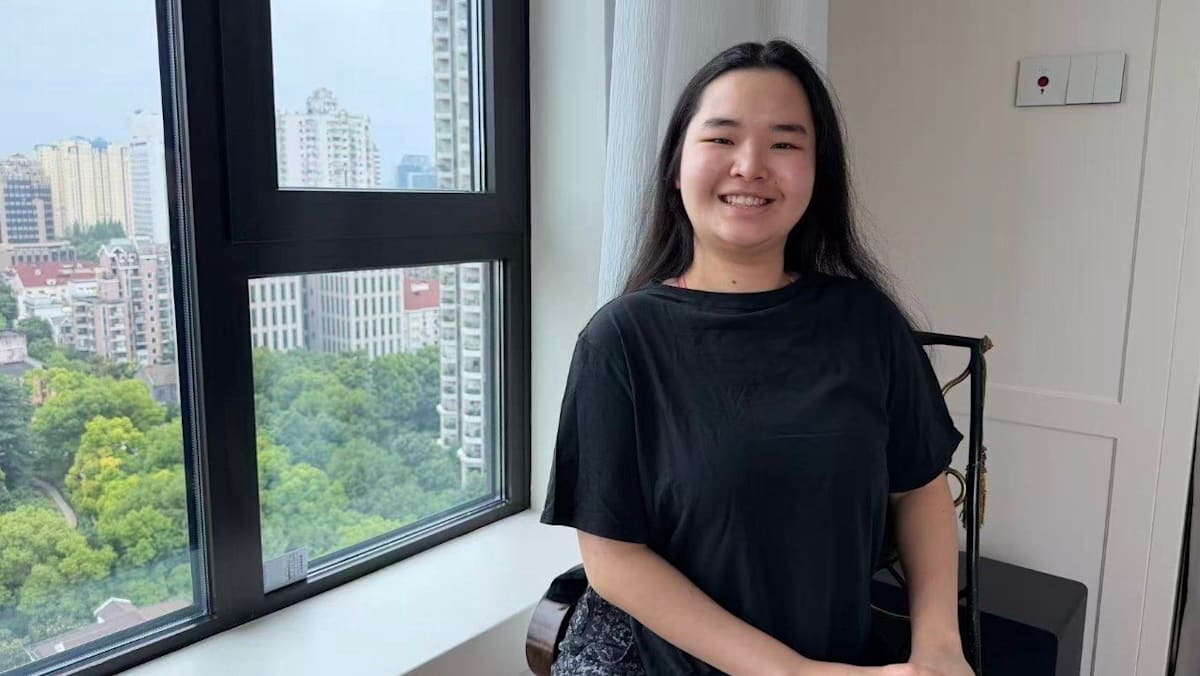
Every five to seven days, Sabrina Wong changes the tiny batteries powering her hearing aids. Without them, the 21-year-old struggles to hear and follow conversations.The tiny devices have also helped make what she once thought was a “wild dream” possible – performing on stage.Born with moderate-to-severe hearing loss in both ears, Wong grew up shy and introverted, often retreating into what she calls “my own world”.Today, the Shanghai-born Wong is set to graduate from LASALLE College of the Arts in August with a bachelor’s degree (Honours) in musical theatre, and has performed in several college productions.For Wong, finding her voice has been a deeply personal experience.GROWING UP WITH HEARING LOSSWong was diagnosed with hearing loss in both ears after a routine newborn hearing screening. However, she did not wear hearing aids consistently until she was around five or six years old.The older, bulkier devices she tried were uncomfortable and some doctors had told her parents it was “fine” for her to go without them.In preschool, while other children gravitated towards friendship groups and shared inside jokes, Wong often felt unsure of what was going on around her.“Spending my kindergarten years without hearing aids shaped my shy and somewhat introverted personality. Since I couldn’t hear what others were saying, that led me to live in my own world,” she said.It was only when she was about to enter elementary school that she began wearing hearing aids to keep up in class. Wong said that missing those early years of language development also affected her speech. Wong performing in a school production at LASALLE College of the Arts. (Photo: Sabrina Wong) She developed a lisp and had difficulty pronouncing words with certain sounds.“Because I didn’t start wearing hearing aids until I was around five, I missed out on an important phase in language and speech learning,” she said. “With my hearing loss, I can hear higher-frequency sounds, but not much mid-frequency or slightly higher low-frequency sounds.“So when I’m not wearing hearing aids, sounds like ‘s’ and ‘z’ are very loud to me. I would overcompensate by pronouncing those sounds louder, which resulted in incorrect pronunciation (and which contributed to the lisp).”Hearing loss also affected Wong academically. She recalled taking much longer than her peers to complete schoolwork.“When I was a kid, I was really behind and very slow in pace. For example, homework that might take other kids one hour could take me two to three hours. I also had extra time during examinations,” she said.While the hearing aids improved how she interacted with others, Wong explained that the experience of hearing through the devices is different from that of natural hearing. For instance, she finds certain background noises overwhelming.“It gets really loud for me on the MRT or in windy places because our ears would naturally filter out these sounds. Hearing aids are electronic instruments, so the sound produced can sound quite electronic. Imagine the sound that an old television makes – that’s what some hearing aids sound like,” she said. Spending my kindergarten years without hearing aids shaped my shy and somewhat introverted personality. Even with her hearing aids, speech can still sound muffled, especially when people are speaking softly.“I still struggle to approach people in newer settings,” she said. “Sometimes, I can’t hear people that well, so I have to keep saying, ‘What did you say? Can you speak louder, please?’ It gets awkward eventually, and it’s a bit uncomfortable to keep asking people what they said.” FINDING HER VOICE THROUGH MUSIC AND PERFORMING ARTSAlthough Wong describes herself as “a shy person”, performing has never intimidated her.“I’ve loved the idea of being a performer since I was a kid,” she said. “When you’re performing, you’re essentially becoming your character. You’re not yourself anymore.“If the character is extroverted, then I become extroverted. Even if I’m just singing in a concert or recital, I’ll be some other persona – I’m not fully Sabrina anymore.”Wong began learning the guzheng (traditional Chinese plucked zither) at around five, but it was watching singers performing on television that sparked her interest to be on stage.“I would see those singers on TV and think, ‘they’re so cool. I want to do that too’,” she recalled.At around nine years old, her parents enrolled her in singing lessons as an enrichment activity. No one imagined those lessons would one day lead her to contemplate a future in musical theatre. Wong’s parents enrolled her in singing lessons when she was around nine, kickstarting her journey into musical theatre. (Photo: Sabrina Wong) At 11, Wong joined a youth musical theatre programme. She landed her first role as an ensemble member in her first major production, juggling rehearsals with school.Recalling the exhilaration she felt on performance day, Wong said: “Standing there, doing what you’ve been practising for months, it’s hard to explain those feelings but it was the ultimate joy to be able to stand there and do what you love.” Although she soon realised how much she loved musical theatre, pursuing it professionally initially felt like “a wild dream”.“I thought it was kind of crazy. I didn’t really think that way because I have hearing loss; I just thought that I’m not good at singing or dancing,” she said. “I realised if that dream was going to come true, I had to practise a lot more.”TAKING HER PASSION TO SINGAPOREIn 2023, Wong left China for Singapore to pursue her dream, enrolling in LASALLE College of the Arts.“I had visited Singapore several times when I was younger. I really enjoyed my visits, and when deciding on where to go for college, I thought Singapore is a pretty good place to live in. And well, I was right,” she said.Moving overseas alone at 18 meant adjusting to a new school and living environment.Living in rented accommodation, Wong learnt to manage daily life while keeping up with the demands of an intensive musical theatre programme. Classes, singing and dance filled up her schedule, while rehearsals for productions often stretched into the evenings.Sabrina also had to carve out extra time to memorise lines and learn choreography, work that usually took longer for her than her peers. Wong (front) performing in the musical Bring It On at LASALLE College of the Arts – she said memorising her lines and learning choreography took her longer than her peers. (Photo: LASALLE College of the Arts) Still, she noted that the programme was demanding for everyone. “Even for people who do not have a (hearing loss) issue like mine, it’s still quite challenging to learn all the material, practise it and become performance-ready,” she said.Despite the rigours of training, Wong found a strong support system at LASALLE. She describes her cohort as tightly knit while her lecturers would help connect her to resources that supported her artistic endeavours. Whenever she felt overwhelmed, visits from family also provided comfort.RE-LEARNING HOW TO SPEAK IN ORDER TO SINGOne of the turning points in Wong’s studies in Singapore was confronting her lisp. While it did not prevent her from communicating in daily life, it posed difficulties in musical theatre, where clear diction and vocal technique are required.“A lot of teachers will tell you to sing like how you would speak, but that does not work for me, because I speak with a lisp. You’re not supposed to sing with a lisp,” she said.Recognising the challenges she faced, a lecturer connected her to a speech therapist.Speech therapy, Wong said, gave her a fundamental understanding of speech and singing. “It helped me understand what’s happening with the mouth, like where your tongue goes, how you should shape your mouth. It is still an ongoing process, and a skill that I’m trying to navigate,” she added. Wong (second from left) found a strong support network in her classmates. Her lecturers also connected her with specialist resources to correct her lisp and treat muscular tension around her tongue and jaw. (Photo: Sabrina Wong) Alongside speech therapy, Wong also underwent vocal physiotherapy, which involves hands-on therapy targeting muscles around the voice box, neck, jaw and upper back.Years of speaking with a lisp had caused tension in her tongue, which was not ideal for singing. “Going through vocal physiotherapy really helped me as a performer,” she said.Looking back, Wong believes that receiving these interventions earlier in life might have made her journey easier. However, she also recognised she has been fortunate to access specialised support. Wong is graduating in August from LASALLE College of the Arts with a bachelor’s degree (Honours) in musical theatre. (Photo: LASALLE College of the Arts) The progress she has made is her source of pride. Asked about her proudest achievement, Wong struggles to single out one particular role or performance.“It’s the moment when you’re standing on stage, being able to finally show what you’ve been working on for the last couple of months, the hard work you’ve been putting into it,” she said.For Wong, graduating from LASALLE marks the culmination of years of perseverance in pursuit of a career in musical theatre.Wong believes that the arts, whether as a performer or in other forms, offer a way for people to voice their personal experiences, opinions and identity. If art can’t carry those voices, she asked, “what is the point of doing the arts?”.After graduation, Wong is taking a gap year before preparing for her next chapter. She hopes to pursue postgraduate studies related to the performing arts in the United States.To other young people with disabilities who may doubt their abilities, Wong said: “Evaluate your circumstances. If you feel like there’s a chance that you can do it, don’t be discouraged. Definitely go for it because you never know (what you can achieve).” CNA Women is a section on CNA Lifestyle that seeks to inform, empower and inspire the modern woman. If you have women-related news, issues and ideas to share with us, email CNAWomen [at] mediacorp.com.sg.
Born with hearing loss, she found her voice on the musical theatre stage
Full Article
Original Source
Read the full article at Cnalifestyle →KhanList aggregates and links to publicly available news content. We do not host full articles from third-party sources. Always verify important information with original sources.