
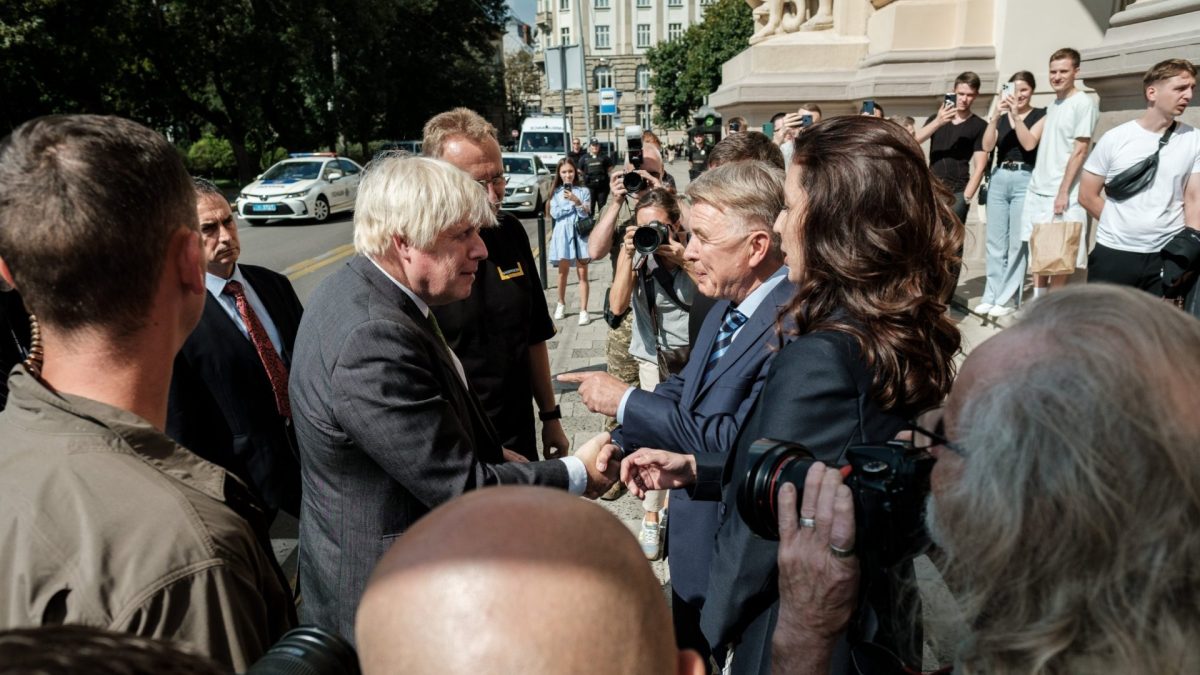
The drone strike that hit a train station in Ukraine where Jonathan Powell, Britain’s national security adviser, and ex-Prime Minister Boris Johnson had recently passed through was not an attempted assassination. But it was clearly a ratcheting up of the propaganda war around Ukraine. On Sunday, the diplomatic train carrying Johnson and others passed through Yahodyn, close to the Polish border. Shortly after, a Russian jet-powered Geran-4 drone hit a stationary locomotive belonging to one of the following trains. There were no casualties. It’s unclear what or who the targets were, but the incident was just the latest in a series of actual and claimed near misses. Shorts Last week, Norway’s prime minister, Jonas Gahr Støre, claimed that Ukraine President Volodymyr Zelensky’s aircraft “was almost hit by a drone” while flying over Moldova. The drone had actually crashed 100 miles away. And the weekend before, Jared Kushner and Steve Witkoff, Donald Trump’s son-in-law and special envoy, were on their way to Kyiv by train when the city’s main airports were hit. Originally, they had considered flying there from Moscow, after meeting with Vladimir Putin. In each case, there seems to have been little real risk, but the repercussions could still be sizeable. The train carrying Powell, Johnson, and national security advisers from Italy, France and Germany was at the station when the first air raid warning came in, so they had ample time either to evacuate or take shelter. They were already across the border into Poland when the drone struck. Russia’s defence ministry said it hit “railway infrastructure” in western Ukraine, while Ukrzaliznytsia, Ukraine’s state railway company, said the diplomatic train was “quite possibly” the target. It seems extremely unlikely that Moscow was really trying to kill a former British prime minister, as well as a brace of national security advisers. Putin has carefully calibrated his campaigns of sabotage and strikes to avoid making too direct a challenge. Even simply hitting the train, regardless of whether the VIPs onboard were hurt, would risk fallout akin to the shooting down of Malaysian airlines MH17 in 2014. Debris from Malaysia Airlines MH17 in Grabovka, Ukraine. The plane was travelling from Amsterdam to Kuala Lumpur when it was shot down by a surface to air missile (Photo: Brendan Hoffman/Getty Images) Back then, Russian-backed insurgents killed 298 civilians when they mistook a civilian airliner for a government aircraft. The result was to transform the Western response to the Russian annexation of Crimea and later the conflict in eastern Ukraine. Europe and the US shifted from limited individual asset freezes to wider economic sanctions against Russia as a result. Kyiv will do what it can to weaponise this attack. Ukraine has been struggling to persuade the US to provide more Patriot anti-missile interceptors, and Europe finds itself having to fill a £20bn shortfall in financial assistance. The Kremlin would have given Zelensky a major boost in his outreach had it actually hit the diplomats’ train. There is also likely a wider game at play. All these near and not-so-near misses appear to be carefully calibrated. At no point were the high-profile individuals in any serious jeopardy. Instead, the intent appears to have been to issue a stark warning: Russia chose not to go for the kill, but it could have – and next time, it implies, if the West continues to push, it may. The route Johnson and others took was a well-worn one for Western leaders visiting Kyiv. Some may now rethink future trips, and the chance to see the impact of the war first-hand. The attack also highlights the current phase of the war. As both sides escalate their attacks on critical infrastructure, Russia has been hitting Ukrainian trains and railway depots, including more than 200 locomotives this year alone. Johnson has called the attacks “random and senseless” but while brutal, they are anything but random or senseless. Both Russia and Ukraine have escalated their attacks on critical infrastructure in recent months (Photo: Danylo Antoniuk/Ukrinform/NurPhoto via Getty Images) Moscow aims to cripple the transport network that brings Western weapons and ammunition into Ukraine, as well as moving supplies around the country. It hopes to choke off the supplies that are keeping Kyiv in the fight. Already this year, according to Ukraine’s economy minister, Oleksandr Kravchenko, damage to infrastructure, including logistical hubs, petrol stations and ports, has hit around £7bn, while the wider impact has cost Ukraine about 1.5 per cent of its GDP. This will have long-term impacts on its ability to fight back. There has already been a marked escalation in Russian “hybrid war” attacks in Europe in recent months, from cyberattacks to sabotage. In part, these represent Moscow’s anger at the West’s direct involvement in strikes deep into Russia, with Ukraine’s use of long-range systems such as British Nyan drones and Storm Shadow missiles, as well as the targeting data to use them. Russia will hope that by ratcheting up not just the real level of attacks, but also public concern, that it may help further undermine public support in the West for continued or greater assistance for Ukraine. However, this could easily backfire. It also raises the very real risk that a miscalculation or simple mishap might lead to an incident that would force an escalation. What if the diplomatic train had been hit? How would Nato react then? This attack may not have been targeting Western officials, but Putin could still be playing with fire.
Boris Johnson’s near-miss shows how easily Putin could plunge us into war
Full Article
Original Source
Read the full article at Inews →KhanList aggregates and links to publicly available news content. We do not host full articles from third-party sources. Always verify important information with original sources.