
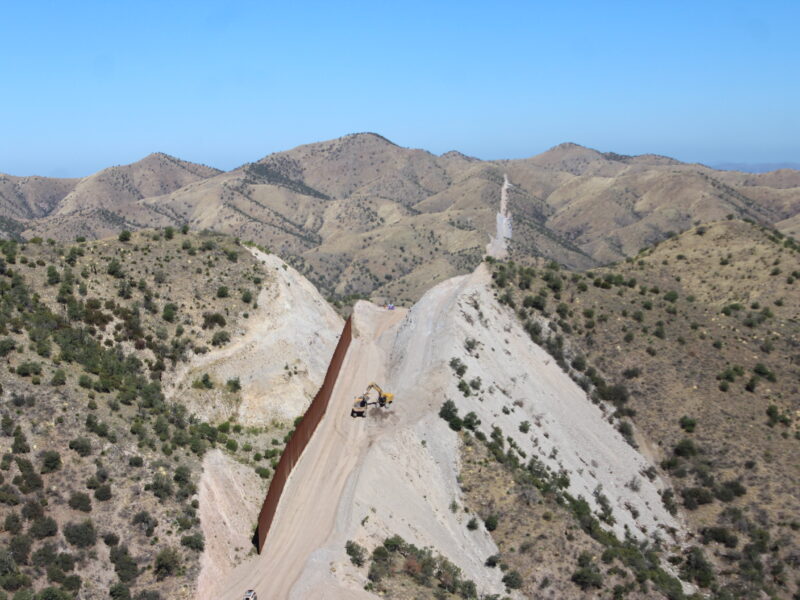
NOGALES, Ariz. (CN) — On a June morning under the beating desert sun, conservationist Eamon Harrity parked his truck along the border a few miles west of Nogales, Arizona. He crouched alongside the 30-foot steel wall, studying an 8.5-by-11-inch opening in the barrier.“This is terrible,” he grumbled.Since time immemorial, desert-dwelling critters have traversed the remote borderlands here unimpeded. Hundreds of species migrate through the Madrean Archipelago, a biodiverse “sky island” of forested mountains above the Sonoran and Chihuahua deserts.Now, though, President Donald Trump’s border wall is closing off those ancient migration routes. Many animals can only cross at designated wildlife passages, but those are few and far between.“The wall is terrible at stopping people [but] excellent at stopping animals,” said Harrity, who works for the nonprofit Sky Island Alliance.The border wall didn’t start with Trump, but his administrations have had an outsized impact on the ecosystems here.In Arizona, he’s walled off at least 220 miles of the 370-mile-long border, with more construction still underway. The wall has plowed through critical habitat of at least 25 threatened or endangered species and impeded the migratory and hunting paths of dozens more.An arrow points to a wildlife passage built into the U.S-Mexico border wall near Nogales, Arizona, which allows small animals like bobcats and javelina to pass through but prevents larger animals like deer, mountain lions and bears. (Joe Duhownik/Courthouse News)From 2022 to 2026, just 9% of all wildlife interactions with the wall resulted in a successful crossing, according to a study conducted by the Sky Island Alliance and the Wildlands Network. Both groups focus on protecting animals that cross this rugged border, using trail cameras to monitor wildlife movement along the wall.To fast-track construction, the Trump administration has waived more than 50 environmental, public health and tribal sovereignty laws, including the National Environmental Policy Act and the Endangered Species Act.In October, the U.S. Department of Homeland Security awarded a $4.5 billion contract for border wall construction. The department is operating on a $106 billion budget, meaning that even if Congress stops the cashflow, it already has enough money to build the wall two times over.“These funds are in place and the law waivers are in place for this construction to happen at a breakneck pace without any environmental review and across cultural sites,” said Emily Burns, program director at Sky Island Alliance. “It’s kind of an unleashed construction project.”DHS did not respond to multiple requests for comment for this story.Most birds can fly over the wall, while smaller animals like coatis, a member of the raccoon family, can squeeze through 4-inch gaps between the wall’s metal bollards. But these barriers have a particularly disruptive impact on larger species like mountain lions, black bears and deer.In the part of the borderlands known as Tucson Sector, Homeland Security has installed 70 wildlife passages, also known as “cat doors.” Successful crossings by animals increase dramatically in places with these passages. But they’re often clustered together, and exhausted mountain lions or bears are out of luck if they don’t fit or can’t find one. In heartbreaking videos, animals have been seen pacing along the wall before giving up and leaving.“The larger the animal, the more they need to move across the landscape,” Burns said. “And they’re the ones not able to cross.”Sky Island Alliance Wildlife Program Manager Eamon Harrity checks a trail camera hidden near a wildlife passage in the southern border wall near Nogales, Arizona on June 18, 2026. (Joe Duhownik/Courthouse News)As the sun rose higher in the sky, Harrity and intern Linda Garcia drove east along the border. They stop every few hundred meters to check their trail cams.A group of armed and armored National Guard soldiers took a break from installing razor wire to ask what animals they’d seen so far. Customs and Border Protection agents regularly stopped to interrogate them.Inspecting one trail camera, Harrity watched a family of coatis that crossed days earlier. “So cute,” he said. At another, he watched a bobcat urinate on the camera.Not long ago, the agents that police the rugged U.S.-Mexico border were opposed to a border wall.In 2012, the National Border Patrol Council, the labor union that represents Border Patrol agents, called walls and fences “temporary solutions that focus on the symptom rather than the problem.” The group said walls would only serve as “speed bumps” for illegal immigration and predicted they would increase fraud and human trafficking at designated ports of entry.Besides the impacts on wildlife, walls have other drawbacks, including high maintenance costs, engineering challenges and damage by flash floods and monsoon rains.Already, sections of the wall are falling apart, in some cases creating openings that are large enough for javelina to squeeze through.In a 2023 report to the U.S. to the House Committee on Natural Resources, the U.S. Government Accountability Office said that “incomplete erosion control measures along the barrier and patrol roads [have] threatened the integrity of the barrier system itself.” The agency also stressed the wall’s negative impacts on wildlife.U.S. National Guard soldiers patrol the U.S,-Mexico border wall near Nogales, Arizona, on June 18, 2026. (Joe Duhownik/Courthouse News)If the Trump administration insists on a wall, the Sky Island Alliance says the feds should at least add more wildlife passages. But according to the group, border authorities have been resistant to changes that could meaningfully help migrating animals.“They mentioned that the most they could possibly consider would be two per mile,” Harrity said. “Which is a start, but still well below the volume needed to meaningfully improve connectivity for wildlife.” He also suggested DHS increase spacing between bollards from 4 to 5.5 inches and keep floodgates year-round, as agents already do during monsoon season. On both fronts, he says the agency has rejected his ideas.Along several parts of the border, the Trump administration wants to build secondary walls to establish what it calls an “enforcement zone.”That includes Arizona’s San Rafael Valley — one of the few places in the state where jaguars have been seen crossing the border — where 90% of the primary wall is complete and at least two miles of secondary wall have already been built. Contractors are also building secondary walls through the Patagonia and Huachuca mountains.With two border walls, “all bets are off,” said Burns, the Sky Island Alliance project director. “Most animals are going to be stopped by a double border system.”The Department of Homeland Security has installed a second wall along some sections of the U.S-Mexico border to create more fortified enforcement zones. (Joe Duhownik/Courthouse News)One partial solution might be to use lures, attracting larger animals to specific cat doors where they cross.At Texas A&M University-Kingsville, graduate students Ray Turner and Chloe Nouzille are doing just that. The pair has been tracking mountain lions around the Texas borderlands since February 2024, using a variety of audio, visual and olfactory lures — including recordings of distressed hares, catnip oil, foil and feathers — to entice them.It’s too soon to tell if this approach will work, but there is “some anecdotal evidence that our mitigation strategies may be working,” Turner said. Though male mountain lions are generally assumed to be too large to fit, the researchers observed an adult male successfully cross from Texas into Mexico at one cat door where Turner placed a scent lure.Known to the researchers as P2, the lion tried nearly a dozen times to cross in another area before he finally found the scented cat door where there was once an open gate. Turner suspects P2 remembered crossing there before.Lures can only do so much. While the pair has seen two mountain lions cross, they’ve also watched as others have tried and failed to get through border walls.In June, Turner and Nouzille saw P2 on a different camera, this time back on the U.S. side of the border. His return crossing wasn’t caught on camera, but Turner assumes he crossed south of their study area, which spans the Texas border from Del Rio to Laredo. Although P2 has been successful in his crossings so far, more border wall construction slated for nearby will only make migration more difficult.To the east of Harrity’s study area, Arizona’s second largest tribal nation is holding out against federal expansion.The ancestral lands of the Tohono O’odham straddle Arizona’s southern border. Since 2020, the Trump administration has bulldozed miles of Tohono O’odham land for the wall, including parts of Organ Pipe Cactus National Monument and a 1,000-year-old, 200-foot-long intaglio etched in the earth.President Donald Trump ordered the Department of Homeland Security to paint the U.S.-Mexico border wall black to prevent rust and make it hotter to the touch. (Joe Duhownik/Courthouse News)The Trump administration wants to go further, building even more barriers along the reservation’s southern edge. The Tohono O’odham Nation sued in June, saying it would slice their nation in half and cause irreversible harm. But in August, a federal judge denied a preliminary bid that would have blocked construction.It’s not just the tribe at stake. More than 60 threatened and endangered species regularly migrate through the reservation, including jaguars, Sonoran pronghorn and the Mexican gray wolf.“Migration of animals has everything to do with who we are and why we are here,” Chairman Verlon Jose told Courthouse News last month. “We speak for them as well. We speak for the four-legged, we speak for all those animals who can’t speak for themselves.”Detentions at the southern border have dropped by more than 95% in the last two years, including on the reservation. The nation credits the reduction to existing security measures — not the wall. Despite losing their preliminary injunction, they’ve vowed to continue fighting, placing “no trespassing” signs around the border to deter federal contractors and encouraging tribal citizens to report suspicious activity.The Trump administration claims its border projects are vital for national security, and most lawsuits challenging them have failed. If the Tohono O’odham’s does too, endangered species will lose yet another migration corridor.Although existing wildlife passages are sparse, some animals have truly benefited. Sky Island Alliance cameras have recently caught coyotes, skunks, racoons and javelina successfully crossing.The wall itself is likely to cause irreversible environmental damage. But if erosion and degradation outpaces maintenance efforts, it may not last forever.Sky Island Alliance Wildlife Program Manager Eamon Harrity examines a wildlife passage built into the southern border wall near Nogales, Arizona, on June 18, 2026. (Joe Duhownik/Courthouse News)On this front, Harrity tries to stay optimistic. “All walls fall,” he said. “Nothing lasts. It’s hubris to think we could build a wall across the whole continent.”It’s not a silver lining, exactly. But he does see a chance for hope for the future, so long as the damage is mitigated in the meantime.Even so, he admits his job often feels futile. Looking out his car window across the vast borderlands, he reminded himself what he’s fighting for.“Everything matters,” he said, including “telling the story that this isn’t normal. At some point the wall will fall, and the landscape will begin to heal.”Subscribe to our free newslettersOur weekly newsletter Closing Arguments offers the latest about ongoing trials, major litigation and rulings in courthouses around the U.S. and the world, while the monthly Under the Lights dishes the legal dirt from Hollywood, sports, Big Tech and the arts.Additional Reads
Border wall construction threatens iconic Southwest species
Full Article
Original Source
Read the full article at Courthousenews →KhanList aggregates and links to publicly available news content. We do not host full articles from third-party sources. Always verify important information with original sources.