
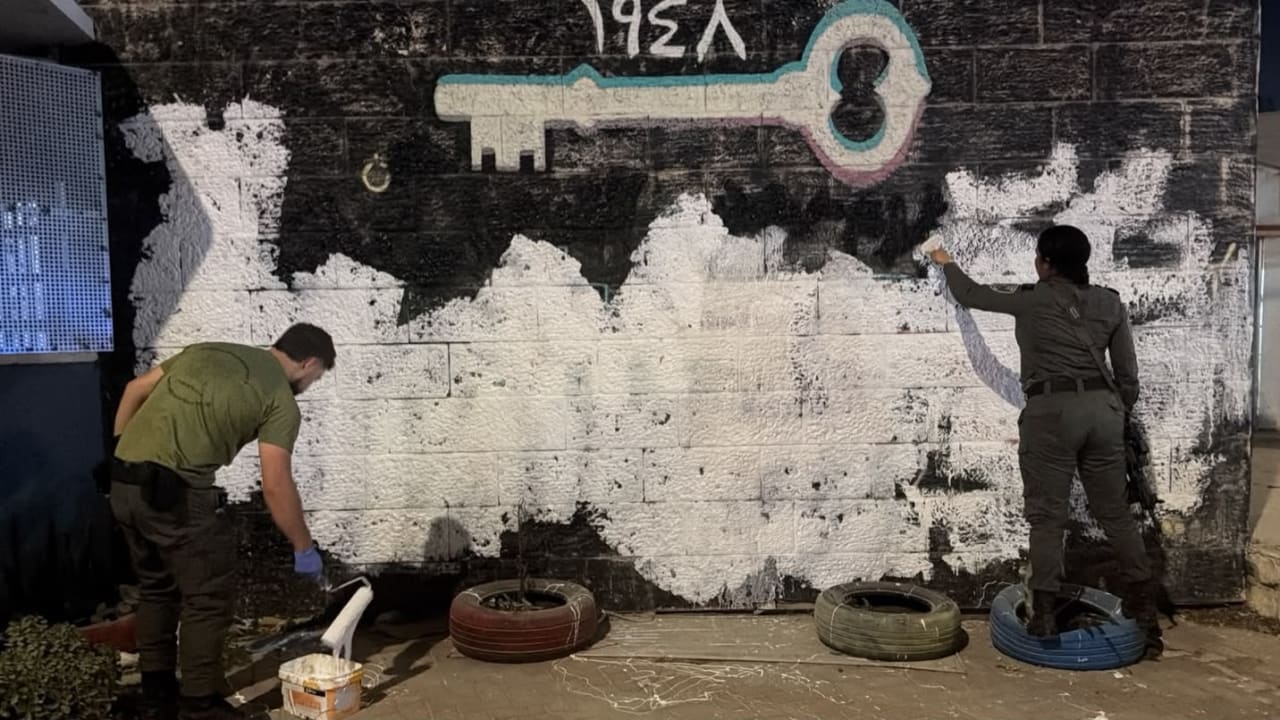
NOVEMBER 6, 2026 23:58Border Police officers in the Coastal District removed graffiti containing nationalist and pro-Palestinian messages from public spaces in several western Galilee villages over the past week, police said in a statement.The operation was part of a broader effort to strengthen governance, maintain public order, and increase the presence of security forces in the area.During the operation, officers identified graffiti containing nationalist and pro-Palestinian messages spray-painted on walls in public spaces. They subsequently painted over the graffiti to restore the walls to their original appearance.Crime and governance dominate concerns in Arab communitiesThe police operation comes amid a broader national debate over governance and law enforcement in Israel's Arab communities, issues that played a significant role in the recent Knesset election.Voter turnout among Arab Israelis reached approximately 77%, just two percentage points below the record of 79.3% set in 1996, as concerns over violence, organized crime, and personal security emerged as major electoral issues, according to the Israel Democracy Institute.A Border Police officer covers graffiti during an operation to remove nationalist and pro-Palestinian messages from public spaces in the western Galilee, November 2026. (credit: ISRAEL POLICE SPOKESPERSON'S UNIT)A survey conducted by an Israeli consulting firm shortly before the election found that 55% of respondents identified violence and crime as the primary concern among young Arab Israelis and a key factor in determining their vote, The Jerusalem Post reported on October 21.The findings reflected concerns expressed by Arab residents earlier this year. In January, several members of Israel's Arab community told the Post that rising violence and organized crime, including the growing influence of armed gangs in Arab towns and cities, had left residents feeling helpless and living in constant fear.These concerns have also shaped the political demands of Arab parties following the election, with leaders seeking greater government action on crime, policing, infrastructure, and public spending.At the same time, Arab political leaders continue to advocate for Palestinian rights and statehood, positions that distinguish them from the Zionist parties they may support in forming the next government.Arab parties balance Palestinian national demands with support for EisenkotDespite these ideological differences, leaders from Hadash, Ta'al, and Ra'am have indicated varying degrees of willingness to support a government led by Yashar leader Gadi Eisenkot, while Ra'am chairman Mansour Abbas has also expressed openness to joining a governing coalition.The prospect of Arab party support has drawn criticism from opponents who question the compatibility of their political positions with those of Zionist parties.Before the election, Gadi Taub, a professor at the Hebrew University of Jerusalem and co-host of the Israel Update podcast, criticized the Arab parties' positions on Israel.“These parties are anti-Zionist; they are against the very existence of Israel, and some of them are direct terror supporters,” Taub said, referring in part to statements made by Balad leader Sami Abu Shehade following October 7, which he subsequently walked back.Arab parties weigh pragmatic support for Eisenkot while maintaining Palestinian national demandsYet Arab party leaders have presented their potential support for Eisenkot as a pragmatic political choice, arguing that replacing the current government could help address pressing concerns within their communities without requiring them to abandon their positions on the Israeli-Palestinian conflict.In an interview with The Independent in Arabic on Thursday, Ta'al leader Ahmad Tibi reaffirmed his support for Palestinian rights and statehood while backing Eisenkot for prime minister."The next government will not be a government of peace, it will not be the fulfillment of our dreams, and it will not work to establish a Palestinian state," Tibi said. "It will not even negotiate to establish a Palestinian state.""Eisenkot has stated more than once that he wants to work to end Jewish terrorism in the West Bank and the occupied territories, and we hope that will be the case," Tibi continued.Tibi also rejected the application of Eisenkot's four conditions to his faction: recognition of Israel as a Jewish state, commitment to Israel's Declaration of Independence, mandatory military, national, or civilian service for all Israeli citizens without exception, and recognition of Hamas as a terrorist organization.He argued that the conditions did not apply to his faction because its members "will not be in government."Instead, Tibi emphasized the domestic priorities that have become central to Arab political demands, particularly the need to address crime and improve living conditions."We want to change the situation of the public and our society in terms of violence and crime, demolition of homes, infrastructure and budgets," Tibi said.According to the Central Election Committee, Arab parties secured 19 Knesset seats in the election, with nearly 840,000 votes representing approximately 15% of the total, giving them a potentially significant role in determining whether Eisenkot can form the next government.Follow us on Google
Border Police remove pro-Palestinian graffiti as Arab parties demand action on crime, governance
Full Article
Original Source
Read the full article at Jpost →KhanList aggregates and links to publicly available news content. We do not host full articles from third-party sources. Always verify important information with original sources.