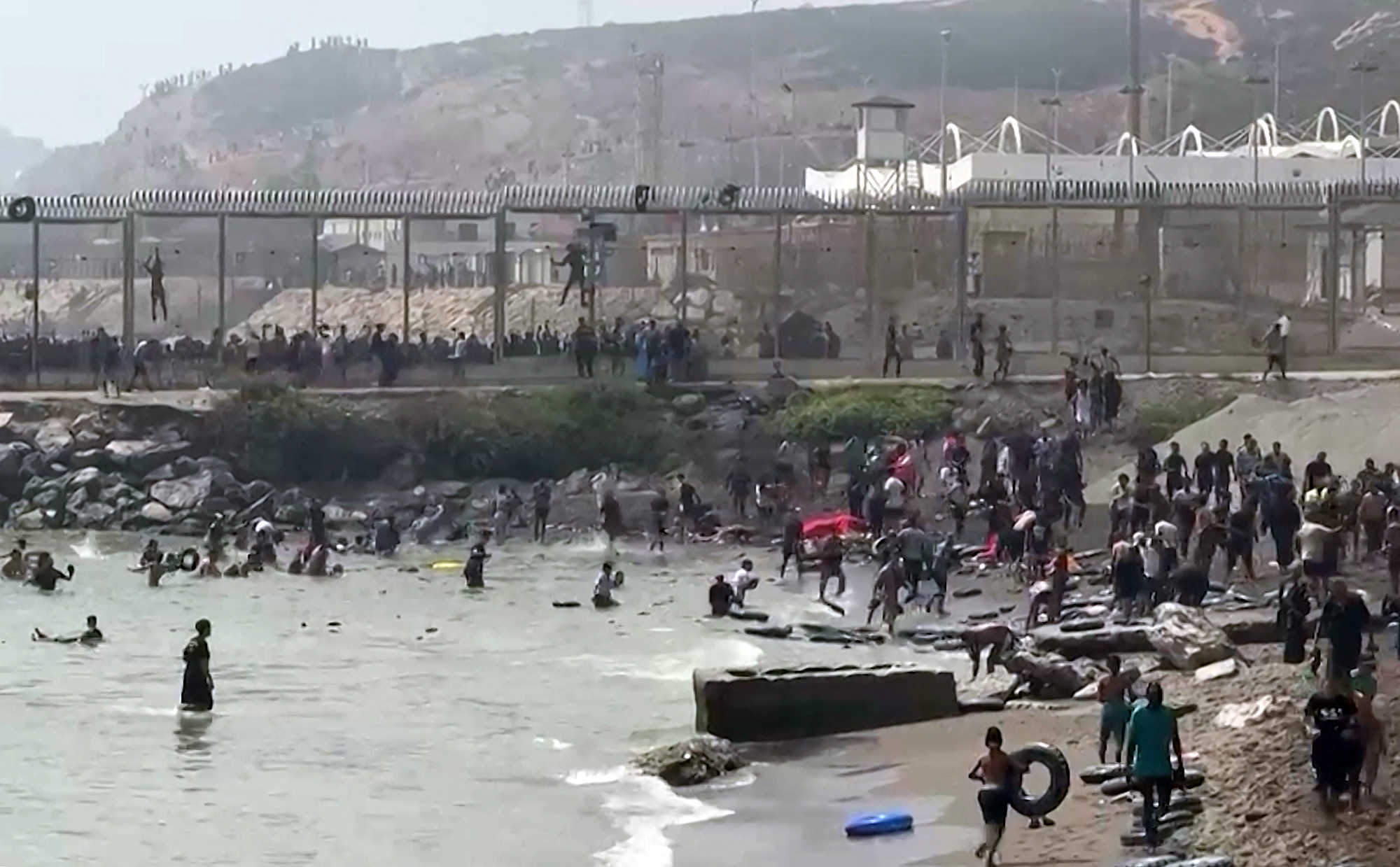
Tens of thousands crossed from Morocco into Ceuta, Spain’s enclave on the North African coast, on July 30, most swimming around a breakwater as Moroccan border controls lapsed. Dozens drowned. Within hours, an explanation took shape that made no reference to Spain’s responsibility for the fiasco. Bruno Macaes, a former Portuguese Europe minister, announced that Israel had provoked the crisis to sway next year’s Spanish election. Tomasz Froelich, a German AfD member of the European Parliament, called it a hybrid attack serving Moroccan, American, and Israeli interests. Spain’s own transport minister, Oscar Puente, amplified a post in which Israel’s ambassador mocked Madrid over the chaos and said the situation was becoming clear — implying a foreign hand. What was becoming clear was a scapegoat. Blaming a hidden hand is a familiar reflex, reached for when the visible causes are less comfortable. No foreign plot explains the crisis. A Border Spain Chose Not To Control Ceuta’s security depends on Moroccan forces stopping migrants before they reach the Spanish fence or swim around it. Spain polices its own shoreline, not Ceuta’s boundaries. When Moroccan enforcement gave way, the Guardia Civil, a Spanish national police force, estimated that roughly 50,000 crossed within a day, into a city of 80,000. Two other gaps were also Spanish handiwork. In early July, Spain’s Supreme Court barred officials from summarily pushing migrants back at sea, ruling that people intercepted swimming toward Ceuta must receive the full asylum and return procedure. That raised expectations of reaching Spanish soil, and smugglers amplified the message, driving the year’s drownings to their highest level since 2014, when 15 migrants died at the Tarajal beach crossing as officers fired crowd-control rounds. The arrangement had bent before: In 2021, after Spain gave medical treatment to a Western Saharan independence leader, an enraged Rabat eased its controls and thousands crossed. This time, the surge followed Prime Minister Pedro Sanchez’s visit to Algeria — Morocco’s chief rival — which Rabat read as a provocation. Whether Morocco relaxed enforcement deliberately or simply lost control remains unclear; its forces have since reinforced the frontier and cooperated on returns. Some 25,000 who crossed went back within a day. A Magnet Spain Built Itself Spain made itself the destination of choice. This spring, Madrid opened an extraordinary amnesty granting legal status to migrants already in the country, and more than a million people applied by the end of June. It covers only those already in Spain before this year, offering nothing to anyone swimming across today, but word traveled faster than the fine print. A government that legalizes a million people at once becomes the European door most likely to open — a message that reached Fnideq, the Moroccan town beside Ceuta, well ahead of the caveats. Within a day, Italy, Denmark, Finland, and Sweden urged Spain’s suspension from Schengen, the passport-free zone of 29 European states, and the European Commission demanded that the crossings stop. Control the Border Before Anything Else Spain lacks not tools but the will to use them. Three steps would make Ceuta the last such crisis rather than a rehearsal for the next. First, return unlawful entrants quickly. In June, the European Parliament approved a Return Regulation that speeds deportations and lets one member state enforce another’s removal orders, replacing a 2008 law under which the union deported barely one in five of those ordered out. It binds fully only in 2027, so the immediate task is to use current powers: process and return entrants fast. A procedure that returns one in five deters no one. Second, reduce dependence on Rabat. Brussels has offered reinforcements from Frontex, the European Union’s border agency; Spain should take them and build its own maritime surveillance and interdiction capacity. A border that relies on another state for the decisive work is vulnerable by design. Third, pair rules with enforcement. The Return Regulation will matter only if states apply it quickly and consistently; a system that orders return but rarely enforces it invites repeated pressure. Europe speaks of strategic autonomy. Ceuta shows that autonomy begins with controlling one’s own borders. Simone Rodan-Benzaquen is senior envoy for Europe at the Foundation for Defense of Democracies (FDD). For more analysis from Simone and FDD, please subscribe HERE. Follow FDD on X @FDD. Follow Simone on X @srodan. FDD is a Washington, DC-based, nonpartisan research institute focusing on national security and foreign policy.
Border Crisis Exposes Spain’s Self-Inflicted Migration Mess
Full Article
Original Source
Read the full article at Fdd →KhanList aggregates and links to publicly available news content. We do not host full articles from third-party sources. Always verify important information with original sources.