
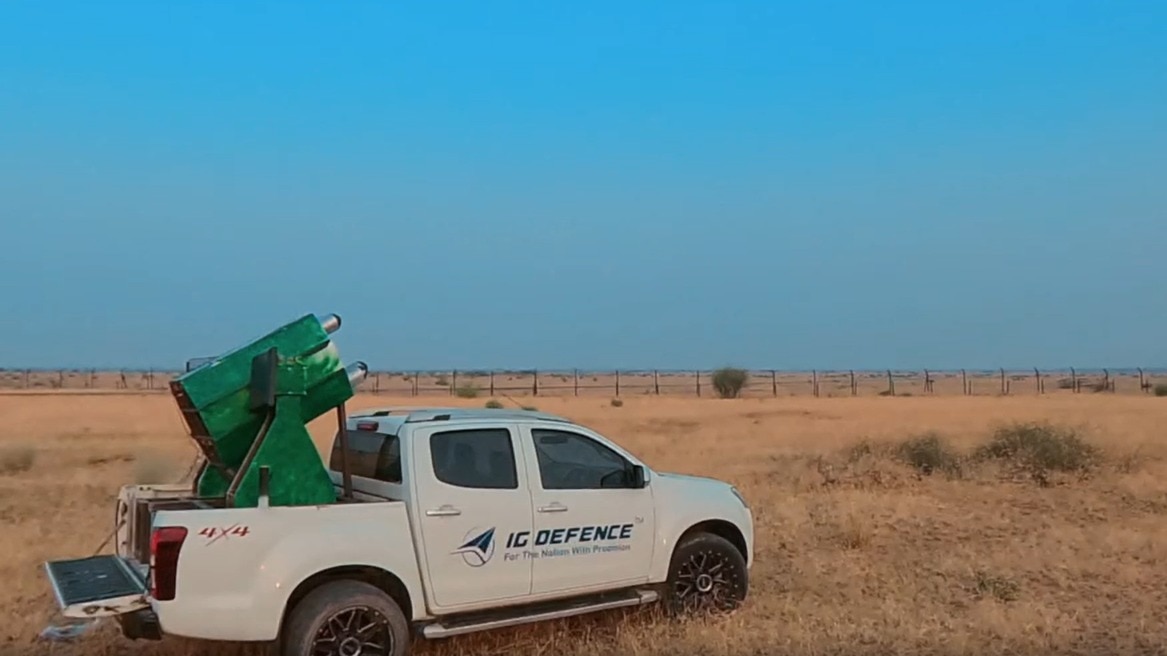
In a landmark development for India's indigenous defence industry, IG Defence has successfully test-fired JWALA MK-1 at the Pokhran test range in Rajasthan, describing the platform as India's first autonomous Counter-Unmanned Aircraft System (CUAS) Micro-Missile System.The test launch marks a significant milestone in the development of next-generation indigenous counter-drone technologies.With an operational range of up to five kilometres, JWALA MK-1 has been developed as an autonomous and cost-effective solution to address the rapidly evolving threat posed by hostile unmanned aerial systems.The proliferation of unmanned aerial systems is fundamentally transforming modern military operations. Recent international conflicts, including the US-Iran war, have highlighted the growing deployment of relatively inexpensive attack drones and the economic challenges of countering them using high-cost conventional air-defence interceptors.This emerging battlefield reality has exposed a critical cost imbalance: low-cost aerial threats can compel militaries to deploy significantly more expensive interception systems, placing pressure on interceptor inventories, ammunition sustainability and the economics of modern warfare. For India, with its complex security environment and evolving aerial threats, developing affordable, scalable and indigenous counter-UAV technologies is a strategic necessity.According to IG Defence, JWALA MK-1 is designed to identify potential hostile drone targets, classify them and facilitate their airborne neutralisation through an integrated mission autonomy architecture.A defining feature of the platform is its integration with GRID, IG Defence's proprietary AI-powered Mission Autonomy and Battle Management System, which acts as the intelligence backbone coordinating the system's operational kill chain.GRID brings together sensor integration, target detection, identification, classification, mission decision-making and engagement management within a unified architecture, enabling coordinated mission execution.Speaking about the development, Bodhisattwa Sanghapriya, Founder and CEO of IG Defence, said: "GRID is not just a standalone Mission Autonomy and Battle Management System; it is the intelligence backbone managing the entire kill chain of JWALA MK-1. From sensor integration and target detection to identification, classification, mission decision-making and engagement management, GRID's AI-driven orchestration brings the entire operational chain together within a unified architecture."He added, "Our vision is to build indigenous defence systems where hardware and software are developed together, with autonomy and intelligence at their core. India must not simply manufacture weapons; we must build the intelligence, technology and integrated systems that power the future battlefield. That is the capability we are building at IG Defence."Commenting on the operational significance of the development, Wing Commander Anoop Sharma (Retired), Associate Vice President, IG Defence, said, "The character of warfare is evolving rapidly, and the growing proliferation of unmanned aerial threats demands a new approach to air defence. Countering low-cost drones with expensive conventional systems is a challenge that modern militaries can no longer overlook. India needs indigenous, reliable and cost-effective solutions that can address these emerging threats at scale."- Ends
Boost to Atmanirbhar Bharat, India tests JWALA MK-1 counter-drone missile system
Full Article
Original Source
Read the full article at Indiatoday →KhanList aggregates and links to publicly available news content. We do not host full articles from third-party sources. Always verify important information with original sources.