
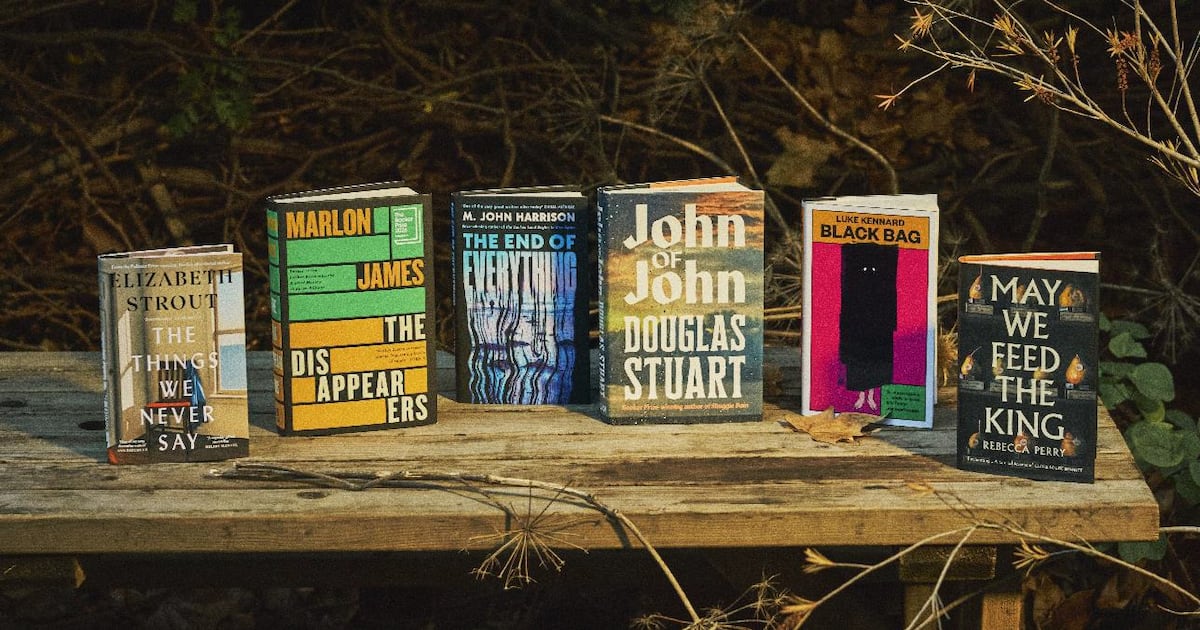
Two former winners of the Booker Prize, who address homophobia in very different ways, and a previously shortlisted author are among the six writers on this year’s Booker shortlist.Douglas Stuart, the New York-based Scottish author, who won with Shuggie Bain in 2020, is back with John of John, in which a son returns home to his repressive father in a traditional Calvinist island community in the Outer Hebrides.The Disappearers by Jamaican Marlon James, who won in 2015 with A Brief History of Seven Killings, follows a survivor of a murderous homophobic attack in 1980s Kingston, Jamaica, set on retribution.US author Elizabeth Strout, who was longlisted in 2016 for My Name is Lucy Barton and shortlisted in 2022 for Oh William!, returns with The Things We Never Say, the story of a teacher with a seemingly comfortable life in coastal Massachusetts who is harbouring a secret.READ MOREThe shortlistThe End of Everything by M John HarrisonThe Disappearers by Marlon JamesBlack Bag by Luke KennardMay We Feed the King by Rebecca PerryJohn of John by Douglas StuartThe Things We Never Say by Elizabeth StroutSpanning genres from dystopian fiction to contemporary realism, from campus satire to historical fiction, the shortlisted authors vividly depict the interior lives of a rich cast of characters.Three British writers make up the rest of the shortlist. In Black Bag by Luke Kennard, an out-of-work actor is paid to attend university lectures zipped inside a black leather bag for a psychology experiment. May We Feed the King by Rebecca Perry, winner of the Waterstones debut fiction prize, features a reluctant monarch in a medieval court under threat by scheming courtiers. A beachcomber ekes out an existence on the coast of Kent in The End of Everything by M John Harrison.The shortlist was selected by a panel chaired by classicist Mary Beard, including poet Raymond Antrobus, singer-songwriter Jarvis Cocker, critic Rebecca Liu, and novelist Patricia Lockwood.“We did not start out with a checklist of the different types of book we wanted to see represented in the final six, or the kinds of authors or subject matter,” Beard said. “But when we looked at our shortlist, neatly propped up against one another, almost glowing, we were happy that we had showcased many of the strengths of contemporary English-language fiction. “These novels range from the hilarious to the discomfiting, from the frighteningly strange to the alarmingly domestic, from the powerfully shocking to the intriguingly understated. In them, we meet characters from different countries and different centuries, created by authors 40 years apart, new talent and well-known favourites.“This is writing at its best. There’s plenty to enjoy, some blissful escapism and prose to die for (‘I just wish I could have written that’ kept going through my mind). But there is also plenty here to change the way we see the world, to surprise us and to challenge our certainties.”Djamel White was the only Irish author longlisted this year, for his debut novel, All Them Dogs, about a young returned emigrant trying to navigate family and relationships in Dublin’s gangland. The last Irish winner of the Booker Prize was Prophet Song by Paul Lynch in 2023.The winner of the £50,000 (€58,000) prize will be revealed on November 9th at a ceremony in London broadcast live on BBC Radio 4’s Front Row.The judges, Irish Times critics and the authors themselves on the shortlisted booksThe End of Everything by M John HarrisonThe judges said: “The End of Everything can be read as a thriller, a mystery, a satire, a dystopia, a road novel, a work of realism. The landscape may be bleak, the catastrophe may be immersive, yet there still were moments we found ourselves laughing aloud.”The Irish Times: “Harrison’s rudderless spin on the post-apocalyptic story is a novel depiction of end times. Toying with staples of the genre, The End of Everything is both a lingering exploration of the psychological effects of planetary destruction and humanity’s tendency to turn a blind eye. Unfortunately, in capturing a world that’s shed its values, Harrison offers a stop-start narrative populated by characters operating outside of a recognisable ‘emotional structure’, making it hard for readers to properly engage with the text. It’s a memorable, haunting work, but who it’s for exactly is unclear.”Harrison said: “The art towns of the UK’s east coast provided the setting. I love that coast, all the way round from Hastings to the Thames – even up into Suffolk. Current affairs provided the themes and the satire: what happens when all of our expectations and explanations of the world become an ongoing disaster, but we still have to make a life?”The Disappearers by Marlon JamesThe judges said: “A Jamaican epic from one of the most impactful Caribbean novelists today; readers will love the shifting register of the dialogue and poetic phrasings, often pierced through with sharp, double-edged humour.”The Irish Times: “If you’re new to James’s work, be ready for a challenging read, but one that will be well worth your time. His style is expansive and freewheeling, a mash-up of forms, perspectives and genres... James calls the novel his most autobiographical to date, and his great accomplishment here is his generous and honest portrayal of men, both queer and straight: their anger, fear, isolation, confusion and longing; their moments of tenderness, camaraderie and melodrama; the journey to self-acceptance; the delight in discovering new forms of sexual pleasure.”James said: “The Disappearers is based on a violent incident that was rumoured to have happened but was never proven, at least not up to the point when I began writing. But in Jamaica we trust rumours more than facts, so the fact that people kept whispering about it meant it was true. But I’m more concerned with an incident’s aftermath than the thing itself, and fiction is ideally placed to bring what might be a closed-off chapter right into the open.”Black Bag by Luke KennardThe judges said: “In a wonderfully quirky campus novel, Kennard combines an absurd experiment with a moving story about human frailty, passion, confusion and identity. There’s something for everyone here.”The Irish Times: “An offbeat meditation on masculinity with delightful surprises including astute commentary from the family dog and a quietly heart-warming thread with his childhood friend, Claudio. This is muddled, however, by an unwieldy plot.”Kennard said: “I came across the original 1960s black bag experiment by accident when I was researching something else. It caught my attention, but I was more interested in the person playing black bag than the results of the study. My narrator is a struggling actor, but I think it’s about trying to be an artist of any kind in the current moment, when arts and culture are so systematically undervalued, when the doubts seem to loom larger than the possibilities. It really tests your hubristic self-belief, and leaves you with a kind of all-pervading shame, which is always a good subject matter for fiction.”May We Feed the King by Rebecca PerryThe judges said: “An affecting and lush jewel of a novel that moves between our present-day world to a medieval court and unsettles the idea that there’s ever one universal historical truth.”The Irish Times: “A poet shortlisted for the TS Eliot Prize, Perry suffuses her prose with the kind of lyricism you’d expect from her (’a fresh day, like cutting into an apple’; bodies ‘like slugs on young plants after rain’), revelling in the cloying materiality of this historical feast for the senses. But Perry’s project is also to question the fickle nature of storytelling itself, keeping her characters at arm’s length in a way that is deliberately unsatiating. Even if Perry’s work sometimes opts for style over substance, this is a taut and assured first novel which surely marks the beginning of an eminent novel-writing career.”Perry said: “Two characters – a woman using replica food scenes to conjure spirits in her home and a young attendant to a dying king – came to me separately, and I was writing them in two short stories.“At a certain point I realised their world, in a way, was the same one, and I embarked on the novel. I knew I wanted to write historical fiction somewhat outside of the genre and, as the book developed, I became preoccupied by questions of memory, agency and imagination. Concurrently, horrifying global events unfolding on the orders of cruel, tyrannical men began feeding into questions the book had about power and responsibility.”The Things We Never Say by Elizabeth StroutThe judges said: “A novel that engages with the deeply divisive politics of present-day America, without itself becoming divisive. This is the kind of book we need now: a calm antidote to contemporary events.”The Irish Times: “If readers are unfamiliar with Strout, this is not the novel of hers to begin with. But for those already enamoured of her subtly profound prose, this should prove a welcome return from a familiar voice, one with a new story to tell.”Strout said: “My inspiration for The Things We Never Say came from two rather odd places. The first was an old obituary I saw from decades ago. My friend in upstate New York sent me a page of them, and there was one man who had the last name Damm. The man in the obituary haunted me because he looked so entirely ordinary and pleasant. He wore big wire-framed glasses and just had an exceptionally kind look to his face.“The second part of the inspiration came from a brief conversation with a man I know in Maine who told me that one day he and his father were riding in a boat off the coast of Massachusetts, and they saw a man’s head in the water. They rode up to him and pulled him out and the fellow telling me the story said that a few nights later his father had called the man and taken him for a drink. From these two images sprang forth the story of Artie Dam.”John of John by Douglas StuartThe judges said: “A rich and moving novel about a father and son who live on a remote Scottish island in the 1990s, where small-town secrets and buried shame reverberate to surprising, devastating and even joyous effect.”The Irish Times: “As a powerful further perspective on Scottish masculinity, John of John is less a return to form but rather an evolution. A masterly storyteller with a poet’s prose, this is Stuart’s best yet.”Stuart said: “I set out to write about the bond between a father and son despite the deep silence between them. I was drawn to the Outer Hebrides because when we talk about class or sexuality or social upheaval, our rural places are so often overlooked. On Harris I found a rich, inspiring culture; a culture shaped by community, with a history of crofting and weaving, in a place that is the stronghold of the Gaelic language and a very devout form of Presbyterianism. There was such richness that I couldn’t help but be inspired. It’s not that I wanted to tell this story now – although the world is as divided as it ever was, and queer people are under increasing attack – but it’s more that this is the story I had to write, and there was nothing that I could do but to write it.”
Booker Prize shortlist: two former winners in running for £50,000 prize
Full Article
Original Source
Read the full article at Irishtimes →KhanList aggregates and links to publicly available news content. We do not host full articles from third-party sources. Always verify important information with original sources.