
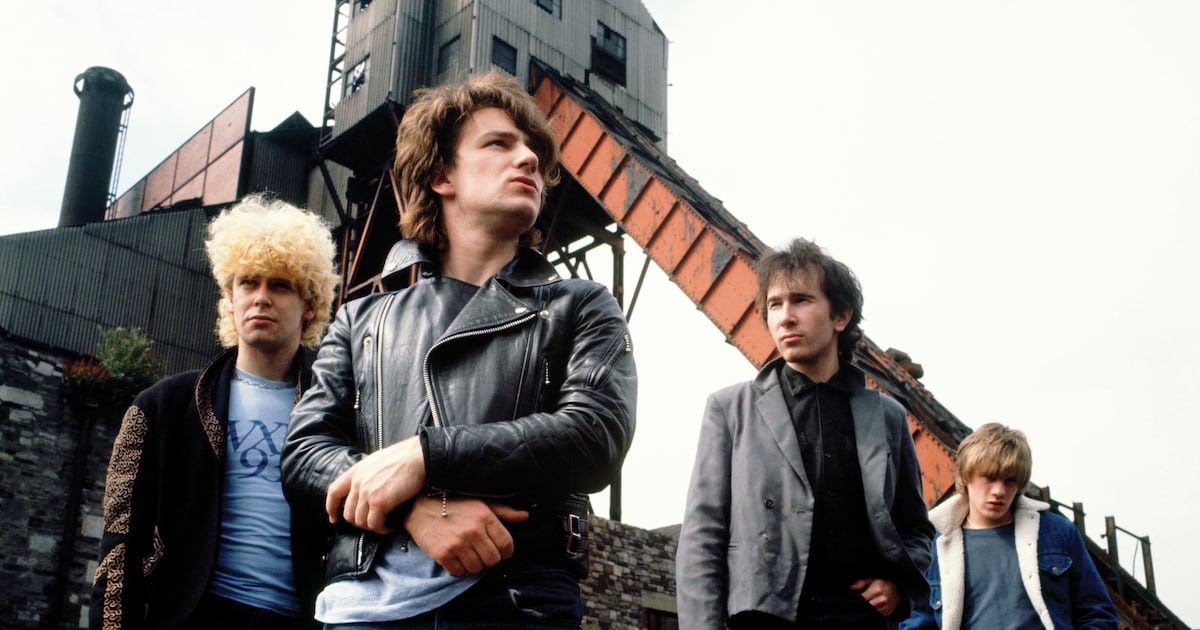
Everybody knows U2’s origin story. Or we think we do. In September 1976 a 14-year-old Larry Mullen jnr posted a note on the noticeboard at Mount Temple Comprehensive School looking for people to play music with. “Drummer seeks musicians to form band. Contact Larry Mullen, third year.”He couldn’t know it then, but his note would turn out to be a seismic moment in Irish and global music culture, a little paper butterfly flapping its wings on the northside of Dublin and causing a musical hurricane across the world. Fifty years later the band that formed out of the simple plea from a quiet teenager with blond hair down to his shoulders are still together, still making music. They’ll be releasing a new album soon.It’s almost unheard of in rock’n’roll, an industry littered with acrimonious splits and line-up changes: U2 as we know them now are U2 as they were back then. Four self-described chancers who made it big.READ MOREFor the past nine months I’ve been researching this origin story for a three-part Irish Times podcast called Drummer Seeks Musicans: The Making of U2. The idea for the series formed in my head last year, when I realised that September 25th would mark 50 years since Mullen put up that note, and it wouldn’t let me go.I’ve been enchanted by this creation myth for decades. I was a teenager at school on the other side of the city when it first caught my imagination. It was 1987, I was 16 and U2 were exploding in the United States with their album The Joshua Tree. The notion that a Dublin band could become one of the biggest in the world, and that it had all started with a note on a school bulletin board, seemed like a miracle to me.Then, five years ago, I found myself sitting at a desk at Mount Temple. It was a dream come true. The dream wasn’t quite what I’d imagined. In my original dream I was a pupil there – a place that educated boys and girls together, a non-denominational school where individuality was encouraged and you didn’t have to wear a uniform. Now I was here as a parent. I sent my children to Mount Temple because of Mullen’s note.Visiting the school over the years for parent-teacher meetings or Christmas concerts, I’d always marvel that it didn’t shout about what happened there. There’s no plaque by the noticeboard commemorating the moment when Mullen put up the note.I’d heard that fans from all over the world would occasionally arrive there to walk the hallowed ground where their musical heroes took their first steps towards becoming U2. U2 at 50: the band in 1978, at a Harp Lager talent competition at the Stella Ballroom in Limerick. Photograph: Michael Cowhey, from Becoming U2 U2 at 50: the band in London in 1981. Photograph: Pennie Smith In a few months they won’t be able to do that any more. The school building where U2 were formed, where half of them met their current partners and where their life’s purpose became apparent is being demolished. A new school is already rising behind the original one.With both the 50th anniversary of the band and the school’s preparations for a new chapter, it felt like the perfect time to deep-dive into the making of U2. The podcast is the story of a note, but it’s also the story of a school. A story of faith, friendship and four teenagers who had no idea what lay ahead. The podcast had the blessing of U2, and Adam Clayton spoke to me for it, but I wasn’t sure until the final weeks of editing whether the band themselves would take part. In the end they did. Here are some edited highlights of that conversation. They talk about Mount Temple teachers such as Jack Heaslip, Albert Bradshaw, Donald Moxham and Sophie Shirley, their religious-education teacher. They share their memories of that now legendary origin story. And at the very end Bono drops a world exclusive about the new album.I began by thanking the band, particularly Mullen, because if it weren’t for him none of this would be happening.Larry: Everyone’s here because of me.Bono: Don’t encourage him.U2 at 50: Bono, Edge, Larry Mullen jnr and Adam Clayton in Dublin in 1980. Photograph: Sheila Rock U2 at 50: the band playing at McGonagles, in Dublin, in 1979. Photograph: James Mahon What do they all make of that famous note 50 years later?Edge: Very grateful for the note. Actually, the weird thing is I never physically saw the note. It was my music teacher, Albert Bradshaw, told me about the note, because I’d let it slip that I was playing electric guitar. And, weirdly enough, another one of my schoolfriends was a drummer, David Barnett, and he was in a garage band. I went to see him play and I was, like, “This is great fun. I’d love to be in a band like this.” Literally the next week I heard about Larry’s note. So I was thrilled.Bono: Well, mostly gratitude, and not just to the friends that I made in U2 but actually friendship in the shape of Reggie Manuel the Cocker Spaniel, who drove me to the rehearsal, told me I could do this when I was arguing with him that it wasn’t the right thing to do. He drove me there on his Yammy 100 and so, yeah, that sort of friendship, the wider friendship, the community that we have around and still have around us, it’s such a creative community.U2 at 50: the band photographed for their album Pop, in 1997. Photograph: Anton Corbijn Adam: I’m questioning the authenticity of this note, as none of us actually saw it. So I’m not sure this note ever existed, but if you need it for narrative, that’s fine.What are the band’s memories of September 25th, 1976, Larry’s kitchen, the day it all began?Larry: It’s something I’ve been pondering over the last few days. It has been 50 years of hell. Had I realised at the time that this is what I was embarking on, I probably would have done something else. The other thing is that there were two other people at the rehearsal in my kitchen. There was Peter Martin, my friend from school, and Ivan McCormick. There seemed to have been a bit of a mistake about who got chosen to be in the band. I ended up with Bono and Edge, but in actual fact it was meant to be Ivan and Peter. I haven’t been able to undo that, but there’s still time.Bono: I can’t remember if it was in the kitchen that first time, but I remember Larry’s mother was a very angelic presence in our lives in general, really supportive of the band. Edge and Larry could play; Adam and myself were bluffing – and we did what all bluffers do: we got into sales. He became management and I became the singer. Sophie Shirley was in this nonreligious school teaching us nonreligion, which ended up in, I suppose, a deep faith – and there was faith in each other, faith in ourselves, faith in God, because God, it turns out, loves to take losers like us and turn them into winners. The divine comedy of U2 is we’re the least likely people.U2 at 50: the band when they were making Rattle and Hum, in 1988. Photograph: Colm Henry Larry: There are so many emotional and physical and complex things that happened in that kitchen, but the most profound, probably, is the fact that my parents moved the kitchen table into the back garden and facilitated this mad idea with these people showing up in the kitchen in suburban Dublin, playing instruments at relatively high volume. That they allowed it is really the thing that is most striking to me.”How do U2 feel now, as adults and parents, about the ethos of Mount Temple Comprehensive School?Edge: We just wanted to hang out and play music together. But the fact that it’s the same people is absolutely astonishing to me. And it speaks about the culture of Mount Temple, and the moment in Irish cultural life that we happened to collide with, and the fact that our school was one of the first multidenominational, coeducational schools, so we were all being educated together, rubbing shoulders with kids from completely different backgrounds. As much as it was a bit of an experiment, from our perspective it was an absolute godsend, the huge dividend of that openness and permissiveness we’re still enjoying. I wish it would be seen more across, particularly, Northern Ireland. I think we need much more integrated education in the North, because that’s what kick-started the southern revolution in all aspects of life.Larry: It’s only in the rear-view mirror that you really take account of what that school represented, the culture within the school, allowing people to express themselves. I remember – I would have been 14 at the time – there was a guy in school who had come out as gay, and for the students there was a little bit of amusement, because it was so unusual, but among the teachers and the staff it was perfectly okay to be who you wanted to be. That particular tolerance of culture and of people permeated every aspect of that school. We were the beneficiaries of the support it offered – which wasn’t that everybody loved what we did; they thought it was funny, but they allowed it nonetheless.U2 at 50: the band play their final gig at Mount Temple Comprehensive School What about the influence of their teachers, the founding principal of Mount Temple, Sean Brooks, and the history teacher Donald Moxham, who was interviewed for the podcast shortly before his death? Bono: Yeah, that’s pretty hard, to lose Donald. I was very close with Donald. We all were. Everybody can point to that one teacher that really helped them get where they were going. Jack Heaslip. God, it’s just hard to imagine our life without him. But you’re right to talk about Sean Brooks, because he was the head. It was his idea. And I’m reminded of Ken Robinson: he talked about a revolution in education where he said human resources are like natural resources: they’re often very deep. You have to create the circumstances where they show themselves.That was where Brooks was coming from. With all this AI stuff, if we are only the information that we contain we can be replaced. We’re much more interesting than that as humans, not just brains on a stick, as another Brooks said – David Brooks. U2 at 50: the band in 1993, when they released their album Zooropa. Photograph: Anton Corbijn We are multidimensional, and that creativity might come out in some people as academia, might come out in other people in just the way they raised their family. There’s genius, he believed, to be discovered and uncovered in everyone.I always mangle the Patrick Kavanagh quote, whenever he said, you know, “God makes all men” – and women – “geniuses, but most men do not like God’s work.” We have to see that in each other.We’re also arseholes and we’re also difficult, annoying, narcissistic as teenagers, and some of us don’t grow out of that, but it’s still great when you put the thing that you’re missing to work for you.What probably happened with U2 is that our very weaknesses became our strengths, in the sense that I certainly feel I’m not a full artist without Edge, Adam and Larry. We needed each other to be whole.U2 at 50: the band in London in 1979 or 1980. Photograph: Martyn Goddard How have U2 managed to stay together so long?Bono: Personal hygiene. Holidays. Distance. Oh, no − we do go on holidays together.Edge: It’s about the spirit of co-operation and realising that we’re better off working with each other than we could ever be on our own. And empathy, which comes from having to ask for forgiveness, as much as forgiving your friends. So friends, friendship, that’s the core of the band.Adam: It’s other people’s tolerance of me, to be honest. We stayed in Ireland, we stayed close, we raised our families. It was, like, why would we split up? Why would we go away? It’s just much more interesting to get up each day, go around and see your mates and make music.Bono: It’s always the thought that just around the corner lies that song – the perfect song or the perfect performance. You might just get that. It’s mad to say, but that’s still the drug of choice in our band. U2 at 50: the band in 2015, the year they released Songs of Innocence. Photograph: Paolo Pellegrin It’s that feeling when we’re in the room and something happens that couldn’t happen in any other room. There are other musicians, there are other bands, they all have their gifts, but there’s something we can do that only we can do. If we get through there’s a kind of humiliation that sometimes is required of great art, if you’re going to make any. And as you get older it gets harder and harder to sublimate the ego, certainly for me and certainly for Adam – I mean, it’s huge. Particularly men as they get older, their egos get very brittle. But the song, that recording and this album we’ve made, we’ve caught it again. And it’s strong stuff. As people who’ve heard Days of Ash or Easter Lily will hear, this is really the prequel to both of them. So am I allowed to say the name of the album or not?Rest of the band: No, not yet.Bono: It’s Carnaval de Luz.[ Drummer Seeks Musicians: the untold story of how Ireland’s biggest band was bornOpens in new window ][ Drummer Seeks Musicians, part two: Band of BrothersOpens in new window ]
Bono on U2’s first days, 50 years ago: ‘Edge and Larry could play. Adam and myself were bluffing’
Full Article
Original Source
Read the full article at Irishtimes →KhanList aggregates and links to publicly available news content. We do not host full articles from third-party sources. Always verify important information with original sources.