
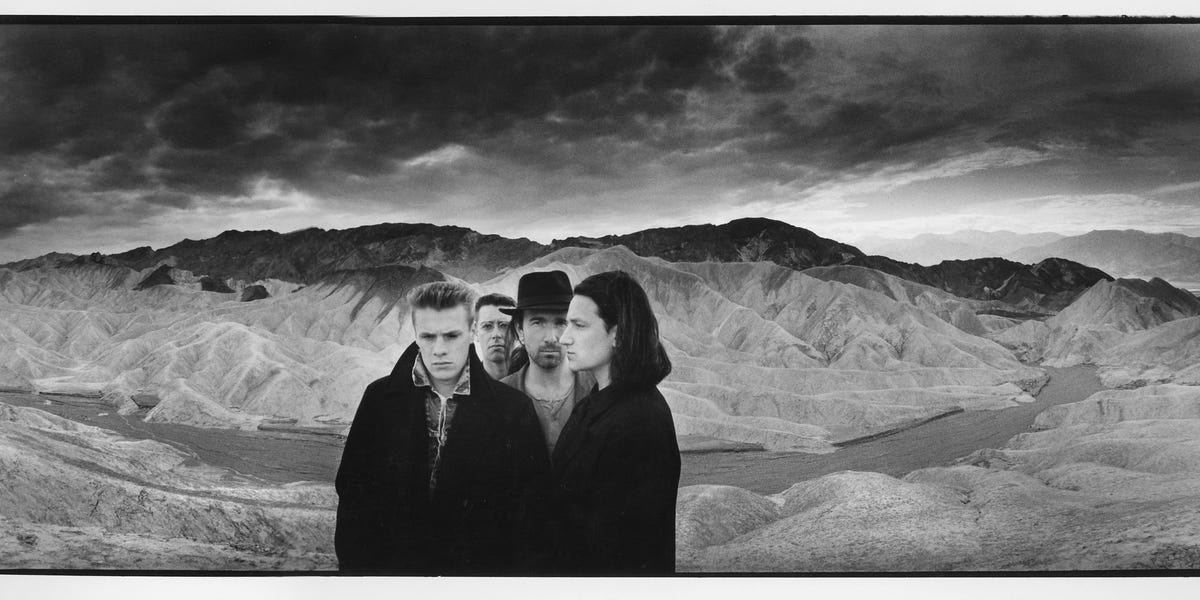
8 min read“Bono is usually a man with a lot of ideas,” says photographer/director Anton Corbijn, “so initially we have a conversation and then maybe I make it more theatrical or whatever.”That overly casual-sounding process has led to the most extensive collaboration ever between a band and a visual artist. Since their first encounter in 1982, Corbijn has helped establish the evolving public image of U2 across album covers, music videos, and photo shoots for almost forty-five years, including the landmark cover of The Joshua Tree, the all-out aesthetic reboot for Achtung Baby, and music videos including “Pride (In the Name of Love)” and “One.” (The partnership is extensively documented in Corbijn’s 2005 book U2&i.) Most recently, they reconnected for a connected pair of surreal and evocative videos—“The Greatest Show on Earth” and “Can’t Stop Us Now”—from U2’s new album Carnaval de Luz, their first full-length release in nine years.Bono recalls first noticing Corbijn’s work when he was still a teenager, especially a photo of Joy Division that ran on the cover of NME in 1980 following the suicide of lead singer Ian Curtis. “Seeing Anton make these images of these people, they were actual human beings,” he says. “We think from their music that they're certainly not, but then these images prove that they're people who lived just across the way. It’s like making movies.”Indeed, Corbijn has gone on to direct films, including the acclaimed 2007 Ian Curtis biopic, Control, as well as doing videos and album covers for Nirvana, Tom Waits, Metallica, the Rolling Stones, and R.E.M. and decades of ongoing work with Depeche Mode.“It’s difficult for a photographer to shoot bands,” he says, “because bands have an identity, and you need to somehow get that right. It's very important that the pictures I do with Depeche Mode don't look like the pictures I do with U2.”Recently, Bono (in New York City) and Corbijn (in Amsterdam) met up on Zoom to discuss their unprecedented alliance, playfully referring to each other as “A” and “B” and recalling shared moments and mutual inspiration. (They also revealed that Corbijn made a film about the American leg of the 2017 Joshua Tree 30th anniversary tour, which they are planning to bring to local screens during next year's Carnaval de Luz: The Greatest Show on Earth dates.)“There are of course, many occasions where a great artist springs up on their own—a painter, a songwriter, a photographer, a filmmaker, novelist,” says Bono. “But often there's some kind of community. U2’s music certainly comes out of community, and Anton is a huge part of our community.”This conversation was edited for length and clarity.Anton CorbijnThe Joshua Tree (1987)Bono: The great stories in songwriting are often unexplained, not resolved. And Anton, your gift to U2 was that you want the emotions to cohere rather than to explain the music. If everything adds up, it adds up to nothing. It's the thing that you can't explain that keeps you going back to the work— which sounds like that might be an excuse for laziness, for half-finished lyrics, but I felt over our time together that you finished some of the lyrics for me with your images.The comedy and the tragedy of “The Greatest Show on Earth” is a real example of that. I hope it's not too close to the bone with the singer playing the leader of a religious cult and the women doing all the work. But look, anyone who can get the members of U2 to put on beards and look like ZZ Top is some sort of shaman. To do one of your film clips is to risk being very silly—and whilst I don't have that fear in general, as is obvious from the pratfalls I've made in my life and artistic life, the other three members of the band do have a certain amount of self-respect, and so only their faith in you as an artist and trust in you as a friend would have them participate at the level they did.Anton Corbijn: I don't want to make anybody look silly, but weird is good, and strange, and like you said. I have a very intuitive approach, and we collaborate. Famously, what became the cover of The Joshua Tree was me looking at the desert for a photograph for an album U2 were calling Desert Songs.Bono: Yeah, yeah, that's right. Another [potential] title was The Two Americas. But wasn't it on that shoot we found the title? Via you, and especially the way you pronounced “Yah-shua Tree.” I hope you still find it amusing that we find your Dutch accent amusing.But as often happens in art, the reason becomes clear years later. That's the strangest thing—it didn't start with the Joshua Tree, it's at the end you discovered it. On Carnaval de Luz, we knew from the beginning what we were thinking about, but we discovered it at the very end with the image maker, with the icon maker.Anton CorbijnThe Joshua Tree (1987)Corbijn: I remember we had a three-day shoot, and we were driving from Reno to Palm Springs, and after the first day, we walked together to the hotel in the desert. And I told you about this tree that I liked so much. I had this landscape camera where the lens moved, so you could get very long shots. I thought it was really nice that you have a tree on the front, and the image goes on to the back, and the band is on the back. So I was talking about that, and I mentioned the name of that tree. And then, the next morning, you came down with the Bible in your hand and said, “It’s got to be The Joshua Tree!”Bono: We had no idea that Joshua is the same name as Jesus, Yeshua, and what post-punk band would put an album out called The Jesus Tree? But we forget, because the world is going through some parched times presently, that even though the ‘80s seemed to be great for a lot of people—you had the Material Girl and dance music, and New York was flying—there was something up in the ‘80s. Springsteen would say there was a darkness on the edge of town. And I think for us to dress as pilgrims, as Irish people coming to America was absurd, but actually very effective.We were trying to figure out, how do you not look stupid on a magazine cover? How are you to be? I mean, we were in our early 20s, and we were not elegantly wasted, as was kind of the mood of the time—if you're in a rock and roll band, you should have the good manners to at least look like you're about to die any minute. You don't want to look earnest. And we needed to find our own way of how do we be ourselves? What masks can we choose to reveal ourselves? What is the iconography of whatever the project is? That naturally led on to Zoo TV and all the various shoots we did for Achtung Baby and Zooropa and all that.My favorite session of ours, Anton, is when we shot for Pop in Miami. They're some of my favorite photographs of the band because you seem to photograph what the work is rather than what the people are. So for Pop, you went for bright colors and mischief and charm. Anton, do you remember those sessions in Miami?Corbijn: Yeah, vividly actually, because you were still recording at the time, in the basement in a hotel. We were young and playful, and so many different options with clothing as well. And we tried funny-looking shots and playful shots, serious stuff as well, but I think after The Joshua Tree, I was attempting to bring more life into the pictures with color use. I also remember you saying that at the time that you liked the colorful stuff I did with Depeche. It was not new for me, but we did cross-processing so the color became very vivid, and that's why Achtung Baby looks so colorful.Bono: We always live by this sort of modus that the songs will tell us what to do. The songs will tell us how to look, how to behave, what the live show is about, how to dress on stage and sometimes even off stage—and because your thing was, I'm shooting the song. I'm shooting the material, not you, I think that really worked for us.Anton CorbijnNo Line On The Horizon (2009)One thing I'd like to ask you, Anton. Would you be comfortable talking about the religiosity of your work? It's a recurring theme for you, and can you explain a little bit of that?Corbijn: Not really, actually. I don't go to church anymore. My father was a pastor, and my grandfather, and all my uncles, and so it sort of made me walk away from it. But I think because I grew up with it, it's just in my visual language. We grew up next to a cemetery and maybe that had something to do with it but the visual iconography, the Christian iconography, is in our society so much that it's hard to not use it. Sometimes it's just there—like the first pictures I did with Depeche Mode in '81, when they were a teeny tiny pop band, was in this studio in London, and there was this cross with Jesus on it in the garden. So in the photograph, they were like teeny bop guys, but still Christ is hanging in the picture.Bono: Religion has often been such a negative force in the world, it’s very understandable that we would try to avoid the obvious imagery associated with it, but in my life, it's turned into a very positive thing. It's sort of buoyed me up. But you have it in all your work, despite your attempt to get away from it, I suppose.Corbijn: I was just thinking, in the “One” video, there's the Father, Son, and the Holy Ghost, and the band, and the woman. It was all in there, I think it's very nice that I knew your father and you met my father.Bono: Yes, that's right. Two powerful men in our lives. But again, your ability to talk people into doing things—you asked my father to stand on a seesaw, and he went along with it, he was fascinated by it. And then you got the four fathers of U2, the fathers and sons.Corbijn: That was one of my favorite pictures of U2. There's a lot of depth in it.Bono: What other favorites do you have, Anton?Corbijn: Well, I made a book of 500 pages on U2, full of pictures I like. I like some of the photographs we did around Rattle and Hum. That was not a good time for me, but I think there's some good pictures there. Also on the rooftop in L. A.—I don't mean the playing one, but the one when we looked at the rooftop, when we discovered it.Bono: I found this hotel, a real hotel called the Rosslyn Million Dollar Hotel. I was reading Bukowski at the time, listening to Tom Waits, and I walked into this hotel. I couldn't believe it existed. Eventually I managed to convince Wim Wenders to make a film there. And we so loved the sign, the Million Dollar Hotel, that when we played on that rooftop, we rebuilt the sign.Corbijn: Yeah, but on a much smaller rooftop. I'm in the video, actually. I'm trying to get through the crowd, pointing to the policeman that I have a pass, and he goes, "You go that way!"Bono: That poor man, that policeman who pulled the plug. By all accounts, his children tortured him, and he was the most unpopular cop in Los Angeles. He was just doing his job.Let me see if I one more question for my hero and friend...Corbijn: I have a question. Why?Bono: That is the question.See More of Anton Corbijn’s Legendary U2 Catalog
Bono and Anton Corbijn Open Up About the Creative Partnership That Changed Rock ‘n’ Roll History
Full Article
Original Source
Read the full article at Esquire →KhanList aggregates and links to publicly available news content. We do not host full articles from third-party sources. Always verify important information with original sources.