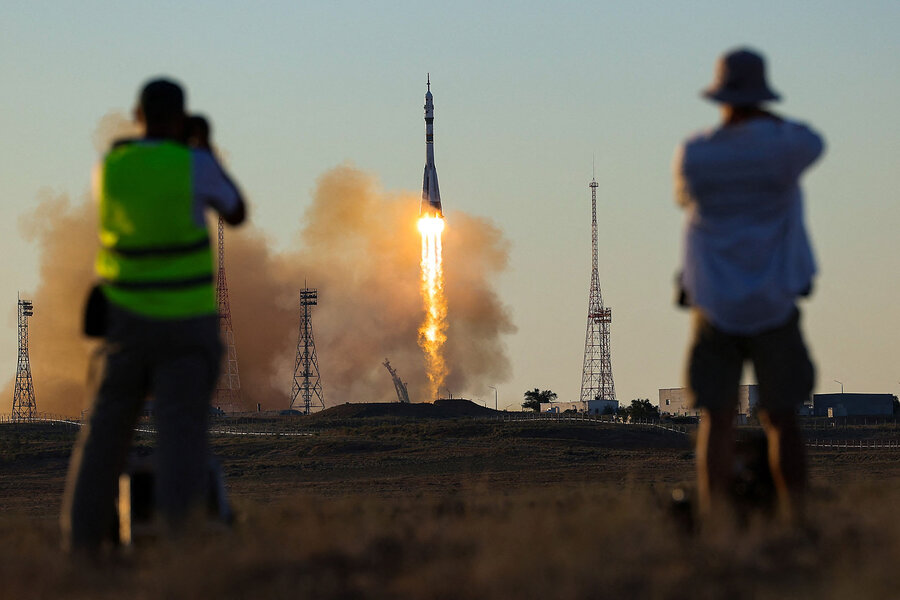
It was a simple handshake, but it came to symbolize much more. In 1975, as Cold War tensions thawed, an American commander and his Soviet counterpart clasped hands in space after their spacecraft docked. The Apollo-Soyuz mission became a defining symbol of detente and a rare moment of cooperation between two nuclear rivals. The crews remained together in orbit for more than 40 hours.This month, two Russians and an American blasted off from Baikonur Cosmodrome in Kazakhstan in a Soyuz spaceship, heading for the International Space Station in the presence of space officials from both countries.But, in many ways, they were flying against the prevailing geopolitical currents. For half a century, space has remained one of the few arenas in which Washington and Moscow continued working together despite crises on the ground. But as the International Space Station nears retirement and a new era of lunar exploration begins, that model of cooperation is being tested. Future partnerships are increasingly likely to reflect geopolitical rivalries rather than transcend them, raising questions about whether space will remain a place where diplomacy can succeed when politics fails. Mikhail Metzel/Kremlin/AP Chinese leader Xi Jinping (left) and Russian President Vladimir Putin walk inside the Kremlin's Grand Palace in Moscow, May 8, 2025. Why We Wrote This The space race has existed from the inception of exploration to the present, as we reported on Space Force. But exploration has also forged cooperation, even between the United States and Russia during the Cold War. Current geopolitics is testing that old model. If U.S.-Russian cooperation is to continue, it will require new models of agreement on Earth about how to continue working together in space, says Andrei Ionin, a Russian space expert, as the levels of mistrust have grown too high. “We need to realize that no country can manage, technologically or financially, to explore deep space on its own,” he says. “No single country has national tasks on the moon or Mars that can justify the costs involved. The only way … is to unite the efforts of leading countries to realize common purposes. It should be easier to reach agreement in space than on Earth.”Even before Russia’s war in Ukraine, hopes to continue developing space peacefully, under the auspices of the United Nations for the “benefit of all humankind,” as established in the 1967 Outer Space Treaty, were fraying.A NASA-led international program called Artemis aims to set up a base on the moon and prepare for future manned missions to Mars. But Russia has refused to sign the Artemis Accords, which lays down a set of principles for moon exploration, on the grounds that they are too ”U.S.-centric” and open the door for a “colonial-style” commercialization of space. Since 2020, some 60 countries, mostly Western ones, have signed the accords while many others, notably China, have declined. Russia’s answer to the Artemis program is to develop its own Russian Orbital Station, using modules from the International Space Station after it has been discarded, which would act as a gateway for lunar exploration. Russia and China are jointly planning to build a lunar base in the next decade, according to local reports, to compete with the U.S.-led project.Experts say it’s not clear what Russia can bring to the partnership, since China has already mastered most of the relevant technologies. But Russia’s lead in building miniature nuclear reactors, such as the power plant of the unlimited-range Burevestnik cruise missile, could give it a foot in the door. In April, the Russian Academy of Sciences approved plans for Russia’s role in the International Scientific Lunar Station, a joint project with China and 13 other countries, according to Denis Kravchenko, deputy chair of the State Duma’s committee on economic policy, in an emailed statement to the Monitor. “I have repeatedly met with leaders of the Chinese space industry, and I want to say that our cooperation definitely has a future,” he wrote. “And here, nuclear technologies in space are of crucial importance, as they will become the basis for long-range missions and future space energy.” NASA astronaut Anil Menon and Russian cosmonauts Pyotr Dubrov and Anna Kikina attend a sendoff ceremony before the launch of the Soyuz spacecraft at the Baikonur Cosmodrome in Kazakhstan, July 14, 2026. Moscow and Beijing have also agreed to integrate their navigation, creating a rival to the U.S.-owned GPS system. Russian experts won’t discuss details, but hint that Chinese-Russian military cooperation in space is well advanced.The war in Ukraine has revealed how far behind Russia is in providing space-based high-speed internet connectivity, such as the U.S.-based Starlink. That has been made available to Ukraine and shown to have battlefield applications, including communications and drone guidance that offer crucial military advantages. A Russian aerospace company, Bureau 1440, has been urgently tasked, and provided state funding, to create an alternative to Starlink, operated by Elon Musk’s SpaceX corporation. It has begun by launching a cluster of 16 low Earth-orbit satellites earlier this year, which are planned to grow to about 900 within a decade. Starlink currently deploys about 10,000 satellites.India, which plans to launch its own manned space station in 2028, is said by Mr. Kravchenko to be deepening its space cooperation with Russia, including a recent deal to share rocket engine technology.Natan Eismont, a researcher at the official Space Research Institute in Moscow, regrets that Russia has so far declined to join with the U.S. on Artemis, as it has the experience and capabilities to contribute, especially on economic development on the moon. He says the two could cooperate to reach Mars and explore deep space, if only Moscow and Washington can rediscover the spirit that animated Soyuz-Apollo half a century ago.“Some might say that space science is outside the realm of politics, but that’s not so,” he says. “In fact, making agreements in space can improve the political climate on Earth.”
Boldly going in different directions? US and Russia diverge on joint space plans.
Full Article
Original Source
Read the full article at Csmonitor →KhanList aggregates and links to publicly available news content. We do not host full articles from third-party sources. Always verify important information with original sources.