
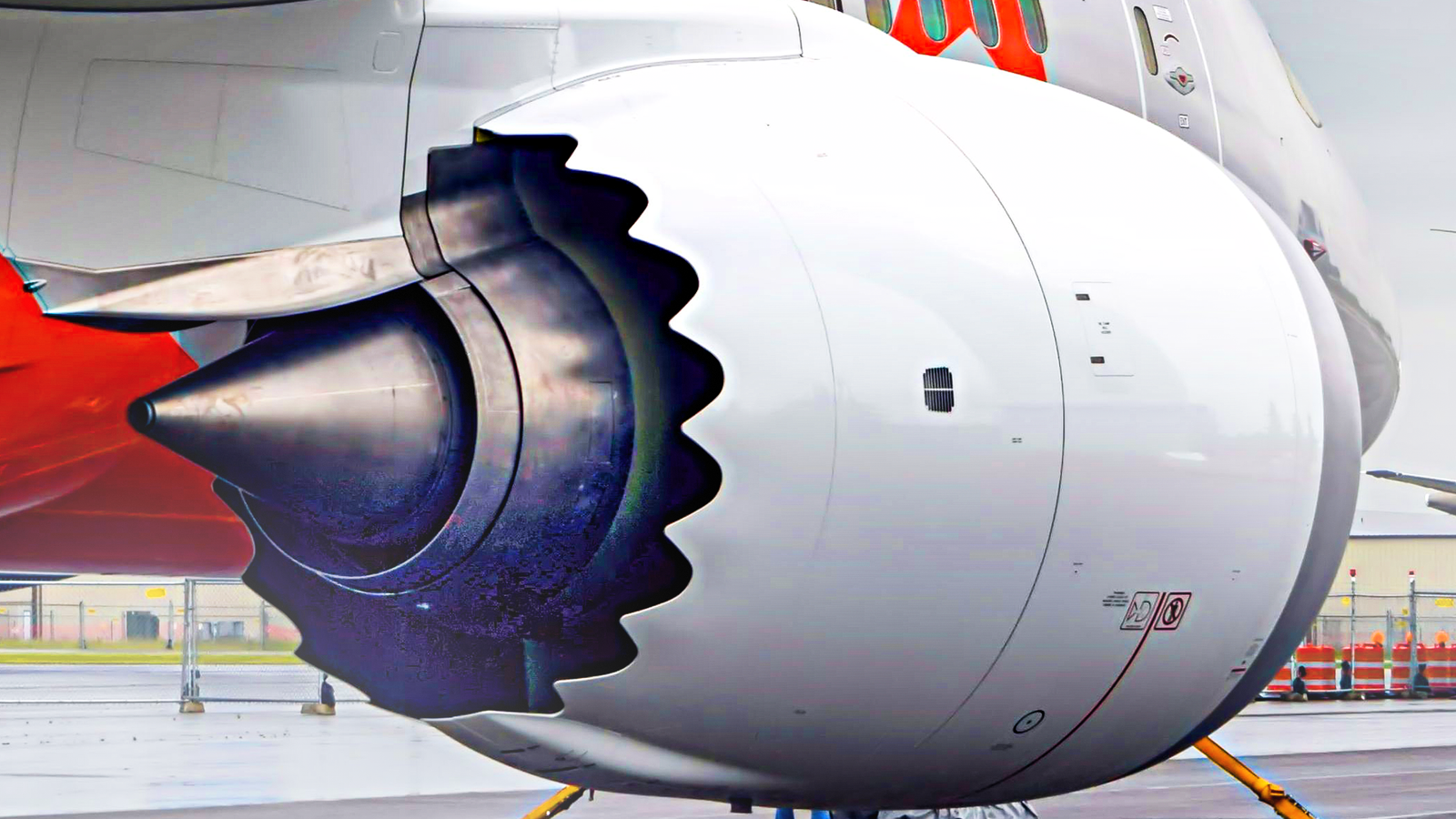
Published Nov 22, 2026, 3:00 PM EST Daniel comes to Simple Flying with a business focused approach to the aviation world. Daniel enjoys analyzing strategy and how companies move against each other to gain a step ahead in the skies. Besides strategy, Daniel also has a passion for aircraft design and the history of aviation. Based in New York Sign in to your Simple Flying account One of the most distinctive features of the Boeing 787 Dreamliner is the unusual sawtooth pattern at the back of the engine nacelle. They're called 'chevrons', and their primary purpose is to reduce the aircraft's noise levels. The 787 wasn't only intended to be game-changing for airlines; it was also meant to be a major leap forward in noise reduction and the passenger experience. Boeing also incorporated chevrons into the engine nacelles of the 747-8 (which came out right before the 787) and the 737 MAX. Boeing patented the chevron design that it implemented into these three aircraft, which is why other manufacturers have not incorporated this exact design. However, the patents for Boeing's chevrons have since expired, and Airbus has publicly rejected integrating chevrons into its contemporary aircraft during this period. Even more interestingly, Boeing has decided not to integrate chevrons into the upcoming 777X, reversing course after initially planning them during early development. The Benefits Of Chevrons Credit: Vytautas Kielaitis I Shutterstock The main reason Boeing designed chevrons for the 787, 747-8, and 737 MAX is noise reduction. They smooth the mixing of hot exhaust air coming out of the engine core with the cooler bypass air flowing around the engine. By blending the air more smoothly, the engine produces less aerodynamic noise, allowing Boeing's newest airliners to more easily comply with increasingly strict noise regulations while providing a more comfortable experience for passengers. Multiple aircraft types also feature chevrons, but other types incorporate them in the inner nozzle, and they are part of the engine rather than a design choice by the airframe. The 787, 747-8, and 737 MAX are the only types widely used today that feature chevrons on the nacelle (which are not actually a part of the engine itself), and they're one of the most distinctive features on modern Boeing airliners. In addition, the company also originally depicted the upcoming 777X with chevrons in concept renderings. However, Airbus notably rejected the idea of using chevrons on the A320neo, A350, and A330neo, all of which entered service in the 2010s. In addition, the 777X will not feature chevrons, and there's no indication that either Boeing or Airbus plans to employ them in future aircraft projects. While the chevrons were an innovative new idea in the 2000s and early 2010s, when the 787, 747-8, and 737 MAX were being developed, they have largely been rendered obsolete today. The Drawback Of Chevrons Credit: eric1207cvb I Shutterstock The vortices generated by the chevrons take energy away from the airflow coming out of the rear of the engine. Because they protrude into the airflow, they also increase drag. As such, it's estimated that chevrons may reduce thrust by up to 0.5% and lead to a slight increase in fuel burn. This is a small amount, but aircraft engineering and design is all about trade-offs to achieve an airframe's desired goals. For Boeing, this was initially worth it to reduce noise levels. Airbus, however, did not view the slight noise reduction as worth the trade-off in fuel efficiency. Instead, its latest aircraft, like the A350, focus more heavily on acoustic treatments within the nacelle, such as sound-absorbing lining, to reduce noise emissions. Both are valid approaches, and they show how Airbus and Boeing pursue different aircraft designs to achieve largely the same goals: cost-effective, competitive airliners that the market wants. Both companies have made very different choices and have found success doing so. Aircraft Entry Into Service Boeing 747-8 (747-8 Intercontinental, 747-8F) 2011 Boeing 787 Dreamliner (787-8, 787-9, 787-10) 2011 Airbus A350 (A350-900, A350-1000, A350F) 2015 Airbus A320neo (A319neo, A320neo, A321neo) 2016 Boeing 737 MAX (737 MAX 7, 737 MAX 8, 737 MAX 9, 737 MAX 10) 2017 Airbus A330neo (A330-800, A330-900) 2018 Boeing 777X (777-8, 777-9, 777-8F) 2027 (projected) While the chevrons do slightly reduce effective thrust and add drag, they can allow Boeing to slightly reduce heavy sound-deadening in the fuselage. This reduces weight, which improves fuel efficiency. As with all aircraft engineering decisions, there are benefits and drawbacks to the chevrons. Boeing decided that the benefits outweighed the negatives and patented its design. Airbus opted to pursue a different direction rather than develop its own chevron design. No More Chevrons On The 777X Credit: VanderWolf Images I Shutterstock The 777X does not have chevrons on its engine nacelles, a change made early in the aircraft's development after initial renderings were released with chevrons. Ultimately, operating costs are extremely important to airlines, and the chevrons' direct fuel-burn impact, while minor, is not ideal. The 777X, however, is Boeing's newest aircraft program, which means that it has years of experience from when the 787 first began development, designing technology to minimize the noise impact of its planes. While Boeing's new approach to keeping noise levels low for the 777X has not been fully disclosed, the most likely explanation is more advanced acoustic treatments inside the engine nacelle, similar to what Airbus has implemented with the A350. Innovations likely make these solutions more effective at reducing noise while potentially weighing less. In turn, this means that Boeing no longer needs to implement chevrons, which work well at eliminating noise but slightly hurt fuel efficiency. In addition to sound acoustics, the 777X's GE9X engines are truly enormous, with a fan diameter of 134 inches (340 centimeters) and a bypass ratio of 10:1. High bypass engines like these generate significantly less noise than turbofans with lower bypass ratios, as less air proportionally is being fed through the engine core. Until further advancements in chevron design reduce the fuel efficiency impact, it's unlikely that future airlines will incorporate them to reduce noise. Differences In Aircraft Design Philosophy Credit: Sergey Kustov I Shutterstock Airbus and Boeing design aircraft that achieve very similar results for airlines, but take very different approaches to get there. There are several main examples, such as how the fuselage is assembled on the 787 and A350. The Dreamliner's fuselage is made up of several 'barrels', which reduces weight and improves fuel efficiency. The A350, however, uses traditional panel construction, which is easier to fabricate and comes with lower maintenance costs. Both are valid approaches. Airbus has tended to favor smaller passenger windows on its aircraft compared to contemporary Boeing aircraft. Smaller windows save weight, but Boeing bets that larger windows deliver a better passenger experience. Boeing designed the 787 and 777X with raked wingtips, which have an aerodynamic advantage on long-haul routes. The A350 uses blended winglets, which effectively increase the aircraft's wingspan while still allowing it to fit within standard airport gates. In addition to these minor design changes, you also see differences in how they approach various aircraft projects. The 777X, for example, is a significant overhaul of the legacy 777 airframe, featuring a fuselage stretch, a brand-new carbon-composite wing, new cabin windows, a new interior, new engines, and a new cockpit. The A330neo, also an overhaul of a 1990s-era widebody, only features a new engine, a new winglet design, and a new interior, along with software enhancements. Reducing Noise Levels On Modern Airliners Credit: Tomasz Warszewski I Shutterstock In the 1960s, a Boeing 707 taking off could easily exceed 110 decibels. Today, a 787 taking off typically produces noise that is under 95 decibels. The decibel scale is logarithmic, meaning the 707 was more than four times as loud as the 787, even though the 787 has a maximum takeoff weight (MTOW) that can be nearly double that of the 707 and engines that are significantly more powerful. Admittedly, the 787 has only two engines instead of four, but it still represents a significant achievement in reducing aircraft noise levels. Over the years, ICAO has set noise standards for aircraft, with deadlines for when aircraft are expected to comply with the new limitations. Other regulators, such as the FAA, may set their own standards that roughly align with ICAO's. FAA Stage Five noise standards require a cumulative reduction of seven decibels compared to Stage Four standards, which equals a cumulative reduction of 17 decibels compared to the older Stage Three standards. The FAA's Stage Five standards, which took effect in 2017, only applied to new aircraft types submitted for review after the standards were implemented, and it did not require already-certified types to be in compliance (however, newer types like the 787 were already in compliance anyway). In the past, the FAA did require pre-existing types to meet newer standards, most notably when Stage Three standards took effect. This required manufacturers to develop 'hush kits' for types like the 727 to lower their noise emissions. Beyond exterior noise, passengers have benefited from noise reductions, since a loud flight can be extremely fatiguing. More advanced acoustic nacelle treatments and innovations such as chevrons have allowed manufacturers to reduce heavy sound-deadening while still providing an overall quieter experience. As innovations in aircraft design continue, airliners will get quieter both outside and inside the cabin, while also becoming even more fuel-efficient.
Boeing's Most Modern Engines Are Quieter, But Its Tricks Weren't Copied By Other Planemakers For One Main Reason
Full Article
Original Source
Read the full article at Simpleflying →KhanList aggregates and links to publicly available news content. We do not host full articles from third-party sources. Always verify important information with original sources.